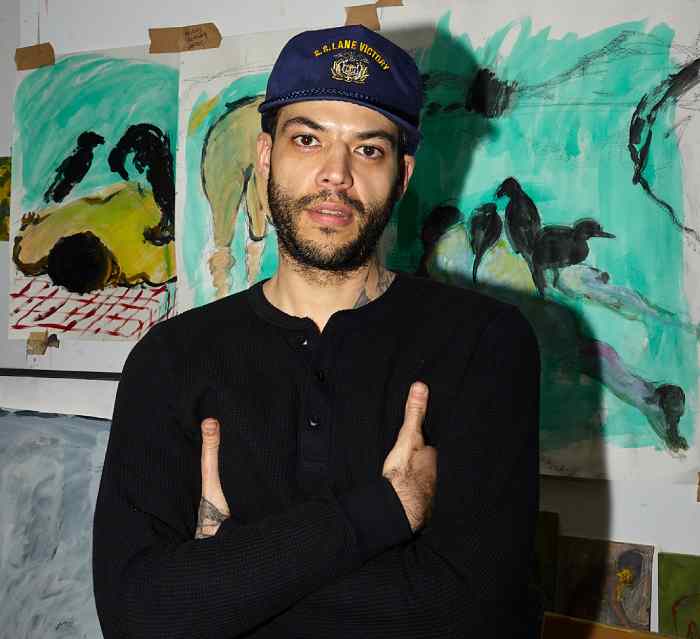
Leyman Lahcine is a contemporary artist whose work sits at the intersection of personal history, cultural memory, and modern visual language. Known for combining playful, almost childlike imagery with deeply emotional and sometimes unsettling themes, he has steadily built a reputation for art that feels both accessible and intellectually layered. His paintings and mixed-media works invite viewers into a world that appears light at first glance, yet gradually reveals complex ideas about identity, trauma, belief, and belonging.
Working primarily from London, Leyman Lahcine draws on his French and North African background to create art that speaks to the experiences of displacement, inheritance, and emotional continuity across generations. His style is immediately recognisable, but what truly defines his practice is the way he uses visual storytelling to communicate feelings that are often difficult to articulate in words.
Who Is Leyman Lahcine?
Leyman Lahcine was born in France in the late 1980s and later relocated to the United Kingdom, where he now lives and works. His personal journey between cultures has played a central role in shaping his artistic voice. Rather than treating identity as a fixed concept, his work approaches it as something fluid, emotional, and deeply influenced by memory.
From early on, Lahcine showed an interest in visual storytelling. His education in the creative arts helped him refine his technical skills, but it was his lived experience that gave his work its emotional depth. Over time, he developed a distinctive visual language that blends contemporary painting with symbolic references drawn from religion, folklore, and popular culture.
Today, Leyman Lahcine is recognised as an emerging yet increasingly influential figure in contemporary British art, particularly among audiences interested in narrative-driven and conceptually rich work.
Artistic Style and Visual Language
Playful Imagery with Emotional Weight
One of the most striking aspects of Leyman Lahcine’s work is the contrast between form and meaning. At first glance, many of his pieces feature bright colours, simplified figures, and cartoon-like elements. These visual cues often evoke innocence, humour, or nostalgia.
However, this surface-level playfulness quickly gives way to deeper emotional themes. Behind the bold colours and exaggerated forms are stories of grief, fear, faith, and inherited trauma. This tension between light and dark is intentional. Lahcine uses it to reflect the complexity of human experience, where joy and pain often coexist.
Use of Symbolism
Symbolism is central to Lahcine’s practice. Religious motifs, mythological references, and recurring figures appear throughout his body of work. These symbols are rarely explained outright, allowing viewers to interpret them through their own emotional and cultural lenses.
Hands, eyes, animals, and abstract human forms frequently appear, often positioned in ways that suggest protection, vulnerability, or confrontation. Rather than offering clear narratives, Leyman Lahcine’s paintings function like emotional maps, guiding viewers through feelings rather than fixed stories.
Material Choices and Technique
While painting remains his primary medium, Lahcine is not limited to a single format. He has explored drawing, sculpture, and mixed-media approaches, each chosen to serve the emotional needs of a particular idea.
His brushwork varies from loose and expressive to carefully controlled, depending on the mood of the piece. This flexibility reflects his broader philosophy: technique is a tool for expression, not an end in itself.
Themes Explored in Leyman Lahcine’s Work
Identity and Cultural Inheritance
Growing up between cultures has given Leyman Lahcine a unique perspective on identity. His work often reflects the feeling of existing in multiple worlds at once, shaped by traditions, beliefs, and expectations that may not always align.
Rather than presenting identity as something to be resolved, Lahcine embraces its contradictions. His art suggests that confusion, hybridity, and emotional tension are not weaknesses, but sources of creative energy.
Transgenerational Trauma
A recurring theme in Lahcine’s work is the idea that emotional experiences can be passed down through generations. Trauma, in this context, is not always dramatic or explicit. It can be subtle, existing in gestures, habits, and unspoken fears.
Through symbolic imagery, Leyman Lahcine explores how these inherited emotions shape behaviour and self-perception. His work encourages viewers to reflect on their own emotional histories and consider how the past continues to influence the present.
Faith, Belief, and Doubt
Religious imagery appears frequently in Lahcine’s art, but it is rarely presented in a traditional or reverential way. Instead, faith is treated as a complex emotional force, capable of providing comfort while also raising questions and internal conflict.
By blending sacred symbols with contemporary forms, Lahcine opens a dialogue about belief in the modern world. His work does not offer answers, but it does create space for reflection and emotional honesty.
Influences and Inspirations
Personal Experience
More than any external influence, Leyman Lahcine’s own life experiences shape his work. Migration, cultural transition, and personal loss all inform the emotional core of his art. Rather than documenting events directly, he translates them into symbolic language that resonates on a universal level.
Art History and Contemporary Culture
Lahcine’s work reflects an awareness of both historical and contemporary art. Elements of expressionism, folk art, and modern illustration can be seen in his approach, alongside references to popular culture and everyday visual language.
This combination allows his work to feel grounded in the present while still engaging with broader artistic traditions.
Exhibitions and Growing Recognition
Over recent years, Leyman Lahcine has gained increasing attention through curated exhibitions, art foundations, and contemporary art platforms. His work has been shown in London and beyond, attracting collectors and critics interested in emotionally driven, narrative-based art.
This growing recognition reflects a broader shift within the art world towards work that prioritises emotional authenticity and personal storytelling. Lahcine’s ability to balance accessibility with conceptual depth places him firmly within this movement.
Why Leyman Lahcine’s Work Resonates Today
In an era marked by rapid change, migration, and cultural mixing, many people find themselves questioning their sense of identity and belonging. Leyman Lahcine’s art speaks directly to these experiences.
His work does not demand specialised knowledge or academic interpretation. Instead, it invites viewers to feel first and think later. This emotional immediacy, combined with layered symbolism, makes his art particularly relevant to contemporary audiences seeking meaning in an increasingly complex world.
Collecting and Appreciating His Art
For collectors, Leyman Lahcine’s work offers more than visual appeal. Each piece carries emotional and conceptual weight, making it something to live with and return to over time.
Appreciating his art often involves patience. The longer one spends with a piece, the more layers reveal themselves. This depth is part of what makes his work enduring rather than trend-driven.
FAQs
What type of artist is Leyman Lahcine?
Leyman Lahcine is a contemporary visual artist known primarily for painting and mixed-media work that explores identity, memory, and emotional experience.
Where is Leyman Lahcine based?
He is based in London, where he lives and works while exhibiting internationally.
What themes are common in Leyman Lahcine’s art?
His work often explores identity, transgenerational trauma, faith, cultural heritage, and emotional vulnerability.
Is Leyman Lahcine’s work influenced by religion?
Yes, religious symbols and themes appear frequently, though they are explored in a personal and reflective way rather than a traditional one.
Why is Leyman Lahcine considered an emerging artist to watch?
His distinctive visual language, emotional depth, and growing presence in contemporary exhibitions have positioned him as a significant emerging voice in modern art.
Conclusion
Leyman Lahcine represents a compelling direction in contemporary art, one that values emotional honesty, cultural complexity, and personal storytelling. Through his distinctive blend of playful imagery and profound themes, he creates work that resonates deeply with modern audiences.
As his career continues to develop, Leyman Lahcine’s art is likely to gain even greater recognition, not only for its visual impact but for its ability to articulate the emotional realities of life between cultures. His work reminds us that art can be both beautiful and challenging, offering comfort while asking difficult questions, and ultimately helping us better understand ourselves and the world around us.