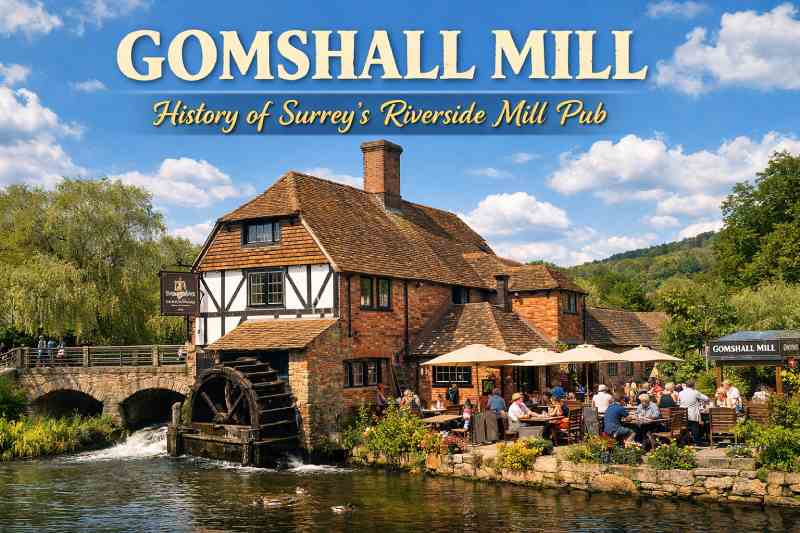
Nestled in the picturesque village of Gomshall in Surrey, Gomshall Mill is one of those rare places where centuries of English history meet modern hospitality. Surrounded by rolling countryside and sitting quietly beside the River Tillingbourne, this historic building has witnessed dramatic changes over the last several hundred years. Once a working water-powered corn mill serving the local farming community, the building today welcomes visitors as a charming riverside pub and restaurant.
Historic mills played a vital role in rural Britain, particularly before industrialisation transformed agriculture and manufacturing. Mills were the backbone of village economies, grinding grain into flour and supporting farming families throughout the countryside. Over time many of these mills disappeared or were converted into homes, yet a few survived and were given a second life. One such example is Gomshall Mill, which has successfully preserved its heritage while adapting to modern use.
The Village Setting of Gomshall
A Traditional Surrey Village
Gomshall is a small village located within the borough of Guildford in Surrey, England. Positioned along the River Tillingbourne and near the A25 road between Guildford and Dorking, the village has long been associated with traditional rural life. The surrounding landscape is part of the Surrey Hills Area of Outstanding Natural Beauty, a region famous for its wooded slopes, winding country lanes and historic settlements.
For centuries the village remained a quiet agricultural community. Farms dominated the landscape, while small industries such as milling and tanning supported the local economy. Villagers depended on nearby rivers and streams for power, which made the location particularly suitable for water-driven mills.
The Role of the River Tillingbourne
The River Tillingbourne flows through the village and has historically shaped its development. During earlier centuries the river powered several mills along the valley, creating an important chain of rural industries. These mills processed grain, produced leather, and supported watercress farms that supplied fresh produce to nearby towns.
Without the steady current of the river, the growth of these industries would not have been possible. It was precisely this dependable water supply that made the location ideal for the construction of Gomshall Mill.
Origins of Gomshall Mill
Medieval Beginnings
The origins of Gomshall Mill stretch back nearly a thousand years. Historical evidence suggests that a mill existed at the site as early as the eleventh century, likely mentioned in records connected to the Domesday survey of England. During medieval times, mills were among the most valuable assets in rural communities because they enabled the processing of grain into flour.
Farmers brought their harvested wheat or barley to the local mill, where it would be ground using water-powered machinery. In return the miller received a portion of the grain or flour as payment. This arrangement made mills essential to everyday life, ensuring the supply of bread and other staple foods.
Although the current building was constructed later, the site itself has been associated with milling activity for centuries.
Development of the Current Structure
The building that visitors see today mainly dates from the seventeenth century. Like many mills of that period, it was constructed using strong timber beams and traditional brickwork, designed to withstand both the movement of the waterwheel and the heavy machinery inside.
Over time the structure was adapted and repaired as technology evolved. Milling equipment was upgraded, water channels were maintained, and the building gradually developed into a working industrial space serving the surrounding countryside.
Despite these changes, much of the original architectural character remained intact, allowing the structure to retain its historical charm.
Life as a Working Watermill
How the Milling Process Worked
At the heart of Gomshall Mill was its waterwheel. Water from the river was directed through a channel known as a mill race, which drove the large wheel mounted beside the building. As the wheel turned, it powered a system of gears connected to millstones inside the structure.
The millstones crushed grain into flour through a grinding motion. Farmers would deliver sacks of grain to the mill, which were then lifted to the upper floors using hoisting equipment. From there the grain passed through the milling machinery before emerging as freshly ground flour.
This process continued day after day, particularly during harvest seasons when demand for flour increased.
Supporting the Local Economy
For generations the mill played a central role in village life. Farmers relied on it to process their crops, while nearby communities depended on the flour it produced. The presence of a reliable mill meant that food production could continue even in challenging conditions.
In addition to milling grain, the building sometimes supported related activities connected to agriculture and trade. Deliveries of grain, sacks of flour, and maintenance of equipment kept the mill busy throughout much of the year.
The sound of the turning waterwheel and grinding stones would have been a familiar part of daily life in the village.
Decline of Traditional Milling
Industrial Change
The nineteenth and twentieth centuries brought dramatic changes to British industry. Large mechanised mills powered by steam and electricity gradually replaced smaller watermills. These new facilities could produce flour on a much larger scale and operate independently of rivers.
As a result many traditional mills struggled to compete. Rural mills either closed or shifted to different uses as modern manufacturing expanded.
Like many historic watermills across England, Gomshall Mill eventually stopped operating as a working corn mill in the early twentieth century.
New Uses for the Building
After milling ceased, the building did not disappear. Instead it was repurposed for different functions within the village. At one stage it served as a local post office, demonstrating how adaptable historic buildings can be when communities seek to preserve them.
However, maintaining an old industrial structure is not always easy. Over time the building required restoration and careful management to prevent deterioration.
Fortunately, the historic value of the site ensured that efforts were made to preserve it.
Transformation into a Riverside Pub
A New Chapter
In the early twenty-first century the building entered a new phase of its long history. Rather than allowing it to fall into disrepair, the structure was converted into a country pub and restaurant.
The transformation allowed the historic interior to remain visible while adapting the space for modern hospitality. Wooden beams, stone walls and other original features were carefully preserved to maintain the atmosphere of the old mill.
Visitors could now enjoy meals and drinks while surrounded by centuries of architectural history.
Restoring the Historic Character
Restoration work focused on protecting the building’s heritage while improving comfort for guests. Areas were redesigned to create dining spaces, seating areas and a riverside garden where visitors could relax during warmer months.
One of the most fascinating aspects of the building is that parts of the original milling equipment, including the waterwheel, remain visible. These elements remind guests of the structure’s earlier purpose and give the pub a distinctive character that cannot be replicated in modern buildings.
The Experience for Visitors Today
A Destination in the Surrey Countryside
Today Gomshall Mill has become a popular destination for visitors exploring the Surrey Hills. Walkers, cyclists and tourists often stop in the village while travelling through the surrounding countryside.
The combination of historic architecture, riverside views and traditional British food makes the location particularly appealing. The outdoor garden area beside the river is especially popular during spring and summer.
Preserving Local Heritage
Beyond its role as a hospitality venue, the building represents an important piece of local heritage. Historic mills provide valuable insight into how rural communities functioned before modern technology reshaped industry.
By preserving the structure and keeping it open to the public, the village maintains a connection to its past while continuing to benefit from tourism and local business.
Architectural Features
Traditional Timber Construction
One of the most striking aspects of the building is its traditional timber framing. Large wooden beams support the upper floors, reflecting construction techniques commonly used in seventeenth-century England.
These beams not only provided strength but also helped distribute the weight of heavy milling equipment that once operated inside.
Riverside Setting
The mill’s location beside the River Tillingbourne remains one of its defining characteristics. Water once flowed through channels designed to power the wheel, and although the machinery is no longer used for milling, the presence of the river continues to shape the building’s identity.
The surrounding scenery enhances the sense of stepping back in time.
Why Historic Mills Matter
Across the United Kingdom many historic mills have disappeared over the centuries. Some were demolished as industry modernised, while others fell into neglect. The survival of places like Gomshall Mill therefore provides an important reminder of how communities once lived and worked.
Mills were not merely industrial buildings; they were central gathering places where farmers exchanged news, delivered crops and supported the local economy. Preserving them helps maintain an understanding of Britain’s agricultural heritage.
FAQs
What is Gomshall Mill known for?
The building is known for its long history as a water-powered corn mill and its later transformation into a riverside pub in the Surrey countryside.
Where is Gomshall Mill located?
It is located in the village of Gomshall in Surrey, England, near the towns of Guildford and Dorking along the River Tillingbourne.
When was Gomshall Mill originally built?
Although milling activity on the site dates back to medieval times, the current building largely dates from the seventeenth century.
Can visitors still see parts of the original mill?
Yes, some historic features such as the waterwheel and traditional structural elements remain visible inside the building.
Why was Gomshall Mill converted into a pub?
After traditional milling declined, the building was restored and converted into a pub to preserve the historic structure while giving it a sustainable modern use.
Conclusion
The story of Gomshall Mill is a fascinating example of how historic buildings can evolve over time while preserving their cultural value. From its medieval origins as a vital corn mill serving the farming community to its modern role as a welcoming riverside pub, the structure reflects centuries of rural English history.
Set beside the River Tillingbourne and surrounded by the beautiful Surrey countryside, the building remains an enduring landmark within the village of Gomshall. Its survival demonstrates how careful restoration and community appreciation can keep historic places alive for future generations. Visitors who step inside today are not simply enjoying a meal or drink; they are experiencing a piece of living history that continues to connect the present with England’s rural past.