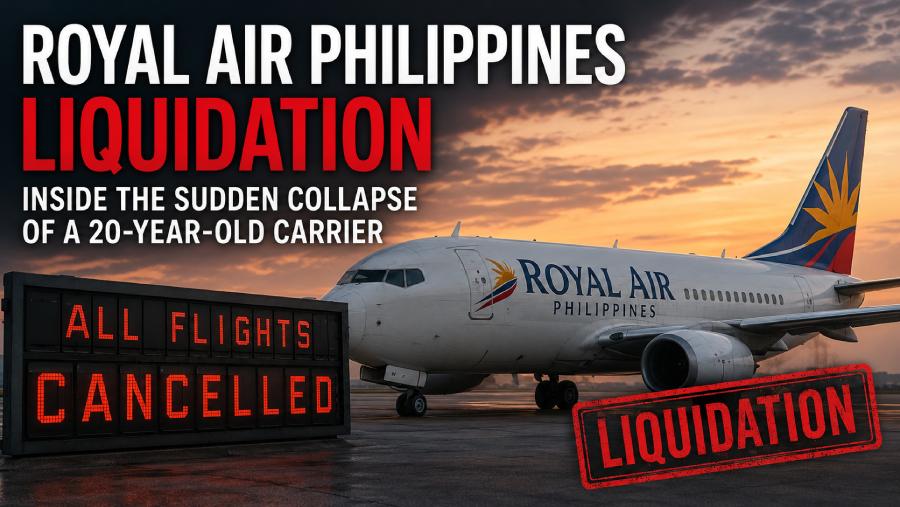
If you follow aviation even casually, you know that airlines rarely die quietly. They limp along, restructure, beg for bailouts, and merge before they finally fold. So when Royal Air Philippines pulled the plug on every single flight overnight, it caught a lot of people off guard — including, apparently, the thousands of passengers who woke up to find their tickets were suddenly worth nothing. The Royal Air Philippines liquidation has become one of the first big aviation stories of 2026, and the more you dig into it, the more it reads like a textbook case of what happens when a small carrier bets everything on a narrow slice of the market and that slice disappears. Let’s walk through what actually happened, who was behind the airline, and why it all came crashing down.
What Actually Happened on January 4
The short version is brutal. On January 4, 2026, Royal Air Philippines cancelled all of its scheduled commercial flights without any meaningful warning and entered liquidation, becoming the first formal airline collapse of the year. There was no slow wind-down, no final farewell route, no months-long grace period for travelers to rebook. One day the airline was selling seats, and the next it was effectively gone. Somewhere between 3,000 and 4,000 passengers were holding reservations for travel stretching from January through March, and every one of those bookings instantly became void. For an airline that had been flying in some form for more than two decades, the ending was startlingly abrupt — the kind of collapse that usually only happens to brand-new startups that never quite found their footing, not established names with a history.
The Message Left Behind
When a company shuts down this fast, what it says on the way out tells you a lot. Royal Air’s website was scrubbed down to a single short statement letting customers know the airline was working on refunds and hoped to resume flights at some unspecified point in the future, thanking everyone for their patience. On paper that sounds almost hopeful, like a temporary pause rather than a death sentence. In reality, industry watchers were quick to point out that once formal liquidation proceedings are underway, the odds of an airline genuinely coming back to life are slim to none. Liquidation isn’t a “see you soon” — it’s the legal machinery that exists to wind a company down and sell off whatever it owns to pay back its debts. That cheerful little note promising a future return was, for most observers, wishful thinking at best.
The Warning That Came Weeks Earlier
Here’s the part that makes the collapse less of a bolt from the blue and more of a slow-motion accident. CEO Eduardo Novillas had actually flagged the trouble weeks before the shutdown. In a letter dated December 22, 2025, sent to a travel agency, Eduardo Novillas spelled out that Royal Air would halt all commercial operations effective January 4, pointing the finger squarely at significantly low interest from the airline’s key markets. So while the general public got blindsided, the writing was already on the wall for anyone inside the industry paying attention. The fact that the CEO put it in writing nearly two weeks ahead of time tells you the decision wasn’t impulsive — it was a calculated, if grim, acknowledgment that the numbers simply didn’t work anymore. That December letter has since become a kind of smoking gun, proof that management saw the cliff coming and chose to stop rather than fly off it.
Who Owns Royal Air Philippines? The Lanmei Group Connection
To understand why the airline existed in the shape it did, you have to look at its ownership. Royal Air Philippines was owned by the Lanmei Group, also known as the Lancang-Mekong Group, a private enterprise backed by Chinese civil capital. This wasn’t a homegrown Filipino flag carrier in the traditional sense — it was part of a broader regional business play built around connecting Chinese and Southeast Asian markets. The Lanmei Group’s involvement explains a lot about the airline’s strategic priorities, particularly its heavy lean toward routes that fed Chinese tourists into Philippine resort destinations. When you build a carrier whose financial backing and commercial logic are both tied to a single source market, you’re essentially making a bet that the demand from that market will keep flowing. For a while it did. And then it didn’t.
Li Kun and the People Behind the Curtain
At the top of that ownership structure sits Li Kun, the chairman of the Lanmei Group and a genuinely heavyweight figure in Asian aviation. Li Kun previously served as president of Shenzhen Airlines, so this wasn’t some outsider dabbling in the airline business for fun — this was someone who had run a major mainland Chinese carrier and presumably knew exactly how thin the margins in this industry can be. That background makes the collapse a little more interesting, not less. When an experienced aviation executive like Li Kun ends up presiding over a carrier that folds overnight, it underscores just how unforgiving the economics of small, market-dependent airlines really are. Even seasoned leadership can’t conjure passengers out of thin air, and no amount of operational know-how fixes a route network when the people who used to fill those seats simply stop showing up.
From Charter Startup to Low-Cost Hopeful
Royal Air Philippines didn’t start out as the low-cost carrier it became. The airline was founded back in 2002 as a charter service, operating in that less glamorous but often steadier corner of the business where you fly groups and contracts rather than selling individual seats to the public. It picked up its license to run commercial flights in 2017, and then in 2018 it pivoted to a low-cost carrier model, operating its first passenger flight on a route connecting Cebu and Macau. From there the network expanded fairly quickly, and at its peak the airline served a spread of destinations including Cambodia, China, South Korea, Hong Kong, and Taiwan, flying a small fleet built around Airbus A320 and A321 aircraft. On paper that’s a respectable little regional operation. The problem, as we’ll see, wasn’t the map — it was how dangerously concentrated the actual demand was on just a couple of those markets.
Why the Airline Couldn’t Survive
This is the heart of the story. Royal Air relied heavily on inbound tourism from China and South Korea, especially leisure travelers heading to resort hotspots like Boracay and Palawan. That’s a wonderful business model when the tourists are coming in droves, but it’s a fragile one the moment that flow slows down. And slow down it did. Arrivals from China to the Philippines were still sitting well below pre-pandemic levels, according to an Asian Development Bank economist, which meant the core engine of Royal Air’s revenue was sputtering. Layer on top of that the regional tensions that have made some of these travel corridors less reliable, and you start to see how the foundation cracked. When your entire commercial case rests on a couple of source countries and those countries stop sending the volume you planned around, there’s very little you can do except watch the cash run out.
Squeezed by the Big Players
Weak demand alone might have been survivable if Royal Air had the market mostly to itself, but it didn’t. While its passenger numbers were softening, the bigger Philippine carriers were doing the opposite — ramping up their fleets and adding routes during the very same window. That’s a deadly combination for a small player. Larger airlines have the scale to absorb low-demand periods, spread their costs across far more seats, and undercut smaller rivals on price when they want to. Royal Air, by contrast, was a niche operator with a thin cash cushion and a route map that didn’t give it many places to retreat to. Smaller carriers that depend on seasonal tourism typically hold far less cash to ride out a sudden demand drop, and Royal Air was caught in exactly that trap — too small to weather the storm, too exposed to avoid it.
The Passengers Caught in the Middle
Let’s not lose sight of the human side here, because thousands of real people got burned. Those 3,000 to 4,000 travelers holding tickets for January through March suddenly had worthless bookings and no clear path to either fly or get their money back. Some of them were on niche leisure routes that vanished entirely — the direct Taipei-to-Boracay service, for example, simply ceased to exist, leaving travelers to cobble together longer, multi-stop journeys on other airlines, usually at last-minute prices that hurt. When a carrier disappears like this, passengers find themselves bounced between the dead airline, their travel agents, and their credit card companies, none of whom can wave a magic wand. It’s the kind of disruption that turns a long-planned holiday into a logistical nightmare, and it lands hardest on the people who had the least flexibility to absorb it.
What Liquidation Actually Means for Ticket Holders
Here’s a piece that a lot of stranded passengers don’t fully grasp until it’s too late: in a liquidation, travelers are usually at the very back of the line. When a company is wound down and its assets are sold to settle debts, there’s a legal pecking order for who gets paid, and passengers typically rank as the lowest-priority creditors — behind secured lenders and other claimants with far stronger legal standing. That means even if Royal Air does eventually process some refunds, the money may be slow to arrive, partial, or uncertain. The cheerful website promise of refunds doesn’t change the underlying reality that there’s only so much cash to go around once the assets are liquidated, and ordinary ticket holders are the last people the process is designed to protect. Understanding that hierarchy is the difference between waiting passively and acting fast to recover your money another way.
How to Actually Get Your Money Back
So what do you do if you’re holding a dead ticket? The practical advice that emerged is worth repeating because it genuinely works better than waiting in the liquidation queue. First, contact your credit card provider immediately and request a chargeback — card companies often offer stronger consumer protections than you’ll ever get from an insolvent airline, and a chargeback can claw your money back far faster. Second, dig out your travel insurance policy and check whether it covers airline insolvency specifically, because not all policies do, and that distinction matters enormously here. Third, rebook alternative flights as quickly as you reasonably can, since demand on overlapping routes tends to spike right after a collapse and prices climb as other stranded passengers compete for the same limited seats. Move fast, in other words. The travelers who treated this as urgent generally came out far better than those who waited around hoping the airline would make good on its refund promise.
A Symptom of a Bigger Problem
Royal Air Philippines didn’t collapse in a vacuum, and that’s part of what makes this story worth paying attention to. Early 2026 turned into a rough stretch for smaller carriers across multiple regions. Indian charter operator Dove Airlines entered voluntary liquidation just one day after Royal Air. Romania’s Legend Airlines went dormant in the same general window after retiring a pair of aging widebodies. Scotland’s Ecojet — which had ambitions to become the world’s first electric airline — failed to lock down the funding it needed and was placed under provisional liquidation before it ever flew a commercial flight. String those together and you get a clear picture: this isn’t one airline’s bad luck, it’s a pattern. Small, specialized, or under-capitalized carriers are operating with almost no margin for error, and when conditions tighten even slightly, several of them go down in quick succession.
Lessons for the Regional Aviation Industry
If there’s a takeaway from the Royal Air Philippines liquidation beyond the immediate misery for passengers, it’s about the danger of concentration. The airline’s fatal flaw wasn’t bad planes or bad management in any obvious sense — it was structural fragility. Building a carrier around inbound traffic from one or two source countries works beautifully until those countries’ travelers stay home, and then there’s no diversified base of demand to fall back on. The bigger, more resilient airlines survive downturns precisely because their revenue comes from many directions at once. For the Lanmei Group and Li Kun, the lesson is an expensive one, but it applies broadly: niche carriers that lack scale and financial depth need to diversify their markets or accept that they’re permanently one demand shock away from disaster. Eduardo Novillas effectively admitted as much in that December letter when he cited weak interest from key markets — the airline simply didn’t have enough other markets to lean on.
FAQs
Is Royal Air Philippines still flying?
No. The airline cancelled all flights on January 4, 2026, and entered liquidation. Although its website mentions hoping to resume someday, a genuine restart is considered highly unlikely.
Who owns Royal Air Philippines?
The airline is owned by the Lanmei Group (also called the Lancang-Mekong Group), a private enterprise backed by Chinese capital and chaired by Li Kun, the former president of Shenzhen Airlines.
Why did Royal Air Philippines collapse?
It leaned too heavily on Chinese and South Korean tourism to resorts like Boracay and Palawan. When that demand stayed weak and bigger rivals expanded, the airline ran out of cash and folded.
Will I get a refund from Royal Air Philippines?
Maybe, but slowly and uncertainly. Passengers are the lowest-priority creditors in liquidation, so requesting a credit card chargeback or claiming on travel insurance is usually the faster route.
When did Royal Air Philippines shut down?
It ceased all commercial operations on January 4, 2026, becoming the first formal airline collapse of the year — though CEO Eduardo Novillas had warned of the shutdown in a letter dated December 22, 2025.
Conclusion
The Royal Air Philippines liquidation is, in the end, a story about fragility hiding behind two decades of apparent stability. From its start as a charter service in 2002 to its pivot into low-cost flying in 2018, the airline built a respectable regional footprint — but it leaned far too heavily on Chinese and South Korean leisure tourism to a handful of resort destinations, and when that demand failed to recover while bigger rivals piled on the pressure, there was nothing left to hold it up. The Lanmei Group and chairman Li Kun, despite serious aviation credentials, couldn’t outrun the basic math, and CEO Eduardo Novillas saw the end coming clearly enough to put it in writing weeks before the final cancellation. For the thousands of stranded passengers, the practical reality is harsh: as the lowest-priority creditors in the liquidation, their best bet has always been chargebacks and insurance rather than the airline’s vague promise of future refunds. And for the wider industry, Royal Air stands as a fresh warning in a year that has already claimed several small carriers — a reminder that in aviation, depending on too few markets is a bet that eventually comes due. Sometimes, as Royal Air’s passengers learned the hard way, it comes due overnight.