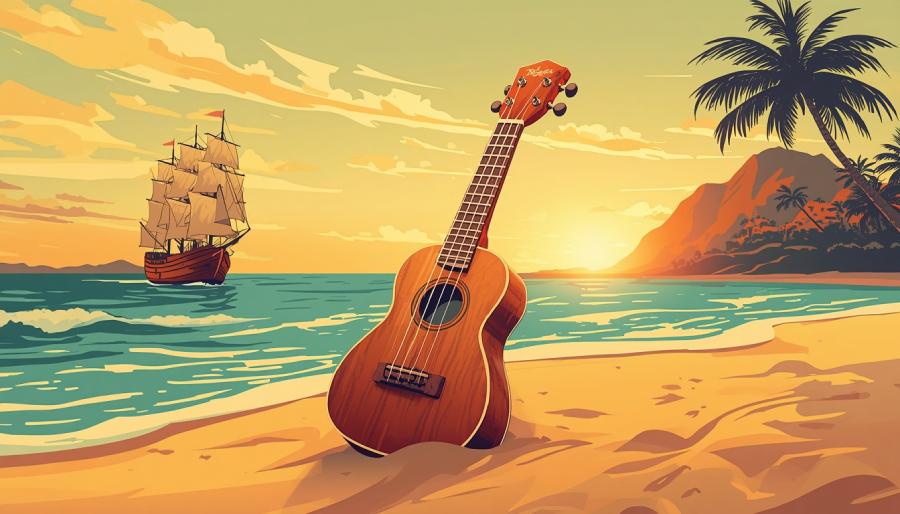
The ukulele originated in Hawaii in the 1880s, but its design is Portuguese. It evolved from small stringed instruments called the machete, cavaquinho, and rajão, brought by Portuguese immigrants from Madeira, the Azores, and Cape Verde who arrived to work Hawaii’s sugar plantations. Hawaiians adapted and renamed the instrument soon after.
Who Invented the Ukulele?
No single inventor exists. Three Madeiran cabinetmakers — Manuel Nunes, José do Espírito Santo, and Augusto Dias — are widely credited as the first ukulele makers. All three arrived in Hawaii in 1879 and later opened workshops in Honolulu, adapting their trade from machetes and guitars to the new four-string instrument.
Each luthier took a different path after settling in Honolulu. Augusto Dias built instruments on Nuuanu Street until his shop was destroyed in a fire that swept Chinatown around 1900. José do Espírito Santo closed his shop the same year and kept building from home until his death. Manuel Nunes proved the most prolific, training apprentices including his son Leonardo, who ran a Nunes factory in Los Angeles until 1930. One of Nunes’s students, Samuel Kamaka, opened his own workshop in 1916 — a company that still makes ukuleles in Honolulu today.
The Voyage That Started It All
The story behind Ukulele History begins with a single ship crossing. In April 1879, the SS Ravenscrag departed Funchal, Madeira, carrying 419 Portuguese contract laborers bound for Hawaii’s sugar plantations. The journey took four months, rounding Cape Horn before reaching Honolulu Harbor. Among the passengers was João Fernandes, a musician who reportedly played his machete and sang on the dock the moment the ship landed, delighting both fellow immigrants and curious locals who had never heard the instrument before.
Details vary between retellings, but the core fact holds across historical sources: Madeiran immigrants brought their machetes ashore in 1879, and within a year local newspapers were already reporting on the instrument’s growing popularity around Honolulu.
Ukulele History Timeline
| Year | Event |
|---|---|
| 1879 | Portuguese immigrants from Madeira arrive in Honolulu aboard the SS Ravenscrag, bringing the machete instrument with them |
| 1880s | Manuel Nunes, José do Espírito Santo, and Augusto Dias begin building the first instruments recognizable as ukuleles |
| Late 1880s | King Kalākaua adopts and promotes the ukulele, embedding it in Hawaiian royal and cultural life |
| 1915 | The Panama-Pacific International Exposition in San Francisco introduces the ukulele to mainland America, sparking the first U.S. ukulele craze |
| 1920s | The ukulele becomes a fixture of Jazz Age music; manufacturers like Martin and Gibson begin mass production |
| 1940s | The baritone ukulele is introduced, expanding the instrument’s range |
| 1950s | Mass-produced plastic ukuleles and TV host Arthur Godfrey drive a second wave of popularity |
| 1993 | Israel Kamakawiwoʻole’s “Over the Rainbow” medley reintroduces the ukulele to a global audience |
| 2006 | Jake Shimabukuro’s viral video performances demonstrate the ukulele’s range as a serious instrument |
| 2009–2018 | U.S. ukulele sales rise sharply, with 1.77 million units sold over the decade according to Statista figures |
How Did the Ukulele Get Its Name?
“Ukulele” is Hawaiian for “jumping flea,” a reference to the rapid finger movement of players strumming the strings. One popular account credits the name to British official Edward Purvis, whose quick playing style reminded onlookers of a jumping flea; historians still debate which origin story is accurate.
Why Did King Kalākaua Matter to Ukulele History?
King Kalākaua, Hawaii’s “Merrie Monarch,” was a major patron of Hawaiian arts and adopted the ukulele as part of his broader cultural revival. His public endorsement turned the instrument from a recent immigrant import into a symbol of Hawaiian national identity, a status it holds today.
Ukulele vs. Its Portuguese Ancestor Instruments
| Feature | Machete (Portugal) | Ukulele (Hawaii) |
|---|---|---|
| Origin | Madeira, Portugal | Adapted in Hawaii from Madeiran instruments |
| Strings | 4-5 strings, gut | 4 nylon strings |
| Tuning | Varies by region | Standard GCEA (reentrant) |
| Body size | Small, similar shape | Slightly modified, distinct “figure-8” body |
| Cultural role | Folk and regional music | National symbol of Hawaii, later global pop instrument |
How Many Types of Ukulele Are There?
The standard soprano ukulele was the original size built by the Madeiran luthiers in the 1880s and remains what most people picture when they hear the word “ukulele.” As demand grew, builders experimented with larger bodies for a fuller tone, producing the sizes still used today.
| Size | Introduced | Typical Length | Tone |
|---|---|---|---|
| Soprano | 1880s | ~21 inches | Bright, classic “uke” sound |
| Concert | 1920s | ~23 inches | Slightly deeper, more volume |
| Tenor | Late 1920s | ~26 inches | Warmer, richer bass tone |
| Baritone | 1940s | ~30 inches | Closest to a guitar, lowest pitch |
Each size shares the same basic four-string design but differs in tuning and scale length, which is why a song that sounds bright on a soprano can sound noticeably mellower on a tenor or baritone.
How Did the Ukulele Become Popular in America?
The 1915 Panama-Pacific International Exposition in San Francisco was the turning point. The Hawaiian Pavilion’s ukulele performances drew massive crowds among the millions in attendance, introducing mainland Americans to Hawaiian music for the first time and triggering nationwide demand for the instrument over the following decade. Performers such as George E. K. Awai and his Royal Hawaiian Quartet, alongside ukulele maker Jonah Kumalae, played a direct role in popularizing the instrument among fairgoers who had never encountered Hawaiian music before.
How the Ukulele Survived the 20th Century
Following the 1915 exposition, the ukulele became woven into American popular culture, and its 20th-century story is one of repeated reinvention rather than steady growth. During the 1920s Jazz Age, its affordability and ease of learning made it a household staple; sheet music publishers printed ukulele chord diagrams alongside piano notation, and manufacturers including C.F. Martin, Gibson, and Regal began producing ukuleles at scale.
The Great Depression, somewhat counterintuitively, helped sustain its popularity. As families could no longer afford pianos or accordions, the cheap, portable ukulele offered an accessible alternative. The Harmony Company became one of the largest American ukulele manufacturers of the era, selling instruments through mail-order catalogs like Sears, Roebuck & Co.
After World War II, the ukulele entered a second boom driven by mass-produced plastic models. Manufacturer Mario Maccaferri alone produced roughly 9 million plastic ukuleles during the 1950s, helped along by TV host Arthur Godfrey, who taught ukulele lessons on his weekly broadcast and brought the instrument into millions of American living rooms. By the 1970s, rock and roll and the electric guitar pushed it toward novelty status, and sales declined sharply through the following two decades — a slump that wouldn’t reverse until the 1990s.
The Modern Ukulele Revival
The ukulele’s comeback began in 1993, when Hawaiian singer Israel Kamakawiwoʻole recorded a medley of “Over the Rainbow” and “What a Wonderful World” using just his voice and a ukulele. The recording later appeared in numerous films, TV shows, and ads, reintroducing the instrument’s sound to listeners who’d never associated it with serious music.
The Ukulele Orchestra of Great Britain, formed in 1985, also reshaped public perception by performing intricate pieces originally written for guitar, proving the instrument could handle far more than simple strumming. By the early 1990s, musician Jim Beloff began publishing ukulele songbooks featuring classic and contemporary music, fueling renewed interest among adult learners.
Online video accelerated the revival further. Jake Shimabukuro’s 2006 viral performance of “While My Guitar Gently Weeps” demonstrated technical virtuosity few associated with the instrument, drawing millions of views and inspiring a new generation of players. U.S. ukulele sales subsequently climbed through the 2010s, with Statista figures showing 1.77 million units sold domestically between 2009 and 2018 alone.
Why Ukulele History Still Matters Today
Ukulele History is more than a chronology of dates — it’s a case study in how migration and cultural exchange produce new traditions. A small Portuguese folk instrument, carried across an ocean by laborers seeking work, was reshaped by Hawaiian musicians into something distinct enough to earn its own name, then carried back across the Pacific to become an American pop culture fixture, and later rediscovered by a global audience through recordings and viral video.
FAQs
Is the ukulele a Hawaiian instrument?
The ukulele was popularized and culturally adopted in Hawaii, but its physical design descends from Portuguese instruments brought by Madeiran immigrants in 1879. Most historians call it a Hawaiian adaptation of a Portuguese original, not a purely native Hawaiian creation.
When was the ukulele invented?
The ukulele was developed in the 1880s in Honolulu, shortly after Portuguese immigrants arrived in 1879 carrying the machete that served as its direct ancestor.
Why did ukulele popularity decline in the 1970s?
The rise of rock and roll and the electric guitar shifted public taste, and the ukulele increasingly came to be seen as a children’s toy rather than a serious instrument — a perception that persisted until revival efforts in the 1990s and 2000s.
What brought the ukulele back into mainstream popularity?
Israel Kamakawiwoʻole’s 1993 recording of “Over the Rainbow,” later used widely in film and television, reintroduced the ukulele’s sound to global audiences. Viral performances by artists like Jake Shimabukuro in the 2000s cemented its modern revival.
Conclusion
Ukulele History shows how a small Portuguese instrument crossed an ocean and became one of the world’s most recognizable musical icons. From Madeiran cabinetmakers in 1880s Honolulu to King Kalākaua’s royal endorsement, from the 1915 San Francisco exposition to Israel Kamakawiwoʻole’s global revival, the ukulele’s journey reflects more than a century of cultural exchange. Today it remains one of the most accessible instruments for beginners, carrying its Hawaiian-Portuguese heritage into modern music worldwide.