If you’ve got a teenager in secondary school, or you’re a student staring down a wall of exams yourself, chances are you’ve heard the name “GCSE Pod” thrown around at least once. Maybe a teacher mentioned it. Maybe it popped up in a parents’ evening. Or maybe you just saw it on your school’s homework portal and thought, “What on earth is this thing, and is it actually worth my time?” Fair questions, all of them. This guide breaks down exactly what GCSE Pod is, where it came from, who runs it now, how it works, and whether the hype holds up — all in plain English, without the marketing fluff.
What Is GCSE Pod?
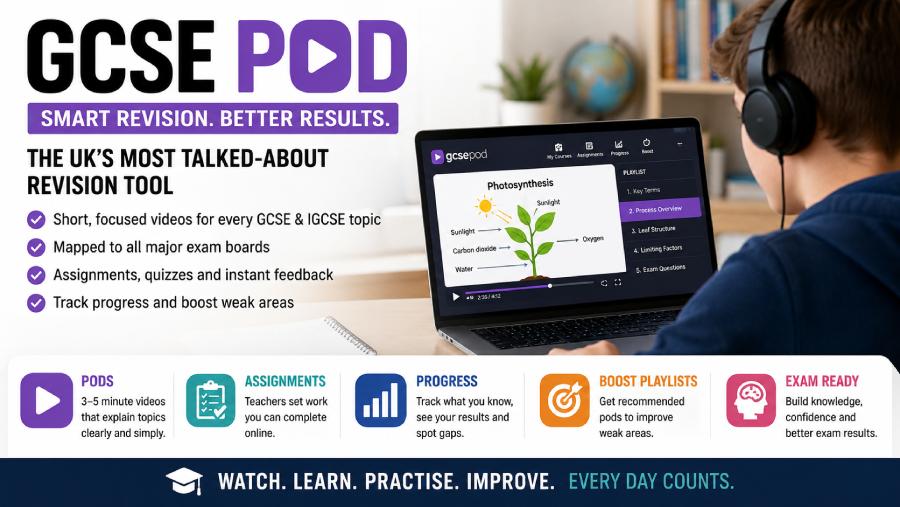
Let’s start with the basics, because “what is GCSE Pod” is genuinely the most searched question about the platform, and for good reason. GCSE Pod is an online learning and revision platform built specifically for UK secondary school students. At its heart, it’s a massive library of short, snappy videos called “Pods” that cover the GCSE and IGCSE curriculum across more than 30 subjects. Rather than dumping a 40-minute lecture on you, each Pod squeezes a single topic into roughly three to five minutes of clear narration paired with simple, focused graphics. The whole idea is to make revision feel less like a chore and more like something you can actually fit into a bus ride or a lunch break. It’s mapped to all the major exam boards, so the content you’re watching genuinely lines up with what you’ll face in the exam hall, not some vague, generic version of the subject.
Who Created GCSE Pod and Who Owns It Now?
Here’s a bit of backstory that most students never bother to learn, but it actually tells you a lot about why the platform feels the way it does. GCSE Pod was founded in 2008 by Anthony Coxon and Ian Thompson, two parents who were frankly fed up with watching a tech-savvy generation of kids try to revise using dusty old methods that clearly weren’t clicking. They figured that if young people lived on their phones anyway, the revision should come to the phone too. The company they built was originally called Soundbite Learning, based up in Newcastle Upon Tyne, with GCSE Pod being its flagship product. Fast forward to October 2021, and the business was acquired by The Access Group, a huge UK software company. That’s why you’ll now see it branded as “Access GCSE Pod” in a lot of places. So to put it simply: the founders are Coxon and Thompson, but the current owner is The Access Group, which folded it into their education division alongside tools used by thousands of schools and colleges.
How GCSE Pod Actually Works
The mechanics of GCSE Pod are refreshingly straightforward, which is half the appeal. Once your school subscribes — and that’s the key thing, it’s usually the school that pays, not you directly — you get a login that opens the door to the entire content library. From there, you can stream or download Pods, work through topic-by-topic playlists, complete assignments your teachers set, and track your own progress over time. Teachers can build custom assignments, set homework, and see exactly where the class is struggling, which means revision stops being a guessing game. There’s also a clever feature where the platform automatically generates “boost playlists” when you stumble on a particular assignment, basically nudging you toward the exact Pods that’ll plug the gap in your knowledge. It’s the kind of quiet, behind-the-scenes intelligence that makes the whole thing feel less like a static website and more like a study buddy that actually pays attention.
The “Pods” Explained: Why Short-Form Content Works
The Pods themselves deserve a proper section, because they’re the entire reason the platform exists and the thing that sets it apart. There’s solid learning science behind the bite-sized approach. When you break a big, intimidating subject into tiny, digestible chunks, your brain finds it far easier to absorb and, crucially, to recall later. GCSE Pod leans hard into proven cognitive techniques like retrieval practice and interleaving — fancy terms that essentially mean “testing yourself often” and “mixing topics up so they stick.” Each Pod is structured to deliver the key vocabulary, the core knowledge, and a few exam tips, all in one tight package. You’re not drowning in waffle; you’re getting the essentials, fast. And because they’re so short, you genuinely can knock out three or four in the time it would take to even psych yourself up for a traditional revision session. That low barrier to starting is honestly underrated — half the battle with revision is just getting going.
GCSE Pod English: A Closer Look
Plenty of students specifically search for “GCSE Pod English,” so it’s worth zooming in on how the platform handles one of the most demanding subjects on the timetable. English Language and English Literature are tricky to revise because so much of the marking rests on analysis, interpretation, and the quality of your writing — things that don’t always reduce neatly into flashcards. GCSE Pod tackles this by breaking the subject down into focused Pods on individual skills and texts: think analysing language techniques, structuring an essay, understanding character and theme in set texts, or nailing the dreaded unseen poetry questions. Because the content is mapped to specific exam boards, the literature Pods line up with the actual texts and anthologies your course covers, which saves you the headache of wading through material that won’t even appear on your paper. For students who find essay subjects intimidating, having a clear, narrated walkthrough of how to build an argument can be a genuine confidence-booster, and that confidence often matters just as much as the content itself when you’re sat in the exam.
GCSE Pod Reviews: What People Actually Say
Now for the part everyone really wants — honest GCSE Pod reviews. The general consensus across teachers, students, and parents leans positive, but it’s worth separating the genuine praise from the marketing. Teachers tend to love it because it slashes their workload; instead of building homework from scratch every week, they can pull from a library of ready-made, exam-aligned assignments. Reviews from educators frequently highlight how useful it is for non-specialist or cover teachers, since it guarantees solid content even when the usual subject expert isn’t in the room. Students, on the other hand, often praise the self-marking features and the ability to get instant feedback during independent study rather than waiting days for a teacher to hand work back. The short format gets repeated nods too, because it fits the way teenagers actually consume content. That said, no tool is perfect, and the fairest reviews acknowledge that GCSE Pod works best as part of a wider revision strategy rather than a magic bullet on its own.
The Big Claim: Does GCSE Pod Really Improve Grades?
You’ll see one statistic plastered all over GCSE Pod’s marketing: that students using it achieve, on average, 1.5 grades higher. It’s an eye-catching number, and it shows up alongside claims of measurable gains in Progress 8 and Attainment 8 scores. So, should you believe it? Here’s the honest, expert take. That figure comes from the company itself, which means it’s a vendor claim rather than independent, peer-reviewed research, and you should treat it with a healthy pinch of salt. That doesn’t mean it’s false — there’s a logical case that regular, consistent revision using well-structured content will lift grades, and plenty of schools report real improvements. But correlation isn’t causation. The students who diligently use a revision tool are often the same students who’d put in the work regardless. The sensible conclusion is that GCSE Pod is a genuinely useful aid that can help most students, but the size of any grade boost will always depend on how consistently and intelligently you actually use it.
How to Get the Most Out of GCSE Pod
Owning access to a tool and getting real value from it are two very different things, so let’s talk strategy. The biggest mistake students make is treating GCSE Pod like passive entertainment — sticking on a Pod and letting it wash over them while they scroll their phone with the other hand. To actually learn, you need to engage. Watch a Pod, then pause and try to summarise what you just heard without looking. Use the assignments and quizzes to test yourself rather than just watching videos, because retrieval is where the real learning happens. Build a routine where you tackle a few Pods most days rather than cramming dozens the night before an exam; spaced-out practice beats panic every single time. Lean on those auto-generated boost playlists when you get something wrong, since they’re pointing you at your actual weak spots. And pair it with other methods — past papers, written notes, study groups — so you’re attacking the material from multiple angles. Used this way, the platform becomes seriously powerful.
GCSE Pod Compared to Other Revision Tools
It would be unfair to discuss GCSE Pod in a vacuum, because there’s a whole ecosystem of free and paid revision tools out there. The most common comparisons are with platforms like Seneca, BBC Bitesize, and various YouTube revision channels. BBC Bitesize is completely free and great for quick reference, but it lacks the structured assignment system and progress tracking that GCSE Pod offers. Seneca is also free for its core content and leans heavily into interactive quizzing, which some students prefer over video. GCSE Pod’s main edge is its tight curriculum mapping, its short-form video format, and the integrated tools that let teachers set, monitor, and respond to student work in one place. The trade-off, of course, is that it’s a paid, school-subscription product rather than something you can just sign up for as an individual. For most students, the honest answer is that these tools aren’t really rivals — they complement each other beautifully, and the smartest revisers raid all of them.
Pricing and How to Access GCSE Pod
This is where a lot of confusion creeps in, so let’s clear it up. GCSE Pod is sold primarily as a business-to-business product, meaning it’s schools and colleges that buy subscriptions, not individual families. If your school subscribes, you’ll be given login details, and once you’re in, you get full access to the entire content library — unlimited streaming and downloading, with no annoying paywalls hiding “premium” content behind extra charges. If your school doesn’t subscribe, you’re a bit stuck on the full experience, though the platform does make some free resources available to anyone, so it’s worth poking around their site to see what you can use. The lack of a simple individual subscription is probably the single most common frustration parents raise, but the upside of the school model is that when access is provided, it’s comprehensive and there are no sneaky add-on costs to worry about.
Is GCSE Pod Right for You?
So, after all that, who should actually be using GCSE Pod? If you’re a visual or auditory learner who finds dense textbooks a slog, the short video format will probably suit you down to the ground. If you’re someone who struggles to start revising and needs low-friction ways to build momentum, those three-minute Pods are a brilliant entry point. Teachers managing big classes and tight schedules will appreciate the time it saves and the visibility it gives into student progress. On the flip side, if you thrive on writing pages of detailed notes or you learn best by grinding through endless past papers, GCSE Pod might play a supporting role rather than a starring one in your routine — and that’s completely fine. The key takeaway is that it’s a well-built, evidence-informed tool that suits a huge range of learners, but like anything, it rewards the people who actually put it to work.
FAQs
Is GCSE Pod free to use?
Not for individuals in the usual sense — GCSE Pod is sold as a school subscription, so access is normally provided by your school. There are a few free resources on their site, but the full library requires a school login.
Can I sign up for GCSE Pod on my own?
No, GCSE Pod doesn’t offer a standard individual subscription. It’s a business-to-business product, meaning schools and colleges buy access and then hand login details to their students.
How many subjects does GCSE Pod cover?
GCSE Pod covers more than 30 GCSE and IGCSE subjects, with content mapped to all the major exam boards so it lines up with what you’ll actually face in your exams.
Is GCSE Pod good for English revision?
Yes — GCSE Pod breaks English Language and Literature into focused Pods on essay structure, language analysis, set texts and poetry, which makes a notoriously tricky subject far easier to revise.
Does GCSE Pod actually improve grades?
The company claims an average 1.5-grade improvement, but that’s a vendor figure rather than independent research. Used consistently as part of a wider revision plan, it can genuinely help most students.
Conclusion
At the end of the day, GCSE Pod has earned its reputation as one of the UK’s go-to revision platforms for a reason. It takes a genuinely smart idea — delivering exam-aligned content in tiny, brain-friendly chunks — and wraps it in a system that supports students, teachers, and parents alike. Founded by two frustrated parents back in 2008 and now backed by the considerable resources of The Access Group, it has grown into a tool trusted by well over 1,700 schools across 40-plus countries. The grade-boost claims deserve a measured, slightly sceptical eye, but the underlying approach is sound, the reviews are largely warm, and for subjects like English where confidence and structure matter, it can make a real difference. If your school provides access, there’s very little reason not to give it a serious go. Just remember the golden rule: GCSE Pod is a fantastic tool, but it’s not magic. The grades still come from the effort you put in — the platform just makes that effort go a whole lot further.