The Industry Spent Years Chasing Fiber Density
For much of the past decade, data center cabling conversations revolved around one concept: density.
As network speeds increased from 40G to 100G and later to 400G, operators searched for ways to fit more bandwidth into the same physical footprint. MPO-based cabling systems became increasingly popular because they allowed multiple optical lanes to be consolidated into a single connector.
At the time, the approach made perfect sense.
Higher-density switching platforms required higher-density cabling systems. More fibers meant more lanes, and more lanes meant more bandwidth.
But as the industry moves deeper into the 800G era, some infrastructure teams are beginning to reevaluate that assumption.
Instead of asking how many fibers can fit into a rack, they are asking a different question:
How can we increase bandwidth without increasing cabling complexity?
That question helps explain the growing interest in 800G FR4 optical modules built around duplex LC connectivity.
Why Cabling Complexity Becomes a Long-Term Problem
The challenge with large-scale networks is that they rarely remain static.
A data center that begins with a few hundred links can eventually grow into an environment containing thousands or even tens of thousands of optical connections. As infrastructure expands, every additional patch panel, trunk cable, and fiber management process adds operational overhead.
The problem isn’t usually bandwidth.
It’s maintainability.
Complex cabling environments are harder to troubleshoot, harder to document, and harder to modify during expansion projects.
This becomes especially visible in AI infrastructure, where deployment schedules often move faster than traditional enterprise environments.
As clusters grow, simplicity becomes increasingly valuable.
Many operators are discovering that reducing fiber management complexity can be just as important as increasing network capacity.
The Return of Duplex LC
For years, some industry observers assumed duplex LC would gradually lose relevance in high-speed environments.
Instead, the opposite is happening.
Technologies such as 400G FR4 and 800G FR4 have demonstrated that wavelength multiplexing can deliver very high bandwidth while continuing to use a simple two-fiber architecture.
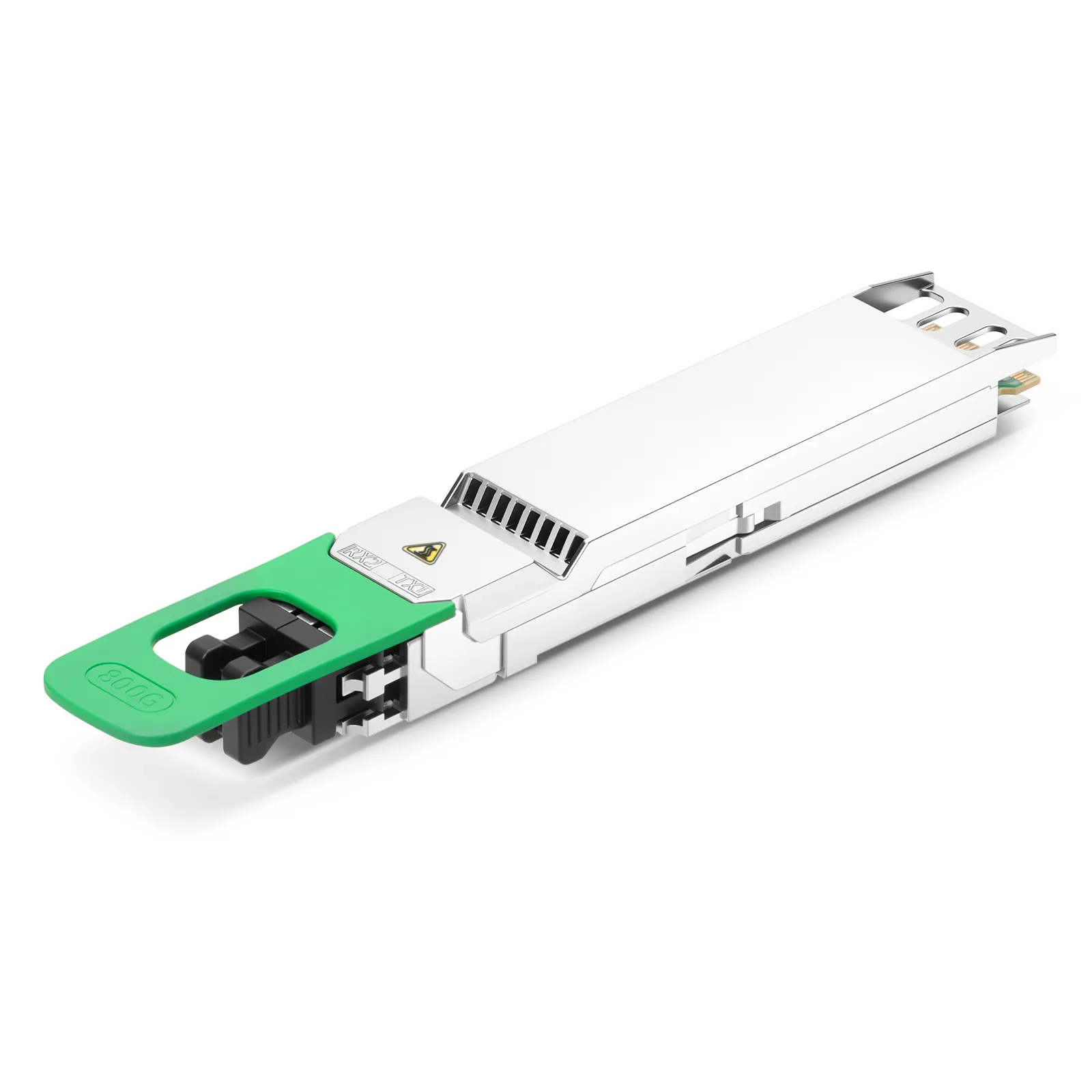
The NVIDIA/Mellanox MMS4X50-NM compatible 800G 2×FR4 OSFP transceiver is a good example of this trend.
Rather than relying on large parallel-fiber structures, the module uses wavelength multiplexing across duplex LC single-mode fiber to support high-speed communication over distances up to 2 kilometers.
For operators managing extensive fiber infrastructures, that design can significantly simplify deployment planning.
The network gains bandwidth without proportionally increasing cabling complexity.
Why Existing Fiber Plants Matter More Than Ever
One of the realities of modern data centers is that fiber infrastructure often outlives multiple generations of active equipment.
Switches may be replaced every few years. Servers come and go. Optical modules evolve rapidly.
Fiber routes often remain in place for much longer.
Because of this, infrastructure decisions increasingly revolve around how effectively existing cabling can support future growth.
Many facilities already contain large amounts of duplex single-mode fiber.
When a new optical technology can leverage those assets directly, the upgrade path becomes much smoother.
The MMS4X50-NM compatible module fits neatly into this strategy by allowing operators to scale bandwidth using infrastructure they may already own.
In many environments, that translates into lower deployment costs and less operational disruption.
Why 2 Kilometers Is a Practical Distance
The 2km reach offered by FR4 technology occupies an interesting position within modern networks.
It is significantly longer than typical intra-row or intra-hall connectivity, yet shorter than traditional metro transport applications.
This range aligns remarkably well with many AI and cloud deployments.
Expansion buildings, secondary data halls, storage facilities, and adjacent compute environments often fall within this distance window. These are exactly the kinds of locations where organizations want high-bandwidth connectivity without introducing additional transport equipment.
The ability to extend 800G links directly across these environments simplifies architecture and reduces the number of network layers required between resources.
Sometimes the best design is not the one that reaches the farthest.
It’s the one that matches real deployment requirements most closely.
Twin-Port Design Supports Infrastructure Flexibility
Another important aspect of the MMS4X50-NM compatible module is its twin-port 2×FR4 architecture.
Infrastructure requirements rarely remain fixed.
A link deployed as 800G today may eventually be repurposed into multiple 400G connections. Traffic patterns may change as clusters expand. New applications may place different demands on the network.
The twin-port design provides flexibility to accommodate these shifts.
Instead of forcing operators into a single deployment model, the architecture allows multiple approaches depending on current and future requirements.
This flexibility helps protect infrastructure investments over longer deployment cycles.
Why Air-Cooled Networks Continue to Dominate
Although liquid cooling receives significant attention within AI discussions, networking infrastructure remains largely air-cooled across much of the industry.
Switches often represent a different thermal challenge than compute equipment. They require dense connectivity, predictable airflow, and consistent thermal performance under continuous operation.
The finned-top OSFP design used by the MMS4X50-NM compatible module addresses this requirement directly.
Improved airflow characteristics help maintain stable operating conditions inside Quantum-2 InfiniBand and Spectrum-4 Ethernet switches, particularly in environments where large numbers of high-speed optics operate simultaneously.
Reliable thermal behavior remains one of the less visible but most important aspects of long-term network stability.
Looking Beyond Raw Bandwidth
The discussion surrounding 800G networking often focuses on speed.
Speed matters, but it isn’t the only factor influencing infrastructure decisions.
Operational simplicity, deployment flexibility, fiber utilization, and long-term scalability all contribute to the success of a network architecture.
The growing popularity of FR4-based solutions reflects this broader perspective.
Organizations are increasingly evaluating how optical technologies fit into the entire lifecycle of infrastructure rather than focusing solely on throughput numbers.
Conclusion
The NVIDIA/Mellanox MMS4X50-NM compatible 800G 2×FR4 OSFP optical transceiver highlights an important trend in modern networking: achieving higher bandwidth without increasing physical complexity. By combining wavelength multiplexing, duplex LC connectivity, 2km single-mode reach, and flexible twin-port architecture, it enables high-performance connectivity while simplifying fiber infrastructure management. As AI clusters, cloud environments, and large-scale data centers continue expanding, solutions that balance performance with operational efficiency are becoming increasingly valuable. In many cases, the future of networking may depend not only on how much bandwidth can be delivered, but on how simply that bandwidth can be deployed and maintained.