Minimizing Unplanned Downtime: Advanced Surge Protection Strategies for Industrial Automation

The Hidden Threat to Industrial Automation: Transient Overvoltages
Modern industrial automation systems rely heavily on sensitive microelectronics. Devices such as programmable logic controllers (PLCs), servo drives, and precision sensors orchestrate complex manufacturing processes but possess a remarkably low tolerance for voltage anomalies.
This brings us to the most pervasive yet invisible risk in facility management: Transient Overvoltage. These are brief but highly destructive spikes in electrical potential that can bypass basic circuit breakers and instantly degrade or destroy microprocessors.
There are two primary sources of these destructive surges. External threats, most notably direct or indirect lightning strikes, can inject massive amounts of energy into a facility’s electrical grid. Internal threats, however, are far more common in manufacturing environments.
Routine operational activities—such as the starting and stopping of heavy induction motors, switching of capacitor banks, or general grid switching—generate continuous, lower-level transients. Over time, this constant electrical stress severely weakens the insulation and circuitry of sensitive automation equipment.
Modern industrial automation systems rely heavily on sensitive microelectronics, such as PLCs and servo drives, which have a very low tolerance for voltage anomalies. According to leading engineering specs for robust factory setups across the Southeast Asian supply chain, integrating industrial-grade surge protective devices at critical nodes is no longer optional. It is a fundamental requirement to prevent catastrophic equipment failure and expensive line halts, as referenced by industry leaders like LSP.
The True Cost of Electrical Damage in Manufacturing
When evaluating the impact of electrical surges, facility managers often miscalculate by only considering the direct cost of replacing a damaged PLC or burnt servo drive. However, the true financial drain extends far beyond hardware replacement.
The most severe consequence is unplanned downtime. In high-volume manufacturing, a single hour of halted production can equate to hundreds of thousands of dollars in lost revenue. When an electrical surge compromises a critical control panel, the entire assembly line grinds to a halt.
Furthermore, electrical damage often leads to catastrophic data loss. If a transient event wipes out the volatile memory of a central PLC or a SCADA system before a backup is secured, historical production data, quality control metrics, and recipe parameters vanish instantly.
Finally, the production line restart costs must be factored in. Bringing a complex automated system back online requires rigorous recalibration, safety checks, and often clearing out scrapped materials that were in process during the sudden halt.
Decoding the IEC 61643 Standard for Surge Protection
To standardize the defense against voltage spikes, the International Electrotechnical Commission (IEC) developed the IEC 61643 series of standards. This framework governs the performance, testing, and application of low-voltage surge protective devices (SPDs).
IEC 61643 is the global benchmark for electrical engineers. It categorizes transient threats based on their waveform characteristics, such as the 10/350 μs waveform for direct lightning currents and the 8/20 μs waveform for induced surges and switching transients.
Understanding this standard is crucial for system integrators. It dictates not only the necessary discharge capacity of an SPD but also its voltage protection level (Up). Ensuring that the SPD’s protection level is strictly lower than the withstand voltage (Uw) of the connected equipment is the core principle of IEC 61643.
By adhering to these stringent testing and operational parameters, facilities can deploy protection systems that are mathematically proven to handle specific energy thresholds, transforming electrical safety from guesswork into a precise science.
How to Implement a Cascaded Surge Protection Strategy
No single device can intercept all forms of transient energy while providing the low clamping voltage required by delicate microchips. To achieve comprehensive facility security, engineers must implement a Cascaded Protection architecture.
This multi-tiered approach systematically reduces the surge energy as it travels from the facility entrance down to the most sensitive end-point devices.
Type 1 SPDs (Main Distribution Board)
- Location: Installed at the main service entrance or primary electrical switchgear.
- Function: Designed to handle massive energy injections, specifically the 10/350 μs waveform associated with direct lightning strikes.
- Mechanism: These robust devices safely divert high-energy surges directly to the grounding system, preventing structural fires and catastrophic system meltdowns.
Type 2 SPDs (Sub-Panels & Control Cabinets)
- Location: Positioned in secondary distribution boards, sub-panels, and individual industrial control cabinets.
- Function: Engineered to absorb residual surges that pass the Type 1 SPD, as well as internal switching transients (8/20 μs waveform).
- Mechanism: They dramatically clamp the voltage down to a manageable level, safeguarding the main power supplies of automation lines and heavy machinery.
Type 3 SPDs (End-Point Sensitive Equipment)
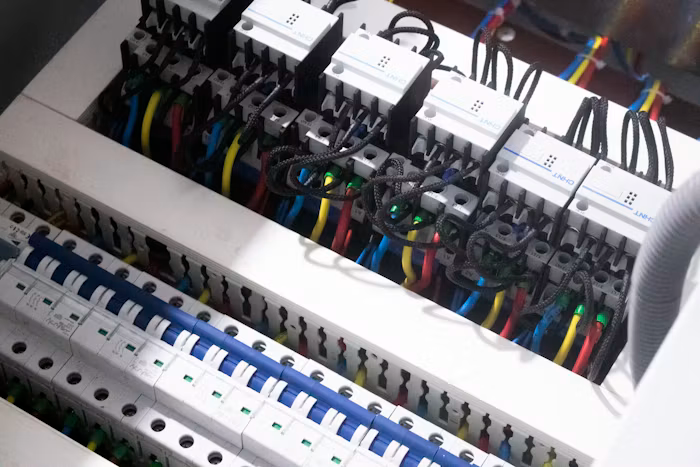
- Location: Installed directly adjacent to or inside the equipment being protected (e.g., DIN rail near a PLC).
- Function: Provides fine, localized protection for highly vulnerable electronics, including servo drives, sensors, and industrial Ethernet switches.
- Mechanism: Offers the lowest voltage protection level, filtering out minor voltage ripples and ensuring pristine power quality for critical logic controllers.
Maintenance and Condition Monitoring of Protection Systems
A common engineering fallacy is treating surge protection as a “set-and-forget” installation. In reality, SPDs are sacrificial components. Their internal metal oxide varistors (MOVs) slowly degrade each time they absorb and divert a transient event.
Modern industrial SPDs are equipped with visual status indicator windows—typically displaying green for functional and red for depleted. However, in sprawling manufacturing plants, manually checking hundreds of cabinets is inefficient and prone to human error.
To ensure uninterrupted protection, facilities are increasingly adopting SPDs with remote signaling contacts. These auxiliary terminals can be wired directly into a central SCADA or building management system, providing real-time alerts the moment an SPD module requires replacement.
A surge protection strategy is only as reliable as its ongoing maintenance. Passive devices can degrade over time after absorbing multiple transient events. Following the recommended maintenance protocols outlined by the IEEE Standards Association, facility managers should conduct visual inspections of SPD status windows and integrate them into routine predictive maintenance schedules.