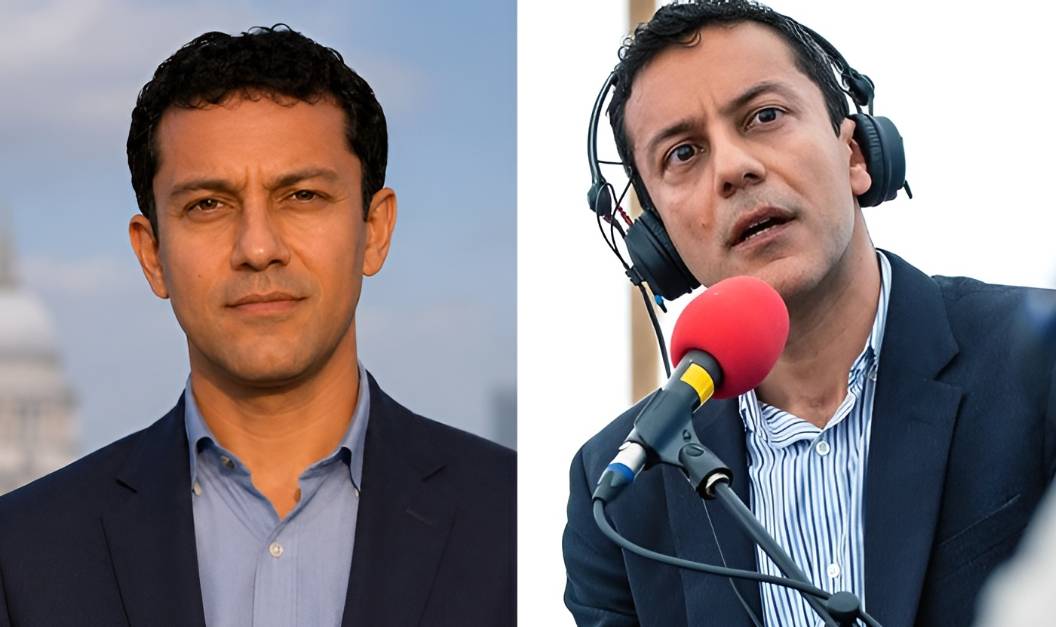
If you have watched BBC News at almost any point over the last two decades, chances are you have seen Aleem Maqbool standing somewhere difficult, explaining something complicated, and somehow making it feel human. He is one of those reporters whose name you might not immediately place, but whose work you have almost certainly absorbed. From dusty roads in Pakistan to the marble corridors of the Vatican, Maqbool has built a career on going where the story is and bringing the rest of us along for the ride. Today he holds one of the most quietly influential jobs in British journalism: Religion Editor for BBC News. Here is a closer look at who he is, how he got there, and why his particular brand of reporting matters.
Who Exactly Is Aleem Maqbool?
Aleem Maqbool is a British broadcast journalist who has spent the better part of twenty years at the BBC, the world’s largest public broadcaster. He is currently the corporation’s Religion Editor, a role he stepped into in the spring of 2022, where he leads the BBC’s coverage and analysis of faith and ethics stories across the United Kingdom and around the globe. Before that, he served as one of the BBC’s most travelled correspondents, with postings that read like a map of the early twenty-first century’s biggest flashpoints. What sets him apart is not just where he has been but how he reports once he gets there: calm, curious, and far more interested in ordinary people than in shouting headlines. That sensibility has become his trademark, and it is exactly what landed him in his current job.
From Neuroscience to the Newsroom
Here is a fun detail that surprises a lot of people: Maqbool did not start out chasing bylines. His early academic life leaned toward science, and he studied neuroscience before journalism ever entered the picture. It is a reminder that careers rarely run in a straight line, and that some of the best reporters arrive at the profession by the scenic route. There is something fitting about a former science student ending up in news, too. Both disciplines reward the same instincts: ask careful questions, test what you are told, follow the evidence, and resist the easy conclusion. Trading the lab bench for the press pack took a fair bit of nerve, but it gave Maqbool an analytical habit of mind that still shows up in the way he unpacks a story today.
Finding His Voice Behind a Microphone
The pivot into media did not happen overnight, and it did not begin on television. Like many broadcasters of his generation, Maqbool cut his teeth in radio, the medium that forces you to paint a picture using nothing but your voice. He has spoken, half-laughing, about the moment he was handed a microphone and first really heard himself speak, which sounds like a small thing but is often the moment a journalist realises this is what they were meant to do. Radio is an unforgiving teacher and a brilliant one. It taught him pacing, clarity, and how to hold an audience without any visual crutch. Those instincts carried straight over to television, where his unhurried delivery and knack for plain language made him a natural fit for the BBC’s flagship bulletins.
Reporting From the World’s Hardest Corners
Maqbool earned his reputation the hard way, working as a foreign correspondent in some of the most demanding postings in the business. He covered Pakistan as the BBC’s man on the ground, reporting on its volatile politics, its relationship with neighbouring India, and the long shadow of militancy in the region. When the world’s attention turned to Abbottabad after the killing of Osama bin Laden, Maqbool was there, filing from the town where the al-Qaeda leader had been hiding in plain sight. He also reported from Gaza and the West Bank, one of the most contested and emotionally charged beats in all of journalism, and later spent time covering Egypt. These are not assignments for the faint-hearted. They demand a steady temperament, deep local understanding, and the kind of even-handedness that does not come naturally to everyone. Maqbool’s willingness to keep listening, even in places where everyone has a fixed position, became one of his defining strengths.
The America Years
In 2014, Maqbool took on the role of BBC News North America correspondent, based in Washington, D.C., and stayed in the post until 2022. It was a remarkable stretch to be covering the United States, a period crammed with elections, social upheaval, and constant political drama. Rather than chase every breaking tweet, he often went looking for the deeper currents underneath the noise. One of his standout pieces saw him retrace the historic 1965 civil rights march from Selma to Montgomery, walking the route fifty years on alongside one of the original marchers. That is classic Maqbool: take a huge, well-worn story and find the living, breathing human thread running through it. His American reporting reinforced the idea that he was less a “gotcha” journalist and more a storyteller who trusted his audience to handle nuance.
Stepping Into the Religion Editor Chair
In April 2022, Maqbool took up the BBC’s Religion Editor post, succeeding the controversial broadcaster Martin Bashir. It was, in some ways, a homecoming for his interests, since faith and ethics had threaded through his foreign reporting for years. The job is bigger than it might first appear. Religion touches politics, identity, conflict, community, and morality, which means the Religion Editor ends up covering some of the most sensitive subjects in public life. Maqbool has spoken openly about arriving in the role half-expecting resistance, worried that editors might be nervous about faith stories, only to find the door pushed wide open. His goal has been straightforward: report on belief the same way he reported on everything else, through the lens of real people trying to make sense of their world.
Beyond Belief and a Broader Platform
Maqbool’s remit is not limited to the evening news. He also presents “Beyond Belief” on BBC Radio 4, a long-running programme that digs into the role of faith in modern life, bringing together voices from different traditions to wrestle with thorny ethical and spiritual questions. It is a natural extension of his on-screen work and a return to the radio roots where he first found his footing. Through the show, he gets to do the slower, more reflective kind of journalism that television rarely has room for, the sort of conversation that does not resolve neatly in ninety seconds. It also underlines how seriously the BBC takes its responsibility to cover belief thoughtfully in an increasingly diverse and sometimes divided society.
A Reporter Who Leads With People
If there is a single phrase that captures Maqbool’s approach, it is “human stories first.” He has said as much himself, describing his aim as explaining what is happening in the world by focusing on the individuals living through it. That philosophy is precisely why he has been trusted with such delicate territory. Faith, conflict, and politics are minefields, and the temptation to editorialise is constant. Maqbool’s instinct is to step back, let people speak, and trust the audience to draw its own conclusions. In an era of hot takes and instant outrage, that restraint feels almost old-fashioned, and refreshingly so.
A Private Life Kept Genuinely Private
One thing worth saying plainly: Maqbool guards his personal life carefully, and there is very little verified public information about his family, relationships, or upbringing beyond his professional background. Plenty of biography websites speculate about such details, but most of it is unconfirmed filler rather than fact. He has chosen to let his work speak for itself rather than turn himself into the story, which is a fairly principled stance for someone whose face appears on national television. It is also a quiet reminder that public figures are entitled to a private life, and that not every gap in a biography needs filling.
FAQs
Who is Aleem Maqbool?
Aleem Maqbool is a British broadcast journalist who has worked at the BBC for nearly two decades. He currently serves as the BBC’s Religion Editor and previously reported as a foreign correspondent from Pakistan, Gaza, the West Bank, Egypt, and the United States.
What does the BBC Religion Editor do?
As Religion Editor, Aleem Maqbool leads the BBC’s coverage and analysis of faith, belief, and ethics stories across the UK and worldwide. The role covers everything from the Vatican to interfaith debates, and he also presents the Radio 4 programme Beyond Belief.
When did Aleem Maqbool become BBC Religion Editor?
Aleem Maqbool took up the BBC Religion Editor role in the spring of 2022, succeeding Martin Bashir. Before that, he had served as the BBC’s North America correspondent from 2014 until 2022.
What did Aleem Maqbool study before journalism?
Aleem Maqbool’s early academic background was in science, having studied neuroscience before moving into media. He began his broadcasting career in radio, where he developed the storytelling and presentation skills that later defined his TV reporting.
Is Aleem Maqbool married?
Aleem Maqbool keeps his personal life private, and there are no reliably confirmed public details about his marriage, partner, or children. Most online claims about his family come from unverified biography sites rather than credible sources.
Conclusion
Aleem Maqbool’s career is a study in patience and substance. He did not become a household name through a single viral moment or a signature catchphrase. Instead, he built credibility the slow way, by showing up in hard places, asking better questions, and consistently putting people at the centre of his reporting. From a neuroscience student to a radio newcomer, from war zones and disaster scenes to the BBC’s Religion Editor chair, his path proves that thoughtful, humane journalism still has a vital place in the modern media landscape. As faith and ethics continue to shape public debate in ways both subtle and seismic, having a reporter like Maqbool steering that coverage feels less like a luxury and more like a quiet necessity. If you take one thing away from his story, let it be this: the best journalists are not the loudest in the room, but the ones who keep listening.