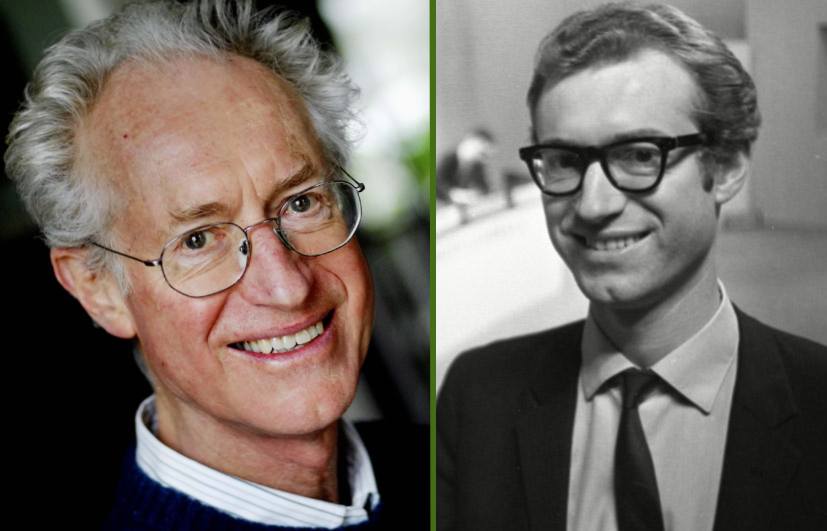
There are television presenters, and then there are presenters who quietly stitch themselves into the fabric of a country’s living rooms. Bamber Gascoigne belonged firmly to the second group. For a quarter of a century, he sat behind the desk of University Challenge, gently coaxing brilliance out of nervous students and turning a high-minded quiz into appointment viewing for millions. But to remember him only as a quizmaster would be to sell short a man who was, by any honest measure, a polymath: a writer, a historian, a theatre critic, an early internet pioneer, and an unlikely custodian of a crumbling Tudor mansion. This is the story of how a softly spoken Cambridge graduate became one of the most recognisable voices in British broadcasting, and why his influence still lingers long after the cameras stopped rolling.
Who Was Bamber Gascoigne?
Arthur Bamber Gascoigne, known to everyone simply as Bamber, was an English television presenter, historian, and author born on 24 January 1935 and active in public life right up until his death on 8 February 2022, at the age of 87. If you grew up in Britain during the 1960s, 70s, or 80s, his name is almost certainly tied in your memory to a single phrase: “Your starter for ten.” He was the original host of University Challenge, and although the show has since passed through other hands, it is Gascoigne whom many people still picture when they think of it. What set him apart was not flashiness or showmanship but the opposite: an air of genuine curiosity, the manner of a clever, courteous don who happened to find himself on commercial television. He made intelligence feel welcoming rather than intimidating, and that, more than anything, is the quality that kept audiences coming back week after week.
A Family With Deep Roots and Grand Connections
To understand Gascoigne, it helps to look at where he came from, because his background reads almost like a chapter of British social history. He was the elder son of Lieutenant-Colonel Derek Ernest Frederick Orby Gascoigne, a military man from an old and well-connected family, and his mother was Mary Louisa Hermione O’Neill, who brought her own thread of aristocratic lineage into the family. Through his mother, Gascoigne could trace links to figures such as Robert Crewe-Milnes, the 1st Marquess of Crewe, and the Barons O’Neill, while on his father’s side he was descended from an 18th-century Lord Mayor of London and a line of Tory politicians, one of whom rather wonderfully also bore the name Bamber. In other words, the patrician air that viewers detected in him on screen was not an affectation; it was simply the world he was born into. Yet what is striking is that Gascoigne never traded on that pedigree or wore it heavily. He carried his lineage lightly, channelling the privilege of a first-rate education into a lifelong love of learning rather than into airs and graces.
The Making of a Scholar
Gascoigne’s education followed the well-trodden path of the mid-century British elite, but he made far more of it than mere social polish. He attended Sunningdale School before winning scholarships to Eton College and then to Magdalene College, Cambridge, where he read English literature. Cambridge clearly suited him, because it was there that the seeds of his later careers were sown. He wrote a college revue that caught the eye of the producer Michael Codron, who liked it enough to develop it into the 1957 musical Share My Lettuce, a production that featured early performances by future stars including Maggie Smith and Kenneth Williams. After Cambridge, he spent a year as a Commonwealth Fund scholar at Yale University in the United States, broadening his horizons further still. There was also a stint of National Service in the Grenadier Guards, during which, by his own cheerful account, he spent six months guarding the Queen at Buckingham Palace. By the time he returned to England and began working as a theatre critic, first for The Spectator and later for The Observer, he had already accumulated the kind of varied, cultured grounding that would make him such a natural fit for a quiz devoted to knowledge in all its forms.
Your Starter for Ten: The University Challenge Years
The defining chapter of Gascoigne’s career began almost by accident, and certainly without any expectation of permanence. In 1962, at just 27 years old, he accepted the role of host and question-setter on a new quiz show for teams of university students. The format was borrowed from an American programme called College Bowl, and it was, initially, planned for a modest run of just thirteen episodes. Nobody involved seems to have imagined what would follow. The show struck a chord, and Gascoigne ended up presenting it for twenty-five years, from 1962 until the original run came to an end in 1987, clocking up an extraordinary 913 episodes along the way. In the early days he wrote every single question himself, which gives some sense of both his work ethic and the breadth of his knowledge. What made his hosting so distinctive was his tone. Where some quiz hosts of later eras leaned into impatience or sarcasm, Gascoigne was encouraging and gentle, a self-described “softy” who seemed to be quietly rooting for the contestants rather than catching them out. He regularly drew audiences of around eleven million viewers, a remarkable figure for a show with no cash prizes, no glamorous set, and a relentlessly highbrow subject matter.
Catchphrases That Outlived the Show
It is one of the quiet ironies of broadcasting that a man so devoted to serious learning should be remembered, in large part, for a handful of short phrases. Yet that is exactly what happened. Lines such as “Fingers on the buzzers,” “Your starter for ten,” and the almost apologetic “I’m sorry, I’ll have to hurry you” slipped out of the studio and into everyday British speech, repeated by people who had never sat a quiz in their lives. The genius of these phrases lay partly in their delivery. Gascoigne never barked them; he offered them, with a kind of courteous reluctance, as though he genuinely regretted having to nudge a struggling student along. That blend of authority and warmth is exactly why they stuck. Decades later, fellow broadcasters still cite his style as a benchmark. The Only Connect host Victoria Coren Mitchell captured it neatly when she observed that no quiz host had ever seemed more capable of answering all the questions himself, a compliment that gets right to the heart of why audiences trusted him.
More Than a Quizmaster: The Writer and Historian
Here is where the popular image of Gascoigne becomes incomplete, because the quiz show, important as it was, occupied only a slice of his working life. He once described University Challenge as being rather like a rich godfather who handed him plenty of money for very little effort, and he used that financial freedom to fund what truly fascinated him: history and scholarship. He wrote and presented ambitious television documentary series, including The Christians in 1977 and The Great Moghuls in 1990, each accompanied by a companion book. He also produced the Encyclopaedia of Britain, a reference work that found a home on the bookshelves of many a quiz enthusiast. Later in life, embracing new technology with the same enthusiasm he brought to everything else, he created an online history resource called HistoryWorld, along with a timeline-searching tool named TimeSearch. He saw the internet not as a threat to learning but as a way to share knowledge more widely than any printed book could manage, which tells you a great deal about how his mind worked. For Gascoigne, the quiz was never the point; the love of knowledge itself always was.
Christina Gascoigne: The Partnership Behind the Man
No account of Bamber Gascoigne’s life is complete without Christina Gascoigne, his wife and lifelong partner in every sense. Born Christina Ditchburn, the daughter of the civil servant Alfred Henry Ditchburn, she was a photographer and ceramicist in her own right, and she met Bamber while they were both at Cambridge. The couple married in 1965 and remained together for more than five decades, settling in Richmond from the late 1960s onward. Theirs appears to have been a genuinely happy and creative union; Christina recalled that the two of them simply never quarrelled, describing a relationship rooted in deep friendship as much as in love. Crucially, Christina Gascoigne was not merely a supportive figure in the background. Her photography illustrated several of her husband’s books, including the volume that accompanied The Great Moghuls, making her a true collaborator in his historical work. The couple had no children, a fact about which Bamber chose to stay private, and together they planned for much of their estate to support the arts after their deaths. In many ways, the story of Bamber Gascoigne is really the story of a partnership, and Christina was at the centre of it from his Cambridge days to his final years.
The Unexpected Inheritance: West Horsley Place
If Gascoigne’s life needed a final, almost novelistic twist, it arrived in 2014 in the form of a 16th-century stately home. His great-aunt, Mary Innes-Ker, the Duchess of Roxburghe, died at the age of 99 and left him West Horsley Place, a sprawling Surrey mansion near Guildford with around fifty rooms and several hundred acres of grounds. The catch was that the house had fallen into serious disrepair after years of solitary occupation; as Gascoigne memorably put it, whenever a new leak appeared, his great-aunt simply fetched a new bucket. The duchess apparently expected him to sell the place. Instead, Bamber and Christina Gascoigne decided to do something far more ambitious. Rather than cashing in, they resolved to restore the house and transform it into a community arts centre, establishing the West Horsley Place Trust to oversee the project. The roughly £10 million cost of repairs was largely covered by selling much of the contents at Sotheby’s, including paintings by Edward Burne-Jones and Lord Leighton’s celebrated Flaming June. A 700-seat opera house, now home to Grange Park Opera, was built in the grounds, and the house has since found a second life as a filming location for productions such as the BBC comedy Ghosts and the film Enola Holmes. It was a gesture entirely in keeping with the man: faced with a private treasure, he chose to give it to the public.
A Legacy in Parody and Popular Culture
A curious mark of how deeply Gascoigne penetrated the national consciousness is the sheer number of times he was parodied. Monty Python alone seemed unable to resist him, invoking his name in sketches and songs with characteristic absurdity, including a memorable reference to a fictional “stationary tree” named in his honour. In the 1984 “Bambi” episode of The Young Ones, which spoofed a University Challenge match, Gascoigne was lampooned under the nickname “Bambi,” played by Griff Rhys Jones, who had already impersonated him in a sketch on Not the Nine O’Clock News. Perhaps the most affectionate tribute came in the form of David Nicholls’ 2003 novel Starter for Ten, whose very title nods to his most famous catchphrase and whose plot revolves around a young man’s dream of appearing on the show. When the book was adapted into a film, Gascoigne was portrayed by Benedict Cumberbatch, and a later stage musical version cast another actor in the role. Being parodied so often and so fondly is a strange kind of immortality, and it speaks to a presenter who was beloved rather than merely watched.
His Final Years and Death
Bamber Gascoigne remained engaged with his many projects well into his eighties, dividing his energies between his historical websites, his writing, and the enormous undertaking at West Horsley Place. When University Challenge was revived in 1994, he chose not to return to the host’s chair, leaving the role to Jeremy Paxman, partly because he was already absorbed in other work and partly, one suspects, because he had no desire to repeat himself. He died at his home in Richmond on 8 February 2022, following a short illness, at the age of 87. The tributes that followed were warm and immediate. Stephen Fry, who had competed on the show as a student in 1980, remembered him as an elegant, intelligent man who had been kind and warm to nervous undergraduates. His wife Christina described him as an incredibly generous person whose life had been devoted to sharing his gifts with others. Across the broadcasting world, contemporaries and successors alike acknowledged that they were unlikely to see his particular blend of erudition and gentleness on screen again.
FAQs
What was Bamber Gascoigne best known for?
He was best known as the original host of University Challenge, presenting the quiz show for 25 years from 1962 to 1987 and setting many of the early questions himself. His courteous style and catchphrases like “Your starter for ten” made him a household name.
Who was Bamber Gascoigne’s wife, Christina Gascoigne?
Christina Gascoigne, born Christina Ditchburn, was a photographer and ceramicist who met Bamber at Cambridge and married him in 1965. She collaborated on several of his books and partnered with him in restoring West Horsley Place.
Did Bamber Gascoigne have any children?
No, Bamber and Christina Gascoigne had no children. He kept the matter private, and the couple instead planned for much of their estate to support the arts after their deaths.
What house did Bamber Gascoigne inherit?
In 2014 he inherited West Horsley Place, a 16th-century Surrey mansion, from his great-aunt the Duchess of Roxburghe. Rather than sell it, he and Christina restored it into a community arts centre and opera venue.
How and when did Bamber Gascoigne die?
Bamber Gascoigne died on 8 February 2022 at his home in Richmond, London, at the age of 87, following a short illness.
Conclusion
Bamber Gascoigne’s career resists easy summary, which is precisely what makes it so interesting. He was the man who asked the questions on Britain’s most cerebral quiz show, yet he was also a serious historian, a published author, a theatre critic, an internet innovator, and the unlikely saviour of a Tudor mansion. Behind all of it stood his partnership with Christina Gascoigne, a creative collaborator and constant companion across more than fifty years of shared adventures. Born into a family of grand connections through his father, Derek Ernest Frederick Orby Gascoigne, and his mother, Mary Louisa Hermione O’Neill, he could easily have coasted on privilege; instead, he spent his life trying to make knowledge feel accessible, generous, and even joyful. That is the thread running through everything he did, from setting questions for student teams to opening up his inherited estate for the public to enjoy. The catchphrases will probably outlast us all, but the better legacy is the spirit behind them: the quiet conviction that learning belongs to everyone, and that sharing it is one of the most worthwhile things a person can do.