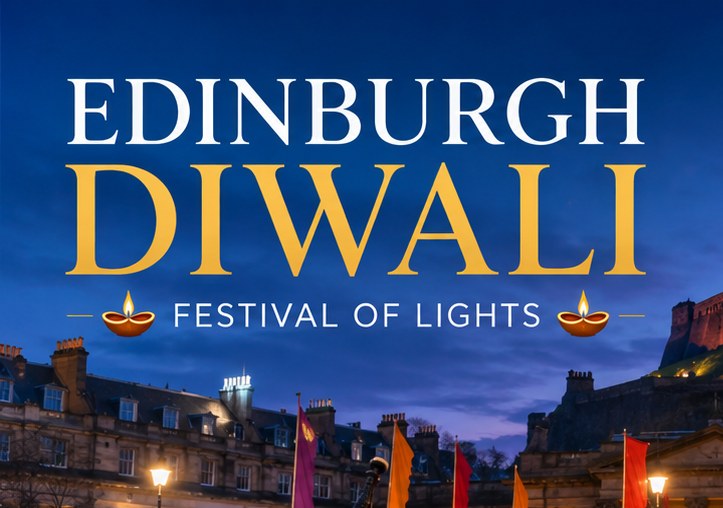
There’s something genuinely special about watching a thousand-year-old Indian tradition unfold against the silhouette of Edinburgh Castle. That’s exactly what happens every autumn when Edinburgh Diwali takes over the city centre, turning the cobbled streets of the New Town into a moving river of colour, music, and light. If you’ve never experienced it, picture bagpipes meeting Bollywood drums, giant gods gliding down George Street, and the whole thing wrapping up with fireworks bursting over the city skyline. It’s a little bit Scottish, a little bit South Asian, and entirely Edinburgh. After years of watching this event grow from a modest community gathering into one of the city’s must-see occasions, I can tell you it’s one of the warmest, most welcoming days on the calendar — and the best part is that it won’t cost you a penny.
What Exactly Is Edinburgh Diwali?
At its heart, Edinburgh Diwali is the city’s public celebration of Diwali, the festival of lights observed by Hindus, Sikhs, Jains, and Buddhists across the globe. The festival symbolises a handful of beautiful ideas all rolled into one: light triumphing over darkness, knowledge overcoming ignorance, good defeating evil, and hope winning out over despair. What makes the Edinburgh version distinctive is that it isn’t tucked away in temples or private homes — it spills right out into the most iconic public spaces in the capital. It’s deliberately designed so that anyone can show up, regardless of their religion, background, or whether they know the first thing about Diwali. You don’t need a ticket, you don’t need an invitation, and you certainly don’t need to be of any particular faith. You just need to turn up and let yourself be swept along by the energy of the day.
A Decade of Light: The Story Behind the Festival
Edinburgh Diwali isn’t some ancient fixture — it’s actually a fairly young event with a surprisingly heartfelt origin story. It launched back in 2015 as an initiative led by the Lord Provost of Edinburgh, with the simple but ambitious goal of bringing one of India’s most famous festivals to the heart of Scotland so that the wider community could share in it. Run by a registered Scottish charity, it set out from day one to be a bridge between cultures rather than a one-sided showcase. In 2025, the festival proudly marked its tenth anniversary, which is no small achievement for a grassroots celebration that relies heavily on community spirit, volunteers, and the goodwill of local performers. Ten years of uniting communities, championing diversity, and proving that Scotland’s multicultural tapestry is something worth celebrating in the most public way possible. That decade-long journey from a fledgling idea to a fixture on Edinburgh’s events calendar tells you everything about how much the city has embraced it.
When and Where It All Happens
Timing-wise, Edinburgh Diwali usually lands on the first weekend of November, slightly offset from the actual five-day Diwali period so that it can claim a proper slot in the city’s busy autumn schedule. In 2025, for instance, the celebration took place on Sunday, 2nd November. The action is concentrated in two main locations that couldn’t be more central or more scenic. It kicks off at St Andrew Square in the New Town, the elegant Georgian heart of the city, before the whole spectacle marches its way through to West Princes Street Gardens. That second venue is where the magic really settles in for the afternoon, set in the shadow of Edinburgh Castle with the Ross Bandstand as the stage. If you’ve ever stood in those gardens and looked up at the castle perched on its volcanic rock, you’ll understand why it makes such a breathtaking backdrop for a festival of lights. The geography of the event is half the charm — you’re not just attending a celebration, you’re being walked through some of the most beautiful parts of the city while you do it.
The Parade: Where the Magic Begins
The parade is, for many people, the absolute highlight, and it’s where the day’s sense of occasion really kicks in. Proceedings begin at St Andrew Square, and in recent years that’s meant a lovely touch — warming cups of chai served up by Dishoom to take the edge off the November chill before things get going. The Lord Provost leads the procession alongside the band of a Scottish Regiment, and behind them streams a parade of well over 150 performers and community representatives. Picture it: pipe bands and marching drums setting the rhythm, folk dancers from both India and Scotland weaving through the crowd, and the whole thing snaking along George Street, turning at Castle Street, and pouring down into West Princes Street Gardens. There’s a wonderful contrast in the air — the skirl of bagpipes brushing up against the beat of Indian percussion — and it captures the entire spirit of the festival in a single sensory rush. Crowds line the route, families perch kids on shoulders, and the energy builds with every step toward the gardens.
Gods on the Move: The Floats You Can’t Miss
If the music sets the mood, the floats steal the show. The parade features enormous, beautifully crafted depictions of beloved Hindu deities, and they tower over the procession in a way that genuinely makes you stop and stare. There’s Ganesha, the elephant-headed god famous for removing obstacles, and Hanuman, the mighty monkey god who served as commander of Rama’s army. Shiva makes an appearance too, the deity associated with destruction and transformation of the universe. The real centrepiece, though, is the horse-drawn chariot carrying Rama, his wife Sita, his brother Lakshman, and Hanuman, depicting their triumphant return from exile after defeating the demon king Ravana. For anyone unfamiliar with the mythology, this isn’t just decoration — it’s the very story Diwali commemorates, the homecoming of Rama and the lighting of lamps to guide the way. Seeing those figures roll past against a backdrop of Georgian townhouses is a surreal and joyful collision of worlds, and it’s exactly the kind of thing that makes Edinburgh Diwali so memorable.
The Performances at the Ross Bandstand
Once the parade reaches West Princes Street Gardens, the focus shifts to the Ross Bandstand, and the afternoon transforms into a full-blown showcase of dance and music. This is where you settle in, grab a spot on the grass, and let the performances wash over you. Edinburgh’s leading classical Indian dance school, Nikkan Dance Academy, has become a fixture here, and in the anniversary year they told the story of Diwali through nine distinct forms of dance — an ambitious, gorgeous undertaking that doubles as a crash course in the richness of Indian classical tradition. There’s also Bharatanatyam on display, one of the oldest and most expressive classical dance forms, defined by its precise footwork, dynamic rhythms, and the storytelling power of its hand gestures and facial expressions. The lineup deliberately balances the traditional with the contemporary, so it never feels like a museum piece. The programme is curated so there’s genuinely something for every taste, whether you lean toward centuries-old classical artistry or you’d rather move to something with a modern beat.
Bollywood Beats and the Modern Side of Diwali
While the classical performances honour tradition, Edinburgh Diwali is equally happy to crank up the volume and celebrate modern Indian culture. Local Edinburgh groups such as Udaan and Bollyfeat bring contemporary Bollywood fusion to the stage, the kind of high-energy choreography that gets the whole crowd clapping along whether they know the songs or not. And then there’s the headline act. In the tenth-anniversary edition, the festival brought in Shoonya, billed as the UK’s premier Bollywood rock band, to close out the day’s performances. Based in London, the band pulls from a genuinely eclectic mix of influences — traditional Bollywood numbers, Indian and Western classical, blues, alt-rock, and even grunge — to deliver a show that’s loud, electric, and impossible to stand still through. It’s this willingness to blend the old and the new, the sacred and the celebratory, that keeps the festival feeling fresh year after year. Diwali, after all, has always been about joy, and the modern performances make sure nobody leaves without a smile.
Food, Henna, and the Little Extras
No festival worth its salt runs on music alone, and Edinburgh Diwali knows that the way to a crowd’s heart often runs through its stomach. Throughout the afternoon in the gardens, you’ll find a tempting spread of North and South Indian cuisine, with vendors and restaurants serving up the kind of warming, fragrant dishes that are perfect for a crisp Scottish autumn day. In the anniversary year, caterers and local restaurants kept the crowds well fed, and there were sweet treats and henna painting on offer too — that last one being a particular hit with younger visitors and anyone who fancies leaving with a bit of intricate temporary art on their hands. These little extras matter more than you might think. They turn the event from a spectacle you watch into an experience you participate in, giving families plenty of reasons to linger and making the whole day feel like a proper celebration rather than a fleeting performance.
The Fireworks Finale
Every great celebration needs a grand send-off, and Edinburgh Diwali delivers one of the most fitting finales imaginable. As darkness settles over the gardens and the castle is lit up against the night sky, the festival closes with a fireworks display that sends colour bursting over the Edinburgh skyline. There’s a lovely symbolism to it — Diwali is the festival of lights, after all, so ending the day with an explosion of light feels exactly right. It’s worth knowing that Diwali shares the autumn season with a few other light-and-fire traditions in Edinburgh, including the Samhuinn Fire Festival around Halloween and Bonfire Night just days later, so the city is no stranger to a sky full of sparks at this time of year. But the Diwali fireworks carry their own particular meaning, capping off a day of cultural connection with a shared moment of awe as thousands of faces turn upward together. It’s the kind of ending that sticks with you long after the last firework fades.
Why Edinburgh Diwali Matters
Beyond the spectacle, there’s a deeper reason Edinburgh Diwali has earned its place in the city’s heart. In a world that can feel increasingly divided, here’s an event that does the quiet, important work of bringing people together. It’s a celebration observed by well over a billion people worldwide, brought right into the centre of Scotland’s capital and offered freely to everyone. It gives the South Asian community a public, proud platform to share their heritage, while inviting everyone else to step in, learn something, and celebrate alongside them. That two-way openness is the whole point. It isn’t a performance happening at the public — it’s a celebration happening with them. For a city that prides itself on its festivals, Edinburgh Diwali stands out precisely because it’s so generous in spirit, asking nothing of attendees except that they show up with an open mind and a willingness to enjoy themselves.
Tips for First-Timers
If you’re planning to go, a little preparation goes a long way. Dress warmly, because early November in Edinburgh is no joke and you’ll be outdoors for a good stretch of the day — layers, a decent coat, and comfortable shoes for standing and walking are your friends. Arrive at St Andrew Square in good time if you want a prime spot for the parade, and don’t rush off once it passes, because the gardens are where the day really unfolds. Bring a bit of cash for food and treats, come hungry, and consider arriving as a family, since the event is thoroughly child-friendly. One practical note worth repeating: while the festival is well established, exact timings and details can shift year to year, so it’s always wise to double-check the latest schedule with the official organisers before you set out. Do that, and you’re all set for one of the most colourful, joyful, and genuinely heartwarming days Edinburgh has to offer.
FAQs
When does Edinburgh Diwali take place each year?
Edinburgh Diwali is usually held on the first weekend of November, slightly offset from the traditional five-day Diwali period. In 2025 it fell on Sunday, 2nd November, but exact dates shift yearly, so always check the official organisers before you go.
Is Edinburgh Diwali free to attend?
Yes, completely free. There’s no ticket, no booking, and no entry fee. You can simply turn up at St Andrew Square or West Princes Street Gardens and join the celebrations, which makes it one of the most accessible cultural events in the city.
Where does the Edinburgh Diwali parade start and finish?
The parade begins at St Andrew Square in the New Town, travels along George Street, turns at Castle Street, and finishes in West Princes Street Gardens. The afternoon performances and fireworks then take place at the Ross Bandstand beneath Edinburgh Castle.
Do I need to be Hindu to enjoy Edinburgh Diwali?
Not at all. The festival is deliberately open to everyone, regardless of religion or background. It’s designed as a shared celebration of culture, light, and community, welcoming first-timers and longtime attendees alike.
What can families expect at Edinburgh Diwali?
Families can enjoy a colourful parade with giant deity floats, classical and Bollywood dance performances, North and South Indian food, henna painting, sweet treats, and a fireworks finale. It’s thoroughly child-friendly and built for a full day out.
Conclusion
Edinburgh Diwali is proof that a festival doesn’t need centuries of local history to feel like it belongs. In just ten years, it has grown from a hopeful idea into a beloved fixture, weaving the ancient story of Diwali into the very fabric of Scotland’s capital. From the chai-warmed crowds at St Andrew Square to the towering gods parading down George Street, from the dazzling dance at the Ross Bandstand to the fireworks lighting up the castle, it’s a day that delights the senses and warms the heart in equal measure. But more than the sights and sounds, what lingers is the feeling — that rare, genuine sense of a whole city coming together to celebrate light over darkness and community over division. Whether you’re deeply familiar with Diwali or you’ve never heard of it before today, this is one celebration that throws its doors wide open and asks only that you join in. And honestly, you’d be hard-pressed to find a better invitation than that.