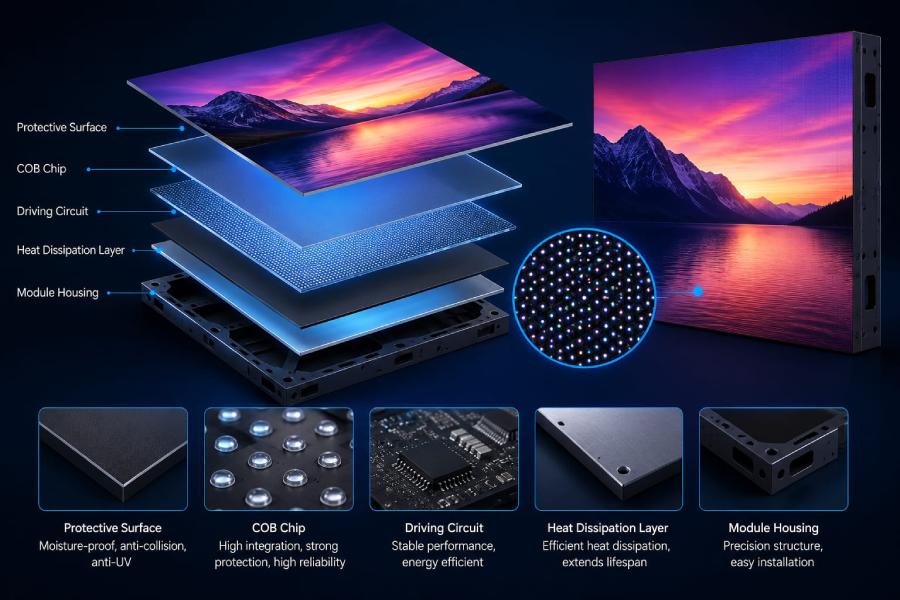
COB technology has become one of the most important packaging solutions for fine-pitch LED displays. It is increasingly popular in applications such as control rooms, conference rooms, broadcast studios, and premium commercial displays.
What Is COB LED Technology?
COB stands for Chip On Board, LED chips are directly mounted onto a circuit board instead of being packaged into individual LED lamps first.
In a traditional SMD LED display, RGB chips are first packaged into separate lamp beads with plastic brackets. These packaged LED lamps are then mounted onto the PCB through surface mounting technology.
COB technology eliminates this intermediate packaging process. The bare LED chips are directly attached to the PCB. After that, the entire pixel area is covered with protective black glue or epoxy resin.
It creates a continuous light-emitting surface without traditional lamp housings, plastic brackets, or exposed solder points.
The Core Structure Difference Between COB and SMD LED Displays
The biggest difference between COB and SMD lies in whether the LED chip package.
Traditional SMD LED Structure
SMD LED packaging usually includes two separate processes:
- First-level packaging
The RGB LED chips are mounted inside a plastic lamp bracket. The package is then filled with epoxy resin to create individual LED lamp beads.
- Second-level packaging
The finished LED lamp beads are soldered onto the PCB through SMT equipment and high-temperature reflow soldering.
It offers mature manufacturing processes and relatively low production costs.
However, the independent lamp package also creates some limitations. The plastic bracket increases the pixel size, affects heat dissipation, and may become a weak point under long-term operation.
COB LED Structure
COB removes the independent LED lamp package completely.The RGB bare chips are directly mounted onto copper pads on the PCB substrate. There is no plastic bracket, no external lamp housing, and no separate solder connection between the LED package and PCB.
After chip placement, the entire display surface is sealed with black protective material.
- A flatter and smoother display surface
- Better impact resistance
- Higher contrast ratio
- Improved moisture and dust protection
- Greater potential for ultra-fine pixel pitch products
Traditional COB vs Flip Chip COB: Two Different Connection Methods
Although COB technology uses direct chip mounting, the internal electrical connection method can be different.
- Traditional COB with wire bonding
- Flip chip COB without wire bonding
The difference between them mainly comes from how the LED chip connects with the PCB.
How Flip Chip COB Technology Works
Flip chip COB is considered a more advanced COB packaging solution because it completely removes the traditional gold wire connection.
Instead of placing the chip face-up, the LED chip is manufactured with both positive and negative electrodes on the bottom side. The chip is then flipped over and directly connected to the PCB through solder bumps or conductive micro-bumps.
The basic structure includes:
- The LED chip electrodes are manufactured on the bottom surface during wafer processing.
- The chip is flipped upside down and directly bonded to matching copper pads on the PCB.
- The chip and PCB form a large-area surface connection without any wire bonding process.
Key Advantages of Flip Chip COB Compared with Traditional COB
No Gold Wire Means Higher Reliability
The biggest advantage of flip chip COB is the elimination of gold bonding wires.
In traditional COB displays, gold wires are extremely thin and can become a potential failure point after years of thermal cycling, vibration, or continuous operation.
Flip chip COB removes this weak link completely.
The LED chip is directly connected to the PCB through solid-state bonding, which provides:
- Better resistance to vibration
- Higher stability during temperature changes
- Lower risk of connection failure
- Longer operating lifetime
Better Heat Dissipation Performance
Heat management is one of the most important factors affecting LED display lifetime.
In wire-bonding COB structures, heat mainly transfers through the backside of the chip. The gold wire can only provide electrical connection and contributes very little to thermal management.
Flip chip COB creates a much larger heat transfer area because the chip electrodes directly contact the copper PCB pads.
The shorter thermal path helps reduce chip junction temperature, which can:
- Reduce LED light decay
- Improve long-term brightness stability
- Increase product lifespan
- Support higher brightness applications
Lower Power Consumption with Better Electrical Performance
Because flip chip COB uses direct electrode contact, the electrical resistance is lower compared with traditional wire bonding.
The reduced voltage loss allows the LED system to operate more efficiently.
Combined with common cathode LED driving technology, flip chip COB displays can achieve lower energy consumption while maintaining excellent brightness performance.
Additional Technical Benefits of COB LED Displays
The removal of traditional LED lamp packages creates several advantages beyond packaging technology.
Mechanical Structure Advantages
A Completely Flat Display Surface
SMD LED displays contain thousands of independent lamp beads. Each lamp bead has a separate plastic housing, creating small physical gaps between pixels.
COB technology eliminates these individual packages.
The LED surface becomes a continuous flat panel, which provides:
- A smoother viewing experience
- Reduced visible pixel structure
- Less glare when viewed closely
- Better camera performance with fewer moiré patterns
Better Protection Against Dust, Moisture, and Impact
Since COB chips and circuits are covered by a complete protective layer, the display surface has stronger environmental resistance.
The encapsulated structure helps protect:
- LED chips
- Electrical connections
- PCB circuits
- Solder points
Compared with exposed SMD lamp beads, COB displays are less likely to suffer from lamp detachment caused by physical impact.
Many COB LED modules can achieve front protection levels such as IP65, making them more suitable for demanding commercial applications.
Optical Performance Advantages
Higher Contrast and Better Black Levels
Traditional SMD LED displays contain white plastic brackets and metal structures around each lamp bead.
When the screen is turned off, these components reflect surrounding light, reducing the perceived black level.
COB displays use black encapsulation material without exposed reflective structures.
As a result, they can achieve:
- Deeper black appearance
- Higher contrast ratio
- More vivid image quality
High-end COB LED displays can achieve contrast ratios above 10,000:1 depending on the design and environment.
COB Manufacturing and Maintenance Considerations
Although COB offers many advantages, its manufacturing requirements are also higher.
- Higher Production Difficulty
- COB production requires:
- High-precision die bonding equipment
- Clean manufacturing environments
- Accurate chip placement
- Advanced encapsulation technology
- Strict quality control
Compared with mature SMD production lines, COB manufacturing has a higher technical barrier. From SightLED 4K video wall cost list, we know COB LED displays usually have a higher initial cost.
Traditional COB vs Flip Chip COB Comparison
| Item | Traditional COB (Wire Bonding) | Flip Chip COB |
| Connection method | Gold wire bonding | Direct electrode bonding |
| Gold wire | Required | Completely eliminated |
| Heat dissipation | Backside heat transfer | Large-area direct thermal conduction |
| Reliability | Good but affected by wire aging | Higher stability and durability |
| Electrical efficiency | Standard | Lower resistance and better efficiency |
| Manufacturing cost | Lower | Higher |
| Technology level | Mature COB solution | Advanced premium solution |
| Best applications | Standard fine-pitch LED displays | Control rooms, studios, high-end video walls |
Conclusion:
Among COB solutions, flip chip COB provides even higher reliability.
For applications that require ultra-high resolution, long operating hours, and stable image quality, such as command centers, broadcast studios, and premium conference rooms, COB and especially flip chip COB will continue to play a major role in the future LED display market.
When selecting a COB LED display, buyers should not only focus on pixel pitch and price, you also know their internal packaging technology, production capability.