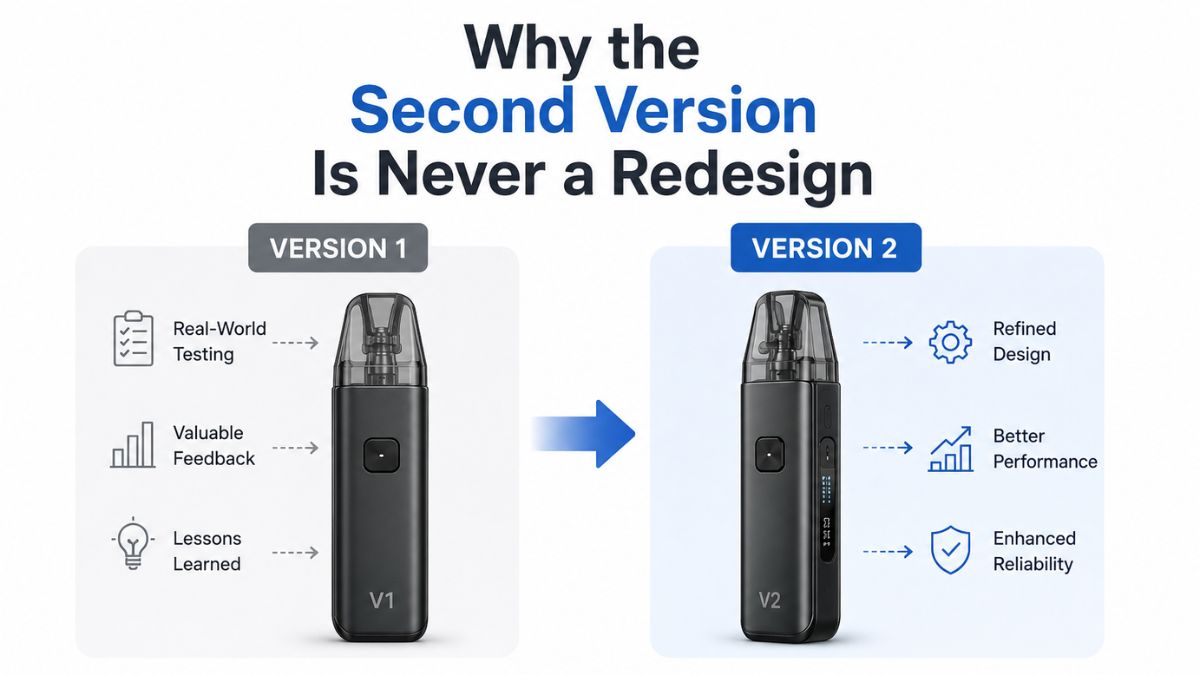
When a product ships a second generation, marked plainly with a “V2” or its equivalent, there is a common assumption about what happened behind the scenes: that engineers went back to a blank page, reconsidered the whole concept, and built something meaningfully new. This assumption is almost always wrong. What actually happens, in the overwhelming majority of mature product development processes, is far less dramatic and considerably more disciplined — a narrow, evidence-driven set of corrections applied to a design that, in its fundamentals, already worked. Understanding why this is true, and why the alternative is rarer than most people assume, says something useful about how real engineering progress tends to accumulate.
The Myth of Starting Over
There is a romantic version of product development in which each new generation represents a fresh creative act, unconstrained by what came before. This version makes for a better story than the reality, which is that a first version of any sufficiently complex product represents an enormous, hard-won accumulation of decisions — about tolerances, about materials, about the countless small trade-offs that only become visible once a design actually reaches production and real-world use.
Discarding all of that accumulated knowledge to start again from a blank page would mean re-deriving hundreds of decisions that the first version had already resolved, most of which had nothing wrong with them in the first place. The parts of a first version that worked correctly do not need to be reinvented. They need to be preserved, precisely so that engineering effort in the next generation can concentrate entirely on the smaller set of things that did not work as well as intended.
What a First Version Is Actually For
A first version of a product serves a purpose beyond simply being sold to its first customers. It functions as a large-scale, real-world data collection exercise — the only reliable way to discover which design assumptions held up under actual use and which did not. No amount of internal testing fully substitutes for the information generated by a product actually being used, repeatedly, by people the design team does not control and cannot fully anticipate.
This is precisely why a second version tends to look, superficially, so similar to the first. It is built on the same foundational architecture, because that architecture was validated by the first version’s deployment. What differs are the specific points where real-world data revealed a gap between intended and actual performance — a tolerance that needed tightening, an interface that needed adjusting, a failure mode that only appeared at scale. The second version exists to close those specific gaps, not to relitigate decisions that the evidence already confirmed were correct.
Why Real Redesigns Are Rare and Risky
A genuine ground-up redesign — one that discards the prior architecture entirely rather than iterating on it — does occasionally happen, but it is a much higher-risk undertaking than an incremental version update, and for good reason. A full redesign forfeits the validated knowledge embedded in the previous generation and reintroduces the exact uncertainty that iteration was specifically designed to avoid. Every assumption has to be re-tested. Every trade-off has to be re-derived. And critically, none of the real-world usage data that justified the previous architecture’s decisions is guaranteed to transfer cleanly to a fundamentally different design.
This is why full redesigns tend to be reserved for situations where the underlying architecture has been genuinely invalidated by new information — a change in requirements significant enough that no amount of incremental adjustment could address it, rather than an available option for teams simply eager for something new. Mature engineering organizations tend to treat “let’s just redesign it” with real skepticism, because it usually represents the more expensive and less informed path relative to disciplined iteration.
Where the Iteratively Refined Version Ends Up
A second-generation product that resulted from genuine iteration rather than a from-scratch redesign carries a specific kind of reliability that a redesigned product cannot yet claim, simply because it has not yet accumulated its own equivalent body of real-world validation. For a technically informed buyer, recognizing this distinction matters: a “V2” is not a marketing label indicating novelty. It is, done correctly, a signal that a design has already survived one full cycle of real-world scrutiny and been deliberately refined in response.
This is exactly the kind of product a discerning buyer looks for when browsing to shop online for something they intend to rely on rather than merely try — not the newest possible concept, but the version that has already been quietly corrected by the evidence the first one generated.