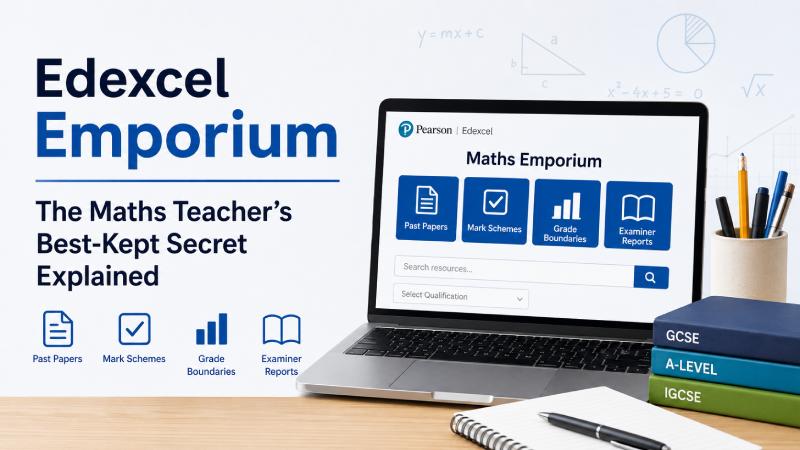
If you have spent any real time teaching mathematics in a UK school or an international centre running British qualifications, you have almost certainly heard someone mention the Edexcel Emporium in hushed, slightly reverent tones. It tends to come up in the staffroom when a colleague is hunting for a tricky past paper, or when a head of department wants to build a mock exam that actually mirrors the real thing. The funny part is that despite how widely it gets talked about, plenty of people still are not entirely sure what it is, who it is for, or how to get inside it. So let’s clear all of that up properly, with no jargon and no fluff, just a straight conversation about one of the most useful tools sitting quietly behind the scenes of maths education.
What Exactly Is the Edexcel Emporium?
The Edexcel Emporium, which most people simply call the Maths Emporium, is an official online library built and maintained by Pearson Edexcel, one of the largest awarding bodies in the United Kingdom. Think of it as a single, enormous, neatly organised vault that holds tens of thousands of mathematics resources tied directly to Edexcel’s specifications. Rather than scattering past papers and mark schemes across dozens of random websites of dubious reliability, Pearson decided to gather everything into one secure home where teachers can find exactly what they need without second-guessing whether it is accurate or up to date. It covers a sweep of qualifications too, stretching from GCSE and IGCSE through AS and A-Level, and even into Functional Skills, which means a single login opens the door to material spanning almost the entire age range a maths department might teach.
Why Pearson Built It in the First Place
Here is the thing about teaching maths: the prep work is relentless. Before a platform like this existed, teachers were cobbling together lessons and assessments from a patchwork of sources, some official and some not, some current and some hopelessly outdated. You would download a paper from one site, grab a mark scheme from another, and then spend an uncomfortable amount of time wondering whether the two actually matched the specification you were teaching. Pearson recognised this was a genuine problem and that inconsistent or stale resources can quietly chip away at student outcomes. The Emporium was the answer to that mess. By putting everything official under one roof and keeping it secure, Pearson gave teachers a dependable starting point, which in turn freed up the hours they used to lose just trying to find trustworthy material in the first place.
The Sheer Scale of What’s Inside
When people first hear that the Emporium contains over twenty thousand resources, it sounds like marketing exaggeration, but it really is that big. We are talking about historic exam papers going back years, full mark schemes, model answers that show precisely how marks get awarded, examiner reports that reveal where students consistently trip up, and the all-important grade boundaries that let teachers benchmark performance honestly. Beyond the raw exam material, you will also find teaching and learning aids like topic grids, ready-made PowerPoint presentations, skills-mapping documents, and training materials designed to sharpen your own delivery. There are even what some call shadow papers or practice papers built to replicate the real exam format closely, so students can rehearse under conditions that genuinely resemble the day itself. It is the kind of breadth that turns a frantic search into a calm browse.
Who Is Actually Allowed to Use It?
This is the part that surprises a lot of people, and it is worth being completely clear about. The Edexcel Emporium is a teacher-only resource. It was built for teachers, exam officers, and authorised staff working within registered schools and colleges, not for students to log into directly. That design choice is deliberate. Because the platform holds secure assessment materials and examiner-level insight, keeping it locked behind professional access protects the integrity of the qualifications themselves. Students absolutely benefit from it, but they do so indirectly, through the worksheets, mock papers, revision packs, and targeted practice that their teachers pull from the Emporium and pass along. So if you are a learner reading this hoping to register, the better move is to ask your maths teacher what they are already drawing on, because the odds are good that the Emporium is quietly powering a chunk of your revision material.
How to Get Access Step by Step
Gaining entry is straightforward, but it does follow a process, and that process exists to verify you are a genuine member of staff. To register, you will need a school or centre email address rather than a personal one like a free webmail account, the official name of your institution, and your centre’s five-digit Edexcel centre number. Once you submit those details, Pearson runs an approval check on the back end, which typically takes a couple of working days rather than happening instantly. After your account is approved, you receive your login credentials and land on a dashboard where you can search and browse the entire archive. It is a small bit of admin upfront in exchange for long-term access to a genuinely deep resource bank, so most teachers consider it time very well spent.
Navigating the Dashboard Without Getting Lost
A library is only as good as your ability to find things in it, and thankfully the Emporium is built with search and browsing in mind. Once you are inside, the dashboard lets you filter by qualification, by paper, by year, and by resource type, so you are not forced to scroll endlessly through an undifferentiated pile of files. If you teach Higher tier GCSE and want the November series from a specific year, you can drill down to exactly that rather than wading through irrelevant material. The first time you log in it can feel a little overwhelming simply because there is so much there, but the structure rewards a bit of patient exploration. Spend twenty minutes poking around and you will quickly develop a feel for where the things you reach for most often actually live, which saves real time during a busy term.
The Real Value of Examiner Reports
Of all the treasures inside the Emporium, examiner reports are arguably the most underrated. Most teachers grab the past papers and mark schemes first, which makes sense, but the examiner reports are where the genuine gold sits. These documents are written by the people who actually marked the exams, and they explain in plain terms where candidates went wrong, which questions caused the most trouble, and what separated the strong answers from the weak ones. Reading them is a bit like getting feedback from someone who has marked thousands of scripts and noticed every recurring pattern of error. If you weave that insight into your teaching, you can pre-empt the exact mistakes your own students are likely to make, which is a far smarter strategy than simply drilling more questions and hoping the message lands.
How It Sharpens Exam Preparation
When you combine authentic past papers, precise mark schemes, examiner insight, and accurate grade boundaries, you end up with something powerful: the ability to prepare students against the real standard rather than a guessed one. Teachers can set internal mocks that mirror the actual exam in difficulty and structure, then mark them using the genuine mark scheme so students get realistic feedback rather than a generous or harsh approximation. Grade boundaries let you tell a student honestly where they currently stand, which is far more motivating and useful than vague encouragement. And because the “Aiming For” style practice papers exist, you can target specific grade thresholds, giving a borderline student the focused practice they need to push from one grade into the next. It turns exam prep from guesswork into something measured and deliberate.
Why Authenticity Matters So Much
It is tempting to think a past paper is a past paper no matter where you download it, but anyone who has been burned by a mislabelled file or a mark scheme that does not match knows otherwise. The single biggest advantage of the Emporium is that everything inside it is either created or formally sanctioned by Pearson Edexcel. That stamp of authenticity matters enormously, because in exam preparation the accuracy and specification-alignment of your materials can quite literally shape student outcomes. When you pull a resource from the Emporium, you are not crossing your fingers and hoping it is the right version. You know it reflects the current specification and the genuine assessment standard. That confidence lets you focus your energy on teaching rather than on quality-controlling the documents you are teaching from.
The Emporium Beyond the UK
Although the platform was designed with the UK market in mind, Edexcel qualifications are taught in international schools right across the globe, which means the Emporium quietly serves a worldwide audience. A maths teacher in Dubai, Lagos, Kuala Lumpur, or Karachi delivering Edexcel IGCSE or A-Level can register with their centre details and access the very same authentic resources as a colleague in London. This global reach does something rather valuable: it keeps standards aligned across borders. A student sitting an Edexcel paper in one country is being prepared against the same benchmark as a student elsewhere, because their teachers are drawing from a shared, official well of material. For international centres that can sometimes feel cut off from the latest updates, that connection to the source is genuinely reassuring.
A Few Honest Limitations to Keep in Mind
No tool is perfect, and it is only fair to mention where the Emporium has edges. First, it is not a learning platform in the way a student-facing revision site is; it supports exam practice and teaching, but it does not teach concepts or hold a student’s hand through a topic. That work still belongs to the teacher and the classroom. Second, the teacher-only access model, while sensible for security, does mean students cannot dip in independently, so the resources only reach them through whatever their teacher chooses to share. And finally, the sheer volume can be a double-edged sword, because a brand-new user occasionally feels buried under options before they learn the layout. None of these are dealbreakers, but they are worth understanding so your expectations are realistic from day one.
Getting the Most Out of It as a Teacher
If you want to squeeze real value from the Emporium rather than just occasionally grabbing a paper, treat it as a long-term partner rather than an emergency drawer you only open the night before a mock. Build a habit of reading the relevant examiner report whenever a new series is released, because that running stream of insight compounds over the years. Use the topic grids and skills-mapping documents to plan your schemes of work so your teaching maps cleanly onto what the exam actually assesses. Curate a personal folder of the resources you return to most, so your most-used materials are always within reach. And do not forget the training and teaching aids, which can quietly improve your own delivery in ways that benefit every cohort you teach after that. Used this way, it stops being a file dump and becomes a genuine professional development resource.
FAQs
Is the Edexcel Emporium free to use?
Yes, the Edexcel Emporium is completely free for eligible users. There is no subscription or charge involved, but access is limited to teachers and exam officers from registered schools and colleges rather than the general public.
Can students access the Edexcel Emporium directly?
No, students cannot log in on their own. It is a teacher-only platform, so learners benefit indirectly through the mock papers, worksheets, and revision materials their teachers download and share with them.
What qualifications does the Edexcel Emporium cover?
It covers a broad range of Edexcel mathematics qualifications, including GCSE, IGCSE, AS Level, A-Level, and Functional Skills, with resources spanning multiple specification years and exam series.
How long does Edexcel Emporium registration take?
After you submit your centre email, institution name, and five-digit Edexcel centre number, Pearson runs an approval check that usually takes a couple of working days before your login credentials are issued.
What kind of resources are inside the Edexcel Emporium?
You will find past papers, mark schemes, examiner reports, grade boundaries, model answers, topic grids, training presentations, and “Aiming For” practice papers, all officially created or sanctioned by Pearson Edexcel.
Conclusion
The Edexcel Emporium is one of those tools that does its most important work out of the spotlight. It will never trend on social media or generate flashy headlines, yet it underpins an enormous amount of solid, standard-aligned maths teaching across the UK and well beyond it. By gathering more than twenty thousand authentic resources into one secure, teacher-focused home, Pearson solved a problem that used to cost educators countless hours and a fair amount of stress, replacing scattered uncertainty with a single dependable source of truth. For teachers and exam officers, registering is a small piece of admin that pays back over and over, and for students, the benefits flow through in the form of better mocks, sharper feedback, and revision material that genuinely reflects the real exam. If you teach Edexcel mathematics and you are not yet using it, the honest takeaway is simple: get your centre details together, register, and give yourself the same edge that so many departments have quietly relied on for years.