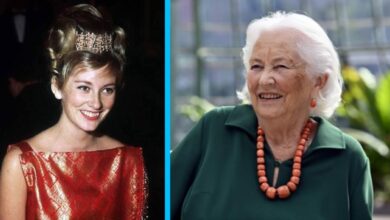
If you grew up watching British films in the late 1960s and early 1970s, chances are you’ve seen Adrienne Posta light up the screen without ever knowing her name. She was the cheeky girl-next-door with the quick mouth and the knowing grin, the kind of performer who could steal a scene with a single look. And while plenty of stars from that era have been written about endlessly, Posta has slipped into a strange sort of half-memory — instantly recognizable, yet curiously under-celebrated. This article takes a proper look at her life, her career, and the people who mattered most to her, including her marriages to rock vocalist Graham Bonnet and, later, to Stephen Davis.
Who Exactly Is Adrienne Posta?
Adrienne Posta was born Adrienne Luanne Poster in Hampstead, London, in March 1949, though you’ll find sources squabbling over whether it was the 1st, the 4th, or the 24th of the month. That kind of inconsistency tells you something about how she operated: she was famous enough to be everywhere, yet private enough that the basic facts got a little fuzzy around the edges. What’s not in dispute is that she was a child of postwar London, raised in a city that was about to reinvent itself entirely. Her father worked as a furniture manufacturer, a solidly middle-class trade, and there was nothing in her background that obviously pointed toward stardom — except for the fact that, almost from the moment she could walk, she clearly wanted to perform.
Early Years and the Italia Conti Connection
Like a great many British performers of her generation, Posta was shaped by the Italia Conti Academy of Theatre Arts, one of the oldest and most respected stage schools in the country. She enrolled young and trained in the disciplines that defined a working stage performer of the period: acting, singing, dancing, and the general all-around stagecraft that let you slot into pantomime one month and a serious television play the next. By her own account she started acting at around twelve, and the pace at which she worked was frankly extraordinary. By early 1966, before she had even turned eighteen, she had reportedly appeared in well over a hundred television plays and cut several records. That’s not the résumé of a hobbyist. It’s the résumé of a young professional who treated performing as a job, and a serious one at that.
From Adrienne Poster to Adrienne Posta
Here’s a detail that trips people up: she didn’t always go by Posta. She was born Poster, and she recorded her early music under that name before adopting the surname Posta in 1966. The change was a deliberate piece of career management. As her acting began to take off, she wanted a clean line between her early identity as a teen pop singer and the actress she was becoming. It’s the sort of small, savvy move that suggests someone thinking carefully about how they wanted to be seen — a reinvention in miniature, perfectly suited to an era that was busy reinventing everything else.
The Pop Singer Before the Actress
Before the films, there was the music, and this is the part of her story that tends to surprise people. Posta started out as a pop singer, and not a minor one either. Her debut single, “Only Fifteen,” arrived in 1963 and leaned hard into her youthful image. More remarkably, she was taken under the wing of Andrew Loog Oldham, the legendary manager and producer behind the Rolling Stones and a whole roster of young British talent. Oldham persuaded Mick Jagger and Keith Richards to hand her a song they had written, “Shang-A-Doo-Lang,” which became her follow-up single in 1964. Think about that for a second: a teenage girl from Hampstead getting an original Jagger-Richards composition handed to her at the height of the British beat boom. She also released records like “The Winds That Blow” on Decca and dabbled in the soul-inflected sound that defined so many British female singers of the time. The pop career never quite turned her into a chart-topping name, but it placed her right at the beating heart of London’s musical moment.
Becoming a Face of the Swinging Sixties
When Posta moved into film, she did it with impeccable timing. The British cinema of the late 1960s was obsessed with youth, with the energy of the streets, and with the rapid social changes happening in London — and she fit that mood perfectly. Her breakthrough came as Moira Johns in the 1967 classic To Sir, with Love, the schoolroom drama starring Sidney Poitier that has since become a genuine cultural touchstone. She followed it with Here We Go Round the Mulberry Bush and Up the Junction, both in 1968, films that captured the restless spirit and shifting morals of young Londoners with a frankness that felt fresh at the time. In these roles she wasn’t the glamorous lead so much as the vivid, lived-in supporting presence — the friend, the girl from the neighborhood, the character who felt like someone you might actually know. That authenticity is exactly why she worked so well on screen.
The Comedy Years and the Carry On Crowd
As the 1960s rolled into the 1970s, Posta settled comfortably into British comedy, which suited her cheeky, fast-talking persona down to the ground. She turned up in a string of films that are practically a shorthand for a certain kind of broad, unpretentious British humor: Spring and Port Wine (1970), Percy, Up Pompeii! (1971), and The Alf Garnett Saga (1972), where she took over the role originally played by Una Stubbs in Till Death Us Do Part. Then came the inevitable Carry On appearance — Carry On Behind in 1975 — in a part reportedly written with series regular Barbara Windsor in mind. She also popped up in the cheerfully low-brow “Adventures of…” comedies of the mid-1970s. This was bread-and-butter work for a British screen performer of the period, and Posta did it with a professionalism and a sense of timing that kept her in steady demand even as the films themselves rarely aspired to high art.
Television, Pantomime, and the Live Stage
Posta’s television work ran in parallel with her film career and arguably reached even more living rooms. One of her most memorable small-screen moments came in the very first episode of Budgie in 1971, where she appeared as a stripper opposite Adam Faith — a role that showed she wasn’t precious about playing characters with a bit of grit. In 1973 she featured throughout the BBC series It’s Lulu, singing, dancing, and acting alongside her friend Lulu and the comedian Roger Kitter, which let her show off the full range of skills Italia Conti had drilled into her years earlier. She also embraced the great British tradition of pantomime, playing Maid Marion in Babes in the Wood at the London Palladium over the 1972–73 season, sharing the stage with Edward Woodward as Robin Hood. The variety of it all is striking. She moved between gritty social drama, broad comedy, light entertainment, and family panto without ever seeming out of place in any of them.
Graham Bonnet and a Rock-and-Roll Marriage
Posta’s personal life intersected with the music world in a big way through her first marriage. In 1974 she married Graham Bonnet, the powerhouse vocalist best known as one half of the pop duo The Marbles and, later, as the frontman of hard rock outfits Rainbow and Alcatrazz. It was one of the more colorful couplings in British entertainment of the era — a respected screen actress paired with a rock singer whose own career would take some wild and unexpected turns. There’s even a charming bit of folklore attached to them: the couple is said to have owned the famous Old English Sheepdog used in the iconic Dulux paint television commercials of the 1970s. The marriage didn’t last, ending in divorce, but it remains a fascinating footnote that links Posta directly to the heavier end of British rock. When people mention Stephen Davis, Graham Bonnet often comes up in the same breath, simply because these two men bracket the two great chapters of her romantic life.
Adrienne Posta and Stephen Davis
If Graham Bonnet represents the loud, rock-and-roll phase of Posta’s life, Stephen Davis represents the steadier chapter that followed. Posta married Stephen Davis in 1983, and this union appears to have been the more durable and private of the two. Unlike her first marriage, which played out partly in the glare of the rock press, her life with Davis unfolded well away from the spotlight, in keeping with a woman who increasingly seemed to value privacy over publicity. It’s worth being honest about the limits of the public record here: while her marriage to Bonnet was widely documented because of his fame, far less has been written about Stephen Davis himself, and Posta has never been one to put her domestic life on display. That reticence is itself revealing. By the time she married Davis, Posta had largely stepped back from the relentless pace of her earlier career, and the marriage coincided with a gentler, more grounded period of her life. The pairing of Stephen Davis and Graham Bonnet in any account of Posta’s life isn’t about gossip — it’s about understanding the two very different worlds she moved between, and the way her priorities shifted from the dazzle of celebrity toward something quieter and more lasting.
The Voice Behind the Cartoons
Here’s where Posta’s story takes a genuinely lovely turn. From the 1990s onward, she reinvented herself yet again, this time as a voice artist in children’s animation — and an entire generation of kids grew up hearing her without ever seeing her face. She lent her voice to multiple characters in the CBBC series 64 Zoo Lane, including Georgina the Giraffe and Doris the Duck, contributing to well over a hundred episodes. She also voiced Grandma Mouseling and other characters in the popular series Angelina Ballerina, bringing warmth and a twinkle to the ballet-loving mouse world that defined the show. She even turned up as a flight announcer in the Red Dwarf episode “Ouroboros” in 1997. There’s something rather wonderful about a performer who started as a teen pop singer in the Andrew Loog Oldham stable ending up as the comforting grandmotherly voice in a children’s cartoon decades later. It speaks to a long, adaptable career that kept finding new rooms to walk into.
Life as a Teacher and Patron
In her later years, Posta moved from being a performer to being a teacher, which is arguably the most meaningful chapter of all. She has worked with students in the Midlands and at the Italia Conti Academy on Goswell Road in London — the very institution that trained her all those years ago. There’s a satisfying circularity to that, the former student returning to shape the next generation, passing on the hard-won practical wisdom of someone who actually spent decades at the working coalface of British entertainment. She is also an honorary patron of the Music Hall Guild of Great Britain and America, an organization devoted to preserving the rich heritage of British music hall and variety. These roles paint a picture of a woman still deeply invested in the performing arts, but now from behind the scenes, as a custodian of the craft rather than a face in front of the camera.
Why Adrienne Posta Deserves to Be Remembered
It’s easy to file Posta away as a minor figure, a familiar face from a stack of old comedies, but that does her a real disservice. Her career spanned more than half a century and crossed nearly every form of British entertainment there is: pop music, serious cinema, broad comedy, television variety, pantomime, voice acting, and teaching. She worked with everyone from Sidney Poitier to Mick Jagger to Lulu, and she did it with a consistency and professionalism that’s frankly rare. She never became a household name in the way some of her contemporaries did, but she was the connective tissue of a whole era — the reliable, vivid presence who turned up in everything and elevated it just by being there. In an industry that chews up young performers and spits them out, Posta built something durable, reinvented herself repeatedly, and came out the other side as a respected teacher and custodian of the arts.
FAQs
Who is Adrienne Posta?
Adrienne Posta is an English actress and singer, born in Hampstead in 1949, who became a familiar face of Swinging Sixties cinema in films like To Sir, with Love before later moving into children’s voice acting and teaching.
Who was Adrienne Posta married to?
She married twice: first to rock vocalist Graham Bonnet of Rainbow and Alcatrazz fame in 1974, and later to Stephen Davis in 1983. Her marriage to Davis was the quieter and more private of the two.
What films is Adrienne Posta best known for?
She is best remembered for To Sir, with Love (1967), Here We Go Round the Mulberry Bush (1968), Up the Junction (1968), Up Pompeii! (1971), and Carry On Behind (1975).
Did Adrienne Posta have a music career?
Yes. Before acting took over, she was a teen pop singer who released “Only Fifteen” in 1963 and recorded a Jagger-Richards song, “Shang-A-Doo-Lang,” under producer Andrew Loog Oldham.
What does Adrienne Posta do now?
She is largely semi-retired and works as a performing-arts teacher in the Midlands and at the Italia Conti Academy, and serves as an honorary patron of the Music Hall Guild of Great Britain and America.
Conclusion
Adrienne Posta’s story is, in the end, a story about reinvention and staying power. From a furniture-maker’s daughter in Hampstead to a teen pop singer handed songs by the Rolling Stones, from a face of Swinging Sixties cinema to a beloved cartoon voice, and finally to a teacher passing the torch at the same academy that launched her, she has lived several careers in one lifetime. Her marriages — first to rock vocalist Graham Bonnet and later to Stephen Davis — bookend a personal life that moved from the noise of celebrity toward the calm of privacy, and the pairing of Stephen Davis and Graham Bonnet in any telling of her life captures that shift perfectly. She may be one of Britain’s most underrated entertainers, but anyone who takes the time to trace her remarkable path will come away with a real appreciation for a performer who simply never stopped finding new ways to keep going. Adrienne Posta earned her place in the story of British entertainment, and it’s well past time more people knew her name.