Simon McBurney: The Stage Genius Who Also Conquered Screen — and Built a Life with Cassie Yukawa

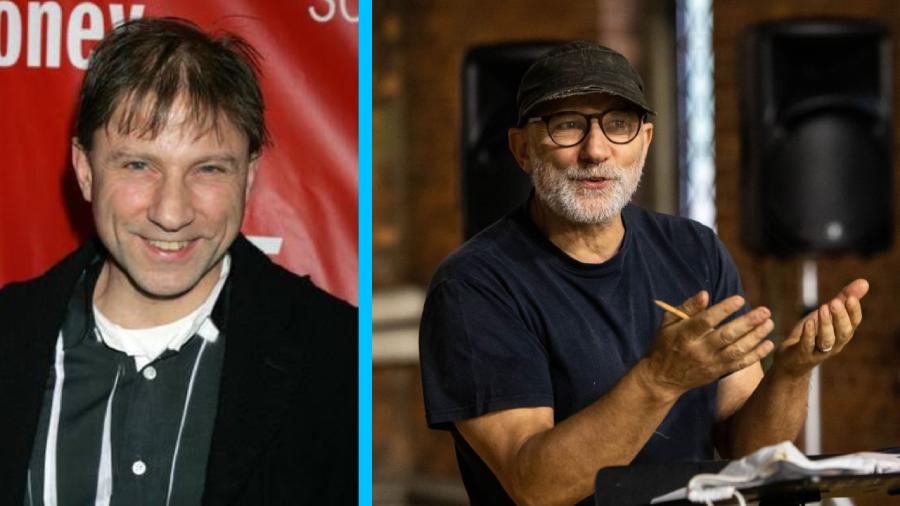
Simon McBurney is one of those rare artists who makes everything he touches feel genuinely alive. Whether he’s commanding a stage with nothing but his body and voice, directing a sweeping theatrical production that bends every rule of what theatre can be, or slipping into a scene in a Hollywood blockbuster and quietly stealing it — McBurney brings something that’s hard to name but impossible to ignore. He’s been at this for over four decades, and somehow, the work keeps getting more interesting.
Early Life: Cambridge, Grief, and a One-Way Ticket to Paris
Simon Montagu McBurney was born on 25 August 1957 in Cambridge, England, into an intellectually rich household. His father, Charles McBurney, was an American archaeologist and academic — the kind of man who spent his life digging up history. His older brother, Gerard McBurney, went on to become a respected composer and writer, which tells you a great deal about the environment the two brothers grew up in. Creative thinking wasn’t an extracurricular activity in the McBurney home — it was simply part of the air.
Simon attended Marlborough College before heading to Peterhouse, Cambridge, where he studied English literature. But it wasn’t the lecture halls that shaped him most during those years — it was the Footlights Theatre Club, where his natural instincts for physical, wordless performance started to take real form. He was developing a style rooted less in language and more in the body, in space, in presence.
Then came grief. His father’s death shook him deeply, and instead of continuing on a conventional academic or performance path in England, McBurney made a decision that changed everything. He left for Paris, enrolled at the Jacques Lecoq mime school, and began training under Philippe Gaulier. It was a pivotal move — one that gave him not just technical skills in physical theatre, but an entirely new philosophy about what performance could mean. He wanted to make, in his own words, “theatre that I can see.” Lecoq gave him the tools to do exactly that.
Founding Complicité: Building a Theatre Company That Actually Changed Things
In 1983, Simon McBurney co-founded what would become one of the most celebrated theatre companies in the world: Complicité (originally called Théâtre de Complicité). He started it in Paris alongside a small group of collaborators, and the early days were genuinely scrappy. There’s a story McBurney has told about how he and a collaborator once sat on a stage in lawn chairs just to test what would happen — and somehow had an audience in stitches for over an hour. That instinct, that deep trust in the raw power of presence, became the philosophical backbone of everything Complicité would go on to create.
The company moved to England and spent years building a reputation for work that was visually daring, physically inventive, and deeply intelligent. What set Complicité apart wasn’t just its aesthetic style — it was the unwavering commitment to process. Every production was built through deep research and intensive collaboration. The ensemble wasn’t just performing a script; they were discovering the work together.
It wasn’t until the company was given a proper space at the Almeida Theatre in 1989 that things truly began to cohere. Productions like Street of Crocodiles (1992), adapted from the life and stories of Bruno Schulz, showed the world what Complicité was capable of. The approach was groundbreaking — actors manipulated everyday props to conjure entire surreal worlds, with no elaborate sets required. The physical and the theatrical merged in a way that audiences had rarely witnessed before.
By 1997, McBurney had directed The Caucasian Chalk Circle at the National Theatre and won a Laurence Olivier Award for it. That same year, Complicité received the Europe Prize Theatrical Realities — an international recognition that the company wasn’t just doing interesting work in Britain; it was reshaping what European theatre could look like.
The Plays That Defined a Career
If you want to understand Simon McBurney’s contribution to theatre, you have to look at the productions that have stayed with audiences long after the curtain came down.
Mnemonic (1999) is arguably the clearest example of McBurney’s obsessions made theatrical. Conceived and directed by him, the play moves across personal memory, the discovery of Ötzi the Iceman, and urgent questions of migration and belonging. It’s non-linear, emotionally demanding, and structurally bold. The fact that it returned to the National Theatre in 2024 — a full 25 years after its premiere — to widespread critical acclaim tells you everything about how far ahead of its time it was.
Then there’s The Encounter (2015), perhaps McBurney’s most audacious solo work. It tells the story of a National Geographic photographer who becomes lost in the Amazon rainforest. McBurney performed it entirely alone, using binaural sound technology to create an immersive experience that genuinely disoriented audiences. The New York Times called it “one of the most fully-immersive theatre pieces ever created.” It premiered at the Edinburgh Festival Fringe, transferred to the West End, and then landed on Broadway — a journey that reflected just how universally the work connected.
A Disappearing Number (2007), which explored the remarkable mathematical collaboration between Ramanujan and Hardy, won four Olivier Awards and further cemented Complicité’s reputation for making intellectually rigorous work feel genuinely theatrical and moving. His 2018 staging of The Master and Margarita at the National Theatre — based on Bulgakov’s hallucinatory novel — earned praise for its inventive use of technology and staging that made the impossible feel visceral.
More recently, Figures in Extinction, a cross-continental collaboration with choreographer Crystal Pite for Nederlands Dans Theater, marked McBurney’s first foray into creating a work exclusively for a dance company. It sold out across Europe after its premiere at Aviva Studios in Manchester — yet another reminder that McBurney never stops pushing into new territory.
Simon McBurney on Screen: From The Vicar of Dibley to Mission: Impossible
Stage work is where McBurney’s heart lives, but his screen career is no footnote. Over the decades, he has built an impressive and genuinely eclectic filmography — the kind that tells you he takes roles based on creative interest rather than commercial formula.
Many British audiences first became familiar with his face through his long-running role as Cecil the choirmaster in The Vicar of Dibley on BBC (1994–2004). It was a recurring comedy role that earned him warmth and recognisability with a broad mainstream audience.
His film work spans a remarkable range. He played Dr. Atticus Noyle in The Manchurian Candidate (2004), British diplomat Nigel Stone in The Last King of Scotland (2006), Fra Pavel in The Golden Compass (2007), Charles James Fox in The Duchess (2008), and Oliver Lacon in the quietly precise Tinker Tailor Soldier Spy (2011). He voiced the house-elf Kreacher in Harry Potter and the Deathly Hallows – Part 1 (2010), stepping into a role previously voiced by Timothy Bateson. His appearance in The Theory of Everything (2014), playing Oliver Sacks, contributed to the film’s Screen Actors Guild Award nomination for Outstanding Cast. He appeared as Director Atlee in Mission: Impossible – Rogue Nation (2015), and most recently turned up in Robert Eggers’ Nosferatu (2024) — proof that he continues to attract serious, ambitious projects.
He also wrote the story for Mr. Bean’s Holiday and served as executive producer, which is a pleasingly unexpected credential for someone with such highbrow theatrical ambitions.
Opera, Radio, and the Refusal to Stay in One Lane
Opera is a dimension of McBurney’s creative life that often gets overshadowed by his theatre work — and it shouldn’t. He has directed several major operatic productions, including A Dog’s Heart (2010), The Magic Flute (2012), The Rake’s Progress (2017), Wozzeck (2020), and most recently Khovanshchina (2025). These are not vanity projects — the opera world takes them seriously, and they have received critical attention as genuinely significant productions in their own right.
He also adapted Susan Cooper’s The Dark is Rising into a 12-part radio dramatisation for BBC World Service in 2022, alongside author Robert MacFarlane — bringing a beloved and complex piece of storytelling into a medium that demands its own particular kind of intimacy. In 2024, he directed Anne Carson’s one-act radio play I Don’t Do Innocents for The Paris Review, adding yet another layer to a body of work that simply refuses to be categorised.
His approach to all of this work comes from the same core belief: that form and content are inseparable, that how you tell a story matters as much as what you are saying, and that audiences deserve to be challenged, moved, and surprised in equal measure.
The Man Behind the Work: Life with Cassie Yukawa and Family
Simon McBurney is married to Cassie Yukawa, and together they have three children. Cassie Yukawa has been a meaningful presence not only in his personal life but in his wider creative and ethical world. It was Cassie who, in 2016, introduced McBurney to Polly Higgins and the Stop Ecocide campaign — a legal and environmental movement that seeks to have ecocide recognised as an international crime. That introduction left a lasting impact on McBurney, and it reflects how profoundly his relationship with Cassie Yukawa has shaped not just his home life but his engagement with global issues.
McBurney is also an Ambassador for Survival International, the global movement for the rights of tribal peoples. His work on The Encounter — which centres on the Amazon rainforest and indigenous communities — shows how deeply these political and ethical concerns are woven into his creative vision. For McBurney, art and activism are not separate pursuits. They come from the same impulse: a need to pay close attention to the world and to tell the truth about what you find there.
His brother Gerard McBurney, the composer and writer, has remained a steady presence in his life across the decades. Both brothers grew up shaped by the same intellectually restless household, and both have gone on to make significant contributions to British cultural life — Gerard through music and writing, Simon through theatre, film, and opera.
Awards, Honours, and Recognition
The formal recognitions have come steadily throughout McBurney’s career, and they span an unusually wide range of disciplines and geographies — which is itself a reflection of how broad his creative reach has been.
In 1997, Complicité received the Europe Prize Theatrical Realities. In 1998, McBurney won the Laurence Olivier Award for Best Choreography for The Caucasian Chalk Circle. In 1999, he received the Critics’ Circle Theatre Award for Best New Play for Mnemonic. In 2005, he was appointed Officer of the Order of the British Empire (OBE) by Queen Elizabeth II for services to drama. In 2008, he received the Berlin Konrad Woolf Prize for Europe’s Outstanding Multi-Disciplinary Artists. In 2009, he was awarded the Yomiuri Prize in Japan — one of the most respected cultural honours in East Asia. He served as Artiste Associé at the 2012 Avignon Festival, and he holds honorary doctorates from several universities, including Cambridge, London Metropolitan University, and Lund University in Sweden.
Taken together, these aren’t just accolades — they are a map of a career that has genuinely mattered across cultures, disciplines, and decades.
FAQs
Who is Simon McBurney?
Simon McBurney is a British actor, playwright, and theatre director, best known as the co-founder of the internationally acclaimed theatre company Complicité. He is also a prominent film and television actor with roles ranging from Tinker Tailor Soldier Spy to Nosferatu.
Who is Cassie Yukawa?
Cassie Yukawa is Simon McBurney’s wife, with whom he has three children. She played a key role in introducing him to the Stop Ecocide campaign in 2016, which has since become a significant cause in his public life.
Who is Gerard McBurney?
Gerard McBurney is Simon McBurney’s older brother and a respected British composer and writer. The two brothers grew up together in Cambridge in a creatively rich household that clearly shaped both of their careers.
What is Complicité?
Complicité is a London-based theatre company co-founded by Simon McBurney in 1983, known for its highly visual, physically inventive, and intellectually rigorous productions. It is widely regarded as one of the most important and innovative theatre companies in the world.
What is Simon McBurney’s most famous solo performance?
The Encounter (2015) is widely regarded as his most celebrated solo work — an immersive one-man show about a photographer lost in the Amazon rainforest, which used binaural sound technology and transferred from Edinburgh to the West End and Broadway.
Conclusion
Simon McBurney has spent more than four decades building one of the most genuinely remarkable careers in contemporary performance. He has never been content to repeat himself, never satisfied with comfort or convention, and never lost the curiosity that took him from Cambridge to a Paris mime school and eventually to stages and screens across the world. With Cassie Yukawa by his side, with Gerard McBurney as part of his wider creative family, and with Complicité continuing to push boundaries under his artistic leadership, McBurney shows no signs of slowing down. If anything, the work feels more urgent and more alive than ever — and that, in itself, is a remarkable thing.