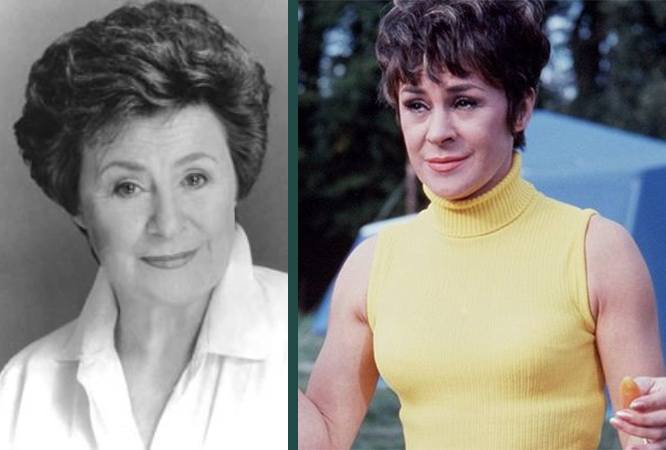
If you have ever sat through a rainy afternoon of classic British comedy, chances are you have seen Dilys Laye light up a scene without ever stealing the spotlight in an obvious way. She was the kind of performer other actors quietly admired, the one who could make a tiny supporting part feel like the whole point of the film. For more than five decades she moved between Broadway musicals, West End comedies, Shakespeare, Brecht, and a handful of beloved British romps, never once settling into a single comfortable groove. This is the story of an actress who built one of the most varied careers in British entertainment, almost entirely on her own terms.
A Childhood Shaped by Absence and Ambition
Dilys Laye was born Dilys Lay on 11 March 1934 in the Muswell Hill area of London, and her early years were anything but glamorous. Her father, Edward Laye, was a working musician, and her mother was Margaret Hewitt before marriage. The family unit did not hold together for long. When Dilys was only eight years old, her father left to pursue musical work in South Africa and simply never returned, a wound that hung over much of her childhood. Things grew harder still during the Second World War, when she and her brother were evacuated to Devon, where they were deeply unhappy and suffered physical abuse. When she eventually came home, it was to a new stepfather and a mother whose own theatrical ambitions had gone unfulfilled. Margaret Hewitt, it seems, was determined that her daughter would have the stage career she herself had never managed, and she pushed Dilys toward performance from an early age. It is one of those bittersweet origin stories, where a difficult home life and a parent’s redirected dreams combine to launch a child into a world she would eventually conquer on her own.
From the Aida Foster School to Her First Bow
Like many British performers of her generation, Laye received her formal grounding at a specialist stage school, in her case the famous Aida Foster School, after an education at St Dominic’s in Harrow. The training paid off quickly. She made her stage debut as a teenager at the New Lindsey Theatre Club in Notting Hill in 1948, and tellingly her first role was a boy, Moritz Scharf, in Noel Langley’s drama “The Burning Bush.” That same Christmas season she popped up in pantomime, playing a young nephew in “Babes in the Wood.” The pattern of her career was already visible: she was versatile, unfussy about the size or gender of a role, and happy to throw herself into anything that gave her something to play. Her screen debut followed in 1949, when she appeared in the film “Trottie True,” playing the title character, originated by Jean Kent, as a young girl. By the time she reached her late teens, Dilys had already accumulated the kind of broad experience, drama, pantomime, revue, film, and early television, that many actors take a decade to gather.
Broadway, Julie Andrews, and the Extra Letter
The mid 1950s brought the adventure that changed everything. In September 1954 she made her Broadway debut as Dulcie in the musical “The Boy Friend,” sharing the stage, and for much of the run a Manhattan flat, with a young Julie Andrews. Andrews later wrote warmly about her friend, praising the husky voice and the instinctive comic timing that Laye brought to Dulcie. New York was a whirl of late nights and unlikely encounters; Laye recalled stars like Cary Grant and Danny Kaye drifting backstage to pay their respects, and she remembered the whole experience as faintly unreal. It was also during this period that she briefly dated a then unknown actor billed as James Baumgarner, who would soon shorten his name to James Garner and become a Hollywood fixture. There was one other lasting change from this American chapter. The Broadway run marked the final time she performed as Dilys Lay; on returning to Britain she added an “e” to her surname and was billed as Dilys Laye for the rest of her life. A small adjustment, but one that gave her the name history would remember.
The Carry On Years and the British Comedy Boom
For a great many film fans, Laye will forever be associated with the “Carry On” franchise, that gloriously cheeky institution of British cinema. She appeared in four of the films, and her entry into the series is a brilliant piece of showbusiness lore. In 1962 she was drafted into “Carry On Cruising” at just three days’ notice to replace an unwell Joan Sims, playing Flo Castle, and she more than rose to the occasion. She returned as Lila in “Carry On Spying” (1964), as Mavis Winkle in “Carry On Doctor” (1967), and as Anthea Meeks in “Carry On Camping” (1969). What set her apart in these films was her ability to make even broad farce feel grounded and specific, finding real character beats inside the slapstick. Around the same stretch she was busy elsewhere too, turning up in earlier comedies such as “Blue Murder at St Trinian’s” and “Doctor at Large,” both from 1957, and even sharing a scene with Marlon Brando in Charlie Chaplin’s “A Countess from Hong Kong” in 1967. On television she co-starred with her friend Sheila Hancock in the sitcom “The Bed-Sit Girl.” It was a period of constant, varied work, and it cemented her as a recognisable face of British popular entertainment.
A Serious Theatrical Range Few Expected
Here is where Laye’s story gets genuinely interesting, because she refused to be boxed in as a comedy specialist. From the late 1960s onward she steered her career toward weightier material, and she did it with real conviction. In 1968 she took on Mrs Shin in Bertolt Brecht’s “The Good Woman of Setzuan” at the Oxford Playhouse, once again sharing the stage with Sheila Hancock. The 1970s brought a long and creatively rich partnership with the playwright Peter Barnes, beginning with a BBC radio adaptation in 1973 and blossoming into years of stage and broadcast collaborations. Through Barnes she joined the Royal Shakespeare Company, making her RSC debut in his historical drama “The Bewitched.” Their shared work ranged across centuries and styles, taking in adaptations of Thomas Otway, Frank Wedekind, Georges Feydeau, and Thomas Middleton. This was not an actress coasting on charm; it was a performer hungry to test herself against difficult, intelligent writing. The Barnes relationship in particular gave her some of the meatiest roles of her career and proved that the woman from the “Carry On” films had a great deal more in her toolkit.
Shakespeare, Sondheim, and a Late Career Renaissance
Rather than winding down as she aged, Laye seemed to gather momentum. Through the second half of the 1980s she was a regular presence in RSC productions, playing the First Witch in “Macbeth,” the Nurse in “Romeo and Juliet,” and roles in everything from “The Wizard of Oz” to “Show Boat.” She tackled Oscar Wilde’s formidable Lady Bracknell in “The Importance of Being Earnest” and tried her hand at Gilbert and Sullivan in “The Pirates of Penzance” opposite a young Michael Ball. The musical theatre kept calling, and she answered, appearing in touring productions of “The Phantom of the Opera,” “Sweeney Todd,” “Fiddler on the Roof,” and “42nd Street.” In 1992 she took on one of the great challenges in modern drama, the central role of Winnie in Samuel Beckett’s “Happy Days” at Salisbury Playhouse, a part that demands enormous stamina and nuance. Her later West End credits included Stephen Sondheim’s “Into the Woods,” the musical “Nine,” and a turn as Mrs Pearce in Trevor Nunn’s revival of “My Fair Lady” at Drury Lane in 2002. The breadth here is almost dizzying, and it speaks to an artist who simply never stopped pushing.
Television Familiarity and a Final Bow
While the stage remained her first love, British television audiences kept seeing her familiar face throughout her later years. She had a recurring role in “EastEnders” in the mid 1990s and joined “Coronation Street” between 2000 and 2001 as Isabel Stephens, a character living with Alzheimer’s disease, a part she handled with characteristic sensitivity. There were appearances in “Holby City,” “Midsomer Murders,” “Doctors,” “The Amazing Mrs Pritchard,” and a Peter Barnes adaptation of Dickens’s “Hard Times.” Her dedication to the work held firm right to the end. In 2004 she earned the Clarence Derwent Award for best supporting actress for her performance as Madame de Rosemonde in a revival of “Les Liaisons Dangereuses.” Her final stage work came in 2006 in the Chichester Festival Theatre’s revival of the epic “Nicholas Nickleby,” where she played three different roles. It was during rehearsals for that production that she was diagnosed with lung cancer. In a move that says a great deal about her character, she kept the illness secret from the rest of the cast, though she ultimately became too unwell to transfer with the show to London.
Three Marriages and a Beloved Son
Laye’s personal life was as eventful as her professional one, and it intersected repeatedly with the entertainment world she worked in. She married three times. Her first husband was Frank Maher, a stuntman whose line of work placed him firmly within the film industry. Her second marriage, in 1963, was to the actor Garfield Morgan, a name many will recognise from his later television work, though that union too ended in divorce. Her third and final marriage came in 1972, when she wed Alan Downer, a writer who crafted scripts for television favourites including “Coronation Street” and “Emmerdale Farm,” as well as the radio serial “Waggoners’ Walk.” Alan Downer suffered years of ill health following a stroke and died in 1995, a loss that marked her deeply. Together, Dilys and Alan had a son, Andrew Downer, who built his own career within the film world as an agent for film crews. The bond between mother and son clearly mattered enormously to her; one of the most touching details of her final months is that she lived long enough to see Andrew Downer marry, having outlasted her doctors’ grim predictions by a full six months. It is a quietly moving coda to a life lived largely in service of performance, a reminder that behind the stage names and the credits was a devoted mother holding on for one more family milestone.
Why Dilys Laye Still Matters
There is a particular kind of actor who never quite becomes a household name in the way leading stars do, yet who earns the lasting respect of everyone they work alongside. Dilys Laye was exactly that performer. She came up the hard way, shaped by an absent father in Edward Laye, a striving mother in Margaret Hewitt, and a wartime childhood that would have flattened a lesser spirit. She turned all of it into fuel. Across her decades on stage and screen she proved that versatility is its own form of genius, refusing to let either the comedy world or the classical theatre claim her exclusively. She could land a punchline in a “Carry On” film one year and wrestle with Beckett the next, and she did both with the same unshowy commitment. Her marriages to Frank Maher, Garfield Morgan, and Alan Downer wove her life into the fabric of the very industry she enriched, and her son Andrew Downer carried the family connection to film forward into the next generation.
FAQs
Who was Dilys Laye?
Dilys Laye was an English actress and singer who worked across the West End, Broadway, film, radio, and television for over fifty years. She is best remembered for her comedy roles, including four appearances in the “Carry On” films, though her range stretched all the way to Shakespeare, Brecht, and Beckett.
What “Carry On” films did Dilys Laye appear in?
She featured in four entries in the series: “Carry On Cruising” (1962), “Carry On Spying” (1964), “Carry On Doctor” (1967), and “Carry On Camping” (1969). Her debut as Flo Castle in “Carry On Cruising” came at just three days’ notice, replacing an unwell Joan Sims.
Who was Dilys Laye married to?
Dilys Laye married three times: first to stuntman Frank Maher, then to actor Garfield Morgan in 1963, and finally to scriptwriter Alan Downer in 1972. Her marriage to Downer lasted until his death in 1995, and they had a son, Andrew Downer.
Did Dilys Laye have any children?
Yes. She had one son, Andrew Downer, with her third husband Alan Downer. Andrew worked as an agent for film crews, and Dilys lived long enough to see him marry, outlasting her doctors’ predictions by six months.
How did Dilys Laye die?
She was diagnosed with lung cancer during rehearsals for “Nicholas Nickleby” in 2006, which she kept secret from the cast. She died of the illness on 13 February 2009, aged 74.
Conclusion
Dilys Laye died of lung cancer on 13 February 2009, at the age of 74, leaving behind a body of work that resists easy summary precisely because it was so wide ranging. She was a child performer who grew into a Broadway ingénue, a comedy favourite who became a respected classical actress, and a working professional who never stopped seeking out the next challenge. Few performers can claim to have shared a flat with Julie Andrews, swapped lines with Marlon Brando, stolen scenes in the “Carry On” films, and earned acclaim in Brecht and Beckett, all within a single career. Yet she did all of that without ever losing the warmth and groundedness that made her such a treasured colleague. When we remember the great character actors of British stage and screen, the ones who held entire productions together from the wings of the spotlight, Dilys Laye deserves a place near the very top of that list. Her legacy is not built on a single iconic role but on a remarkable, decades long demonstration of what genuine craft and quiet courage can achieve.