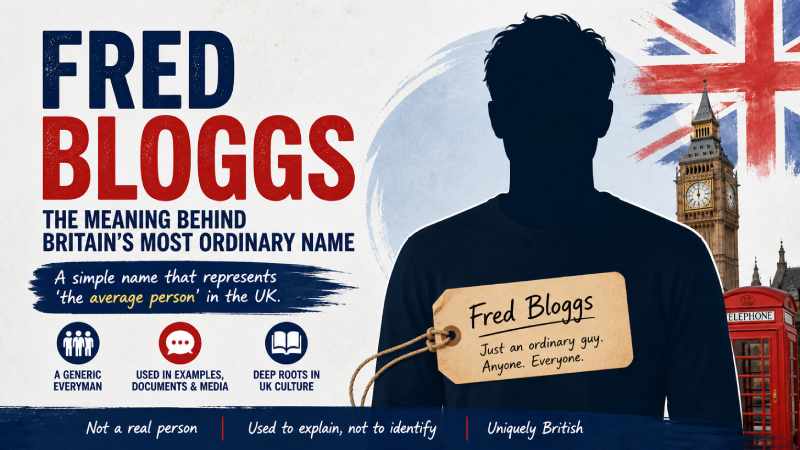
If you have ever come across the name “Fred Bloggs” in the UK, you might have paused and wondered whether it belongs to a real person or just a clever invention. The truth is far more interesting than it first appears. “Fred Bloggs” is one of those names that quietly sits in the background of British culture, used in conversations, examples, and even official documentation to represent the everyday person. It may sound unremarkable, but its role in communication is surprisingly important.
In a world filled with specific identities, data points, and personalization, placeholder names like Fred Bloggs serve as a neutral ground. They allow speakers and writers to explain concepts without referring to a real individual. This makes communication safer, clearer, and more relatable. Whether you are reading a legal example, a tech guide, or a casual blog post, the name stands in as a symbol for “anyone.”
The Origin and Evolution of Fred Bloggs
Understanding where “Fred Bloggs” comes from requires looking at the broader tradition of placeholder names. In the UK, names like “Joe Bloggs” have been used for generations to represent the average person. Over time, variations such as “Fred Bloggs” emerged, offering a slightly different flavor while maintaining the same purpose. The choice of “Fred” as a first name adds a touch of everyday realism, as it has long been a common and recognizable name in Britain.
The surname “Bloggs” is particularly interesting. It is not a widely used real surname, which makes it ideal for placeholder purposes. Because it is uncommon, it avoids confusion with real individuals while still sounding believable. This balance between realism and anonymity is what makes the name effective in both formal and informal contexts.
As language evolved, so did the contexts in which “Fred Bloggs” appeared. Initially, it might have been used in spoken examples or casual writing. Over time, it found its way into educational materials, business documentation, and even digital content. Today, it continues to adapt, appearing in online tutorials, user interface examples, and fictional scenarios where a neutral identity is required.
Cultural Significance in the United Kingdom
The use of “Fred Bloggs” goes beyond simple convenience; it reflects a deeper cultural tendency in the UK. British communication often values understatement, subtle humor, and relatability. A name like Fred Bloggs fits perfectly into this style. It is unpretentious, slightly humorous, and instantly recognizable as representing the “ordinary person.”
In everyday conversation, using such a name can make explanations feel more grounded. Instead of speaking in abstract terms, people can say, “Even Fred Bloggs could understand this,” and immediately convey the idea that something is simple or accessible. This kind of phrasing adds clarity while maintaining a conversational tone.
There is also an element of inclusivity in the use of placeholder names. By representing a generic individual, “Fred Bloggs” allows speakers to avoid assumptions about specific groups or identities. It becomes a universal stand-in, making communication more neutral and broadly applicable. This is particularly important in professional and public contexts, where sensitivity and clarity are essential.
Fred Bloggs in Modern Communication
In today’s digital world, the role of placeholder names has expanded significantly. “Fred Bloggs” is now commonly used in examples across various fields, including technology, marketing, and education. For instance, developers might use the name when demonstrating how user data is stored, while marketers might include it in sample customer profiles.
The rise of online content has increased the demand for clear and relatable examples. Writers and educators need ways to illustrate concepts without involving real people, and “Fred Bloggs” provides a ready-made solution. Its familiarity ensures that readers immediately understand its purpose, reducing confusion and improving comprehension.
Another interesting aspect of modern usage is how the name appears in user interfaces and documentation. When companies design forms or tutorials, they often include sample data. Using a name like Fred Bloggs helps users understand what type of information is expected without exposing real personal details. This makes the learning process smoother and more intuitive.
Comparison with Other Placeholder Names
To fully appreciate “Fred Bloggs,” it is helpful to compare it with similar names used around the world. In the United States, “John Doe” is perhaps the most well-known equivalent. While both names serve a similar purpose, their usage contexts can differ. “John Doe” is often associated with legal or formal situations, whereas “Fred Bloggs” tends to feel more casual and conversational.
Another common British placeholder is “Joe Bloggs,” which is arguably more widely recognized than Fred Bloggs. The two names are closely related, with “Joe” often used in everyday speech and “Fred” appearing as a variation that adds diversity to examples. Both names share the same underlying function: representing the average person without referencing anyone specific.
These comparisons highlight how different cultures develop their own linguistic tools. While the concept of a placeholder name is universal, the specific names chosen reflect local preferences and traditions. “Fred Bloggs” is distinctly British, carrying with it the tone and character of the culture in which it is used.
Why Placeholder Names Are Important
At first glance, placeholder names might seem trivial, but they play a crucial role in communication. They allow people to explain ideas without introducing unnecessary complexity. By using a neutral identity, writers and speakers can focus on the concept itself rather than the individual involved.
In professional settings, this becomes particularly important. For example, when discussing data privacy, using real names could lead to ethical concerns or misunderstandings. Placeholder names like Fred Bloggs eliminate this risk, ensuring that examples remain hypothetical and safe.
There is also a psychological benefit to using such names. They make abstract ideas more concrete by giving them a human element. Instead of talking about “a generic user,” referring to “Fred Bloggs” creates a clearer mental image. This can improve understanding and retention, especially in educational contexts.
The Subtle Humor Behind the Name
One of the reasons “Fred Bloggs” has endured is its subtle humor. The name sounds ordinary to the point of being slightly amusing. It captures the essence of the “everyman” in a way that feels both genuine and lighthearted. This humor makes it memorable, which is a key factor in its continued use.
British humor often relies on understatement and familiarity, and Fred Bloggs fits perfectly into this style. It does not try to be overly clever or dramatic. Instead, it quietly conveys its meaning while adding a touch of personality to the conversation.
This balance between functionality and humor is what makes the name so effective. It serves a practical purpose while also enhancing the tone of communication. Whether used in a serious document or a casual explanation, it adds a subtle layer of engagement.
Fred Bloggs in Business and Media
The influence of “Fred Bloggs” extends into business and media as well. Companies sometimes use the name in hypothetical scenarios, training materials, and marketing examples. It provides a consistent and recognizable way to illustrate customer journeys, user experiences, or case studies.
In media, the name can appear in articles, scripts, or commentary where a generic individual is needed. It helps avoid unnecessary specificity while maintaining a relatable tone. This makes it a valuable tool for writers who need to balance clarity with neutrality.
Interestingly, the name has also been used in fictional contexts, such as band names or company names. In these cases, it often carries a tongue-in-cheek quality, emphasizing its role as a symbol of ordinariness. This versatility shows how deeply embedded the name is in British culture.
The Future of Fred Bloggs in a Digital Age
As communication continues to evolve, the role of placeholder names like Fred Bloggs is likely to remain relevant. In fact, the increasing focus on data privacy and anonymity may make them even more important. As organizations strive to protect personal information, the need for safe and neutral examples will only grow.
At the same time, digital communication introduces new challenges. Global audiences may not always be familiar with culturally specific names like Fred Bloggs. This raises questions about how such names will adapt in an increasingly interconnected world. Will they remain localized, or will they be replaced by more universally recognized alternatives?
Despite these challenges, the enduring simplicity of “Fred Bloggs” suggests that it will continue to have a place in communication. Its clarity, neutrality, and subtle charm make it a reliable tool for explaining ideas, regardless of the medium.
Conclusion
“Fred Bloggs” may seem like an ordinary name, but its significance goes far beyond its simplicity. It represents a powerful concept in communication: the ability to explain ideas clearly without referencing real individuals. Through its use in conversation, education, and professional contexts, it has become a staple of British language and culture.
From its origins as a variation of “Joe Bloggs” to its modern role in digital content, the name has evolved while maintaining its core purpose. It reflects the values of clarity, neutrality, and relatability, making it an essential tool for effective communication.