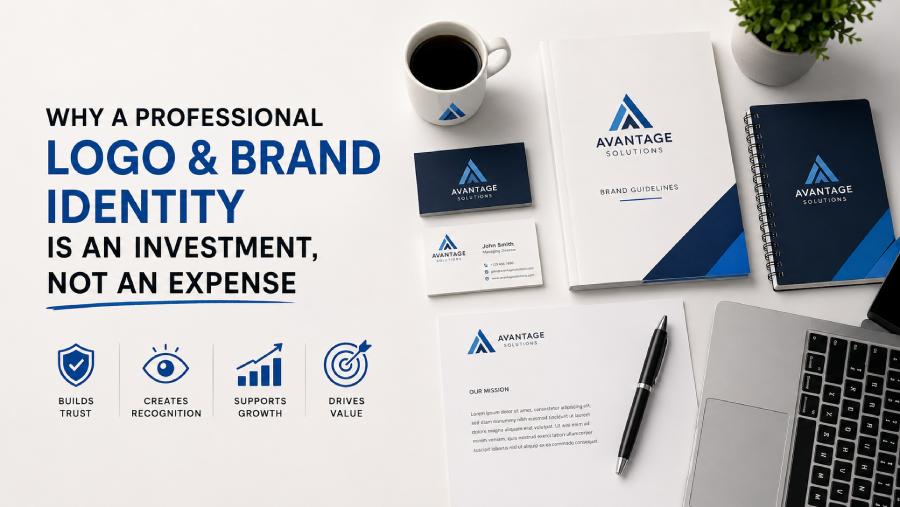
Every business spends money to grow. Some invest in marketing, others in technology, equipment, or hiring the right people. Yet when it comes to branding, many business owners ask a question that can shape the future of their company:
“Do I really need to spend this much on a logo?”
It’s a fair question. After all, a logo is just a symbol—right?
Not quite.
A professional logo is not simply a graphic. It is the visual foundation of your business. More importantly, it is only one part of a complete brand identity that influences how customers perceive your company before they ever experience your product or service.
Whether you’re launching a startup, expanding an established company, or rebranding after years in business, investing in a professionally designed brand identity is rarely an unnecessary expense. More often, it’s one of the smartest business decisions you can make.
First Impressions Are Made in Seconds
Research consistently shows that people form impressions of brands almost instantly. Before reading about your services, comparing prices, or contacting your team, potential customers notice your visual presentation.
Your logo, typography, colors, imagery, and overall consistency silently answer questions such as:
- Is this business trustworthy?
- Does it look professional?
- Does it seem established?
- Would I feel comfortable buying from this company?
These judgments happen naturally and often within seconds.
A polished visual identity creates confidence before a single conversation takes place. A weak or inconsistent identity can do the opposite, regardless of how excellent your products or services may be.
This is why branding isn’t about making a business look attractive—it’s about making it look credible.
Your Logo Represents More Than Your Business Name
Many people think of a logo as a decorative element placed on a website or business card.
In reality, a professional logo serves a much greater purpose. Businesses seeking expert logo design often see better long-term consistency.
It becomes the visual signature of your business. Every interaction a customer has with your company—from your website and social media to packaging, invoices, advertisements, presentations, and signage—will likely feature your logo.
Over time, customers begin associating that symbol with their experiences.
Think about the brands you instantly recognize without reading their names. Their logos aren’t valuable because they’re complex or colorful. They’re valuable because they’ve become symbols of trust, quality, and consistency.
While every business starts small, every memorable brand begins by creating a professional identity that customers can recognize and remember.
A Brand Identity Is Much More Than a Logo
One of the biggest misconceptions in business is believing that branding begins and ends with a logo.
A logo is the starting point—not the entire system.
A complete brand identity creates consistency across every customer touchpoint. It includes elements such as:
- A professionally designed logo system
- Carefully selected brand colors
- Typography that reflects the company’s personality
- Iconography and supporting graphics
- Brand patterns and visual assets
- Image style and art direction
- Social media branding
- Business stationery
- Brand guidelines that ensure consistency across all platforms You can also connect with the author on LinkedIn for branding insights.
Together, these components create a unified experience that customers remember.
Imagine visiting a company’s website that uses blue branding, then seeing its social media in red, receiving an invoice with different typography, and opening a presentation using another logo version entirely.
Even if the business provides excellent service, the inconsistency creates uncertainty.
Strong branding removes that uncertainty by presenting one clear, professional identity everywhere customers interact with the business.
The Hidden Cost of Cheap Design
Many businesses choose the lowest-priced design option believing they’re saving money.
Unfortunately, inexpensive design often becomes one of the most expensive decisions in the long run.
Poor branding can lead to:
Loss of Trust
Customers naturally compare businesses visually.
If your competitors present polished, consistent branding while your company appears outdated or unprofessional, potential customers may question your credibility before they even read about your services.
Trust is difficult to earn and remarkably easy to lose.
Frequent Redesigns
Businesses that invest in rushed or low-quality logos often discover within a year or two that the design no longer represents their growth.
This leads to:
- Rebranding expenses
- Website redesigns
- Updated marketing materials
- New packaging
- New signage
- Social media updates
- Reprinting business stationery
Instead of paying once for quality, businesses often end up paying multiple times to fix earlier decisions.
Inconsistent Marketing
Without clear brand guidelines, every designer, marketer, or employee may create materials differently.
Different fonts.
Different colors.
Different logo versions.
Different layouts.
Over time, the brand loses recognition because customers never experience a consistent visual identity.
Consistency isn’t about perfection—it’s about making your business recognizable wherever people encounter it.
Branding Shapes Customer Perception
Businesses often compete on price because they fail to compete on perception.
Strong branding helps customers understand value before they compare costs.
Consider two companies offering identical services.
One presents itself with a refined visual identity, consistent messaging, professional marketing materials, and a memorable logo.
The other relies on generic templates, inconsistent graphics, and outdated visuals.
Even if both businesses provide the same level of service, many customers will naturally assume the first company is more established, more reliable, and ultimately more valuable.
That’s the power of perception.
Professional branding doesn’t guarantee success—but it significantly influences how your business is perceived before a customer ever makes contact.
Branding Is a Long-Term Business Asset
Unlike many business expenses that disappear after they’re paid, branding continues creating value for years.
A professionally developed brand identity supports:
- Marketing campaigns
- Advertising
- Product launches
- Sales presentations
- Packaging
- Social media
- Website design
- Customer recognition
- Business growth
Every future investment becomes more effective because it’s built upon a consistent visual foundation.
Instead of creating new visuals every time, businesses can confidently build on an established identity that customers already recognize and trust.
Branding Delivers Value Beyond Design If you have branding questions, contact the author.
Many people judge branding by how it looks. Successful businesses judge branding by what it helps them achieve.
A strong brand identity can influence how customers remember your business, how confidently your team presents your company, and how effectively your marketing performs. While branding alone won’t guarantee success, it creates the foundation that supports every interaction with your audience.
Businesses with a clear and consistent visual identity often experience benefits such as:
- Stronger brand recognition
- Greater customer trust
- More professional marketing materials
- Improved consistency across digital and print platforms
- Higher perceived value
- Easier expansion into new products or services
When every touchpoint reflects the same identity, customers begin to recognize your business without needing to read your name. That recognition builds familiarity, and familiarity often leads to trust.
A Strong Brand Helps You Stand Out
Today’s customers have more choices than ever before. In almost every industry, businesses compete not only on price and quality but also on perception.
Ask yourself this:
If two companies offer the same service at a similar price, what encourages someone to choose one over the other?
Often, the answer is confidence.
A professionally branded business appears organized, reliable, and established. It communicates that attention has been paid to every detail, including the customer experience.
This doesn’t mean flashy graphics or complicated logos. In fact, some of the world’s most recognizable brands have remarkably simple visual identities.
What makes them effective is consistency, clarity, and purpose.
Your brand should communicate who you are, what you do, and why customers should trust you—all before a single conversation takes place.
Common Misconceptions About Branding
“A logo is enough.”
A logo is the starting point, not the destination.
Without a complete visual identity, businesses often struggle to maintain consistency across websites, presentations, advertisements, packaging, and social media.
A logo introduces your business.
A brand identity defines how your business is experienced.
“I’ll invest in branding once my business grows.”
Many successful companies invested in professional branding early because they understood that credibility helps create growth—it doesn’t simply follow it.
Waiting until your business becomes successful can mean spending years building recognition around inconsistent visuals, only to replace everything later.
Starting with a strong foundation saves time, money, and effort in the long run.
“Any designer can create a logo.”
Anyone can draw a symbol.
Professional logo design requires understanding strategy, typography, scalability, color psychology, visual hierarchy, target audiences, and how a brand will function across both digital and physical environments.
The goal isn’t simply to create something attractive.
The goal is to create something meaningful, memorable, and functional.
When Is the Right Time to Invest in Branding?
While every business has different needs, there are several moments when professional branding becomes especially valuable.
You should consider investing in a complete brand identity if you’re:
- Launching a new business
- Rebranding an existing company
- Entering a competitive market
- Expanding into new products or services
- Building a stronger online presence
- Looking to improve customer trust and recognition
Branding is not reserved for multinational corporations.
Small businesses, startups, agencies, retailers, restaurants, consultants, and service providers all benefit from presenting themselves professionally.
Regardless of industry, customers appreciate businesses that communicate with clarity and consistency.
Think Beyond Today
Many business owners evaluate branding by asking:
“How much does a logo cost?”
A better question is:
“What value will this brand create over the next five or ten years?”
Your logo will appear on your website, social media, presentations, packaging, business cards, proposals, advertisements, invoices, email signatures, uniforms, signage, and countless other customer touchpoints.
It becomes one of the most frequently seen assets your business owns.
Viewed from that perspective, branding isn’t simply another business expense.
It’s an investment that continues working long after the design process is complete.
Final Thoughts
A professional logo and brand identity won’t replace excellent products, outstanding customer service, or a strong business strategy.
However, they amplify all of them.
They help customers remember you.
They help your business communicate with confidence.
They create consistency across every interaction.
And perhaps most importantly, they help establish trust before your customers ever make their first purchase.
Businesses grow through relationships, and relationships begin with first impressions.
Investing in your brand means investing in how the world experiences your business.
In the end, that’s far more valuable than simply having a logo.
About the Author
Mudasir Kamal Soomro is a Brand Identity Designer with over 5 years of experience helping businesses build memorable and professional visual identities. Having completed 250+ branding projects through freelance platforms such as Fiverr, 99designs, Upwork, and direct client collaborations, he specializes in logo design, brand identity systems, brand guidelines, social media design, and print design for companies of all sizes.