If you spent any time in Edinburgh between 2017 and 2023, chances are you’ve stood in a queue that snaked out of a shop plastered in neon pink signage, all of it built around one cheeky instruction: “fill your hole.” That shop was Bross Bagels, and for a good few years it was one of the most talked-about food brands in Scotland’s capital. It’s a story with everything you could want — a Canadian comedian chasing a homesick craving, a cult following built on charm and marketing, rapid expansion, celebrity fans, and, eventually, a fairly dramatic financial collapse. Whether you came for the McBross or you’re just curious how a bagel shop became local legend, here’s the full picture, warts and all.
Who Is Larah “Mama” Bross?
At the centre of this whole saga is one person: Larah Bross, the woman the press affectionately dubbed “Mama Bross” and, later, “the Bagel Queen.” She isn’t your typical hospitality entrepreneur, and that’s a big part of why the brand worked so well. Originally from Montreal — which, if you didn’t know, is one of the world’s two great bagel capitals alongside New York — Larah arrived in Scotland in 2006, initially planning to spend a summer working at the Edinburgh Fringe before heading home. She never left. Before bagels ever entered the picture, she’d built a genuinely eclectic career as a jobbing actor, a stand-up comedian, an improv performer, and even spent a stint working on a Disney cruise ship, which is where she met her partner Marc. For a decade she also ran a children’s theatre company in Portobello, the seaside community on Edinburgh’s eastern edge. That performer’s instinct for showmanship, comic timing, and reading a crowd ended up being the secret ingredient in everything Bross Bagels did.
From Montreal to Portobello: The Origin Story
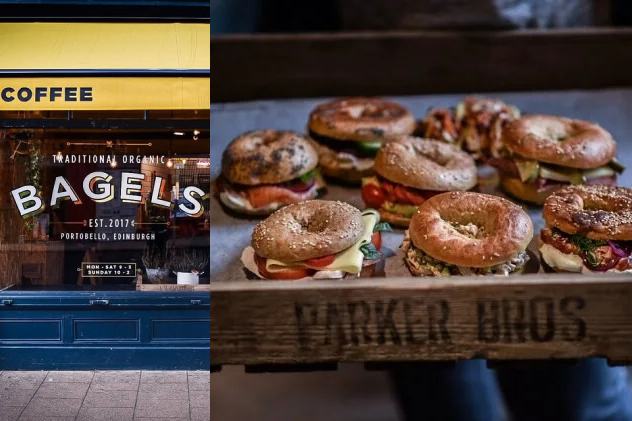
The founding story of Bross Bagels is almost too good to be true, but by all accounts it’s largely accurate. After more than a decade living in Scotland, Larah was reportedly desperate for a proper bagel — the kind she grew up with in Montreal. She’d resorted to begging visiting friends and family to smuggle bagels over from Canada, stashing them in the freezer and rationing them out during moments of genuine craving. When a PhD application of hers was rejected, she decided to pivot entirely and open a little café, imagining a gentle business where she could write comedy on her laptop between serving coffees and still pick up her daughters from school. That fantasy of a quiet little shop evaporated almost instantly. When Bross Bagels opened its doors on Portobello High Street in August 2017, there was, by her own account, a queue running down the block. From day one, the demand was far bigger than anyone had anticipated, and the comedy-writing café plan was quietly shelved in favour of building a bagel business.
What Actually Makes a Montreal Bagel Different
A lot of people assume a bagel is a bagel, but Bross built its identity on the distinction between the Montreal style and the chunkier, doughier bagels most Brits had encountered. Montreal bagels are noticeably denser and skinnier, with a smaller, tighter ring rather than the big puffy rounds you’ll find at a typical supermarket. The real magic happens during preparation. Where many bagels are simply boiled in plain water, the Montreal method involves boiling the dough in honey-sweetened water, and Bross added a touch of maple syrup directly into the dough itself. The result is a bagel with a subtly sweet edge, a chewier bite, and a character all its own. Bross leaned hard into this authenticity, and once the operation scaled up, the bagels were baked fresh every night, with the Leith branch doubling as the central bakery where customers could actually watch the bagels being made. It gave the brand a credible “we know what we’re doing” backbone underneath all the playful marketing.
“Fill Your Hole”: Branding That Refused to Be Ignored
You genuinely could not walk past a Bross Bagels location without noticing it. The aesthetic was loud and unapologetic — neon pink bagel-shaped signs, exposed brickwork, oversized menus mounted above the counter, and that signature catchphrase, “fill your hole,” printed somewhere in every shop. It was cheeky, a little risqué, and absolutely impossible to forget, which is exactly the point. This is where Larah’s background as a performer really paid dividends. The brand’s social media presence was quirky, irreverent, and relentlessly engaging, turning a simple bagel shop into a personality-driven phenomenon. The marketing didn’t just sell food; it sold a vibe, a sense of humour, and a feeling of being in on the joke. In a city full of perfectly nice cafés, Bross stood out precisely because it refused to be polite and beige. That distinctiveness built a fiercely loyal customer base in a remarkably short space of time, the kind of word-of-mouth momentum most independent food businesses can only dream about.
The Menu: McBross, Buffanono, and Beyond
For all the branding flair, none of it would have stuck if the food wasn’t good — and by most accounts, it was. Bross took those authentic Montreal bagels and stuffed them with New York deli-inspired fillings, creating a menu that was both indulgent and genuinely creative. The star of the show was arguably the McBross, a playful nod to Scottish cuisine featuring plant-based haggis that became something of a signature. The Chicken Parm, loaded with everything seasoning and marinara sauce, developed its own devoted following among regulars. For the more adventurous, there was the Buffanono, which threw deep-fried cauliflower, buffalo sauce, and Montreal slaw into the mix. Crucially, Bross was ahead of the curve on vegan and vegetarian options, offering a proper range of plant-based fillings rather than treating them as an afterthought, and even making its vegan buns egg-free. There were vegan hot dogs like the Plain Jane for anyone who fancied something a little different. The menu had range, it had humour, and it gave people a reason to keep coming back to try the next ridiculous-sounding combination.
Rapid Expansion Across Edinburgh
Success came fast, and so did the growth. Within roughly eighteen months of that first Portobello shop opening, Bross Bagels had expanded to three outlets across Edinburgh, with the second location on Leith Walk serving as the all-important baking hub. From there, the empire kept growing, adding sites in the West End on Queensferry Street, in Bruntsfield, and in Stockbridge, each carrying that same instantly recognisable neon-pink identity. Staff numbers climbed accordingly, and what had started as a one-woman dream became a genuine small chain employing dozens of people across the city. The crowning moment came in 2021, when Bross opened its flagship “deli” — a 1,200 square foot unit in the St James Quarter, one of the most prominent and high-profile retail locations in the entire city. For a brand born out of a homesick craving and a rejected PhD application, landing a unit in such a prime spot felt like the ultimate validation. It was, in hindsight, also the moment the ambition may have started to outpace the underlying finances.
The Crowdfunding Gamble: “Share Holer”
To fund its growth, Bross Bagels turned to its community rather than the banks, launching a crowdfunding initiative cheekily branded the “Share Holer.” The idea was rolled out in October 2020 and again in September 2022, and the pitch was characteristically friendly. Supporters could contribute, with the headline offer being that anyone putting in £1,000 would receive £100 per year in bagel vouchers plus invitations to VIP events, with their original money returnable after a four-year period. It was framed as a way for the loyal people of Edinburgh, who had backed the brand so enthusiastically from the start, to literally buy into the story. And buy in they did — reports suggest the crowdfunding efforts raised somewhere in the region of £150,000. At the time, it looked like a heartwarming example of a community rallying around a beloved local business. The problem, as later events would reveal, is that crowdfunding a hospitality business is a genuine financial risk, and those backers were trusting that the business would remain healthy enough to honour its promises.
Celebrity Co-Signs and Cult Status
A brand this loud was always going to attract attention beyond the queue outside the shop, and Bross Bagels managed to punch well above its weight in terms of profile. The cult following it built was supported by all that quirky marketing and social media energy, and it eventually culminated in high-profile collaborations, most notably with the Scottish actor and Hollywood star Alan Cumming. Having a genuinely famous, instantly recognisable name associated with your bagels is the kind of marketing money struggles to buy, and it cemented Bross’s status as more than just a place to grab lunch — it became a slice of Edinburgh’s cultural identity. The brand was featured in food guides, local magazines, and city blogs, frequently described as the place that brought authentic Montreal bagels to Scotland. For a few golden years, Bross Bagels was riding a wave of goodwill, media coverage, and celebrity endorsement that very few independent food businesses ever experience.
When the Dough Ran Out: Liquidation and Aftermath
Here’s where the story takes its sharp and sobering turn. Behind the neon signage and the buzzing queues, the business was reportedly accumulating serious debt. That St James Quarter flagship proved short-lived, and mounting cash flow problems eventually caught up with the operation. In August 2023, Bross Bagels was placed into liquidation by Edinburgh Sheriff Court following a petition from its own directors, after the company became unable to pay what it owed. According to reporting, the business had run up an estimated £1.27 million in debt, including a substantial sum — around £626,000 — owed in taxes. The fallout was painful for many. Those crowdfunders who had backed the “Share Holer” scheme were left in a precarious position, with at least one telling the press they didn’t expect to ever see their investment returned. Adding to the controversy, the official liquidator’s reporting indicated that around £61,000 in directors’ loans could not be recovered despite significant efforts. It was a stark and unhappy contrast to the feel-good narrative the brand had spent years cultivating.
Hot Mama, Hot Bagels: The Phoenix Attempt
The story didn’t simply end with liquidation. In what observers described as an attempt to “phoenix” the business — closing down a debt-laden company and re-emerging under a new name without the old debt — a new entity called Hot Mama Bagels Ltd was registered with Companies House in July 2023, just days before liquidators were appointed. Hot Mama Bagels began trading from several of the former Bross units, including Portobello, Bruntsfield, and the St James Quarter, initially continuing to use the familiar Bross branding. However, phoenixing a failed company is heavily restricted under insolvency law precisely to protect creditors, and the manoeuvre ultimately didn’t save the venture. Hot Mama Bagels was itself placed into liquidation in August 2024. The Portobello premises were later rebranded as “Hot Bagels,” reflecting a shift in the business model toward a bakery that also sells bagel sandwiches, while the Bruntsfield shop reportedly continued under the original name. Larah Bross, with the help of a business advisor, has been described as trying to pivot toward wholesale, catering, and corporate breakfast models — a humbler, more cost-conscious version of the empire she once ran.
What the Bross Bagels Story Teaches Us
It would be easy to reduce the Bross Bagels saga to a simple cautionary tale, but it’s more interesting than that. On one hand, it’s a genuine triumph of branding, creativity, and grit — proof that personality and a great product can build a devoted following from absolutely nothing. Larah Bross turned a freezer full of smuggled Montreal bagels into a citywide phenomenon, and that’s no small achievement. On the other hand, it’s a sobering reminder that rapid expansion, expensive flagship sites, and community-funded growth all carry real risk, and that loyal customers and crowdfunders can end up bearing the cost when the numbers don’t add up. The episode raises uncomfortable questions about crowdfunding consumer businesses and about the use of phoenix companies. The truth, as is so often the case, sits somewhere in the middle: a brilliantly marketed, genuinely loved business that simply couldn’t keep its finances in step with its ambitions.
FAQs
Is Bross Bagels still open?
Not in its original form. The main company went into liquidation in 2023, and the successor business, Hot Mama Bagels, was also liquidated in 2024. The Portobello site was rebranded as “Hot Bagels,” while the Bruntsfield shop reportedly continued trading under the original name.
Who founded Bross Bagels?
Bross Bagels was founded by Larah Bross — affectionately known as “Mama Bross” — a Montreal-born former comedian and actor who opened the first shop on Portobello High Street in August 2017 after years of craving an authentic Canadian bagel.
What makes a Bross Bagels bagel different?
Bross specialised in Montreal-style bagels, which are denser and skinnier than typical bagels. They’re boiled in honey-sweetened water with maple syrup added to the dough, giving them a chewier bite and a subtle sweet edge, then stuffed with New York deli-inspired fillings.
What was Bross Bagels’ most famous bagel?
The standout was the McBross, a playful Scottish twist featuring plant-based haggis. The Chicken Parm with everything seasoning and marinara, plus the cauliflower-loaded Buffanono, were also firm customer favourites.
Why did Bross Bagels go into liquidation?
Mounting debts and cash flow problems caught up with the rapidly expanding business. Reports indicate it accumulated roughly £1.27 million in debt, including around £626,000 owed in taxes, leading to liquidation in August 2023.
Conclusion
Bross Bagels is, ultimately, one of the most compelling small-business stories Edinburgh has produced in recent memory — a tale of homesickness turned into a craving, a craving turned into a queue, and a queue turned into an empire that briefly seemed unstoppable. For several years it delivered genuinely excellent Montreal-style bagels, a brand voice nobody could ignore, and a sense of fun that made it feel less like a chain and more like a local character. Its collapse, the losses suffered by crowdfunders, and the controversy around its aftermath are an undeniable and important part of the story, and they shouldn’t be glossed over. Yet the legacy is complicated rather than purely negative. Whatever happens next for Larah Bross and her ongoing attempts to rebuild in a more sustainable form, the original Bross Bagels left a real mark on Edinburgh’s food scene — and plenty of people in the city will tell you, with a wistful sort of fondness, that nobody else ever quite managed to fill the hole it left behind.