Nissan X-Trail 2023–2026 Recall: What’s Going On With That 1.5-Litre Engine, and What You Should Actually Do

If you own a recent Nissan X-Trail, or you’ve been eyeing one on the used market, you’ve probably stumbled across some unsettling headlines lately. Words like “engine failure” tend to do that to a person. The short version is that Nissan kicked off a major recall in early 2026 covering X-Trails built between 2023 and 2026 that carry the brand’s 1.5-litre three-cylinder petrol engine. The longer version, which is the one actually worth your time, involves a genuinely interesting bit of engineering, a lubrication quirk that can snowball into something serious, and a fix that ranges from a quick software update to, in the worst cases, a brand-new engine. Let’s walk through all of it without the panic and without the jargon soup.
So, What’s Actually Being Recalled?
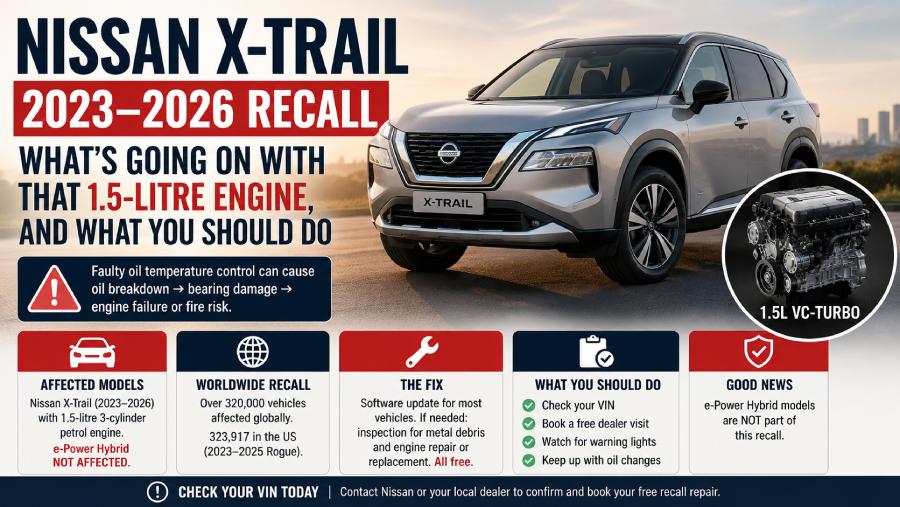
The recall targets a fairly specific slice of the X-Trail lineup rather than every single one on the road. We’re talking about cars fitted with the 1.5-litre three-cylinder petrol engine, manufactured roughly between 2023 and 2026. In North America, where this same vehicle wears the Nissan Rogue badge, the recall was formally filed with the National Highway Traffic Safety Administration under campaign number 26V080 and covers the 2023 to 2025 Rogue. The model year window shifts slightly depending on which market you’re in, which is normal for global recalls, but the common thread everywhere is that little turbocharged three-cylinder. If your X-Trail has a different powertrain, you’re almost certainly in the clear, and we’ll get to exactly why a bit further down.
The Heart of the Problem: That Clever Little 1.5-Litre VC-Turbo
Here’s where it gets genuinely fascinating, because the engine at the centre of this whole saga isn’t some boring old motor. It’s Nissan’s VC-Turbo, which stands for variable compression turbo, and it’s one of the more ambitious mass-production engines of the last decade. The idea is that the engine can physically change its compression ratio on the fly, raising it for efficiency when you’re cruising gently and lowering it for power when you put your foot down. To pull this off, Nissan packed in a multi-link mechanism that adjusts how far the pistons travel, which is clever stuff that no other mainstream manufacturer has really matched at scale. The trade-off with that kind of complexity, though, is that there are more moving parts working under more stress, and the bearings inside have to cope with a hard life. That sophistication is precisely what makes the engine impressive, and unfortunately, it’s also what makes the lubrication issue at the core of this recall a bigger deal than it would be in a simpler design.
Why Engine Oil Temperature Is the Villain Here
The actual fault, when you boil it down, comes from heat doing nasty things to the oil. Under certain conditions, the engine oil temperature can climb higher than it should, and oil that gets too hot starts to break down and lose its ability to lubricate properly. Once the oil isn’t doing its job, the engine bearings, which rely on a thin, consistent film of oil to keep metal from grinding against metal, are left exposed. From there the chain of events is pretty grim. The bearings can wear, then seize, and a seized bearing in a running engine is the mechanical equivalent of a heart attack. In the most severe scenario, a failing bearing can actually punch a breach in the engine block, which then lets hot oil escape. So what begins as an invisible thermal problem with the lubricant can, if left unchecked, end with a dead engine and a genuine fire risk. That progression from “slightly too hot” to “catastrophic” is exactly why Nissan treated this as a safety recall rather than a quiet service campaign.
How Many Cars Are We Talking About?
This is not a small, niche recall affecting a handful of unlucky owners. Nissan has described it as a worldwide effort, and the global figure being cited is north of 320,000 vehicles. In the United States alone, the official NHTSA paperwork lists 323,917 affected Rogues, which gives you a sense of just how widely that 1.5-litre engine was deployed. Exact figures for individual markets like the UK weren’t immediately confirmed when the recall broke, with Nissan still tallying the local numbers, but the scale tells the story on its own. When a recall reaches into the hundreds of thousands across multiple continents, it usually means the affected component was a standard fitment across a popular, high-volume model, and the X-Trail and Rogue are about as mainstream as family SUVs get. So if you own one of these cars, you’re far from alone, and you shouldn’t feel singled out by bad luck.
Is It Dangerous? Understanding the Real-World Risk
It’s worth being honest and measured about the actual danger, because “engine failure” sounds terrifying but the lived reality for most owners is far less dramatic. A recall of this nature is fundamentally precautionary, designed to catch a problem before it spreads, and the vast majority of affected vehicles will never experience a failure at all. That said, the consequences described in the official documentation are serious enough to take seriously. An engine that loses power while you’re driving can leave you stranded in traffic or on a motorway, which is dangerous in its own right, and the small but real possibility of an oil-fed engine fire is not something anyone should shrug off. The sensible way to hold both of these truths at once is this: you almost certainly don’t need to abandon your car on the roadside in a panic, but you also shouldn’t ignore the recall notice and assume it’ll never happen to you. Get it inspected, get the fix applied, and the risk drops to essentially nothing.
The Fix: What Nissan Dealers Will Actually Do
The remedy here is tiered, which is a smart way to handle a problem that shows up to wildly different degrees in different cars. For the bulk of vehicles, the core of the fix is a software update. Dealers reprogram the engine control module with revised software that manages the engine more conservatively, keeping oil temperatures in a safer range so the whole lubrication problem never gets a chance to start. That’s a relatively quick visit. Beyond the reflash, technicians are instructed to scan the car for any stored diagnostic trouble codes and take it for a test drive to confirm everything behaves. In cases where there’s reason for concern, they’ll go further and inspect the oil pan for metallic debris, because tiny shavings of metal in the oil are the telltale fingerprint of a bearing that’s already started to break down. If they find that debris, the situation escalates and the dealer will repair or, if necessary, replace the engine entirely. Nissan has indicated that a full engine swap shouldn’t take much more than around fifteen hours of labour. Crucially, every part of this, from the simple software update to a complete new engine, is carried out free of charge to the owner. That’s the whole point of a recall: the manufacturer foots the bill.
How to Find Out If Your X-Trail Is Affected
The most reliable way to check whether your specific car is part of the recall is to use its vehicle identification number, or VIN. Every car has a unique one, usually visible through the base of the windscreen and printed on your registration documents, and manufacturers load the affected VINs into their lookup systems so you can get a definitive yes-or-no answer rather than guessing based on model year alone. In the United States, affected VINs are published on both Nissan’s owner website and the NHTSA recalls portal, and Nissan planned to mail owner notification letters by late March 2026. In the UK, Nissan said it would begin contacting customers from March to let them know they could book in at an authorised dealer for the free update. If you’d rather not wait for a letter, you can ring Nissan’s customer service line directly or simply call your local dealer, give them the VIN, and ask them to check it against the open recall campaigns. Owners in the US have been pointed to Nissan’s customer service number for exactly this kind of query.
What It Means If You’re Outside the UK or US
Most of the early reporting on this recall came out of the UK and North American press, which makes sense given how popular the X-Trail and Rogue are in those markets, but the engine in question was sold globally and the recall has been framed as a worldwide programme. That matters if you’re reading this from somewhere like Pakistan, the Middle East, Southeast Asia, Australia, or anywhere else the X-Trail is sold, because the underlying mechanical issue doesn’t respect borders. What does change from country to country is the administrative side: the exact model-year range included, the timing of owner notifications, the local campaign reference number, and the process for booking the work. The safest move if you’re outside the headline markets is to contact your regional Nissan distributor or an authorised local dealer and ask them directly whether your vehicle’s VIN falls under the campaign. Don’t assume that because a recall was announced “in the UK” it doesn’t apply to your car; assume the opposite until a dealer confirms otherwise, because the engineering fault is the same regardless of where the car happens to be parked.
Does This Recall Affect the e-Power Hybrid? Good News
Here’s a genuinely reassuring bit for a large chunk of X-Trail owners. The recall is specifically about the 1.5-litre three-cylinder petrol setup, and Nissan’s e-Power hybrid system is not part of it. If your X-Trail uses e-Power, you can breathe easy on this particular issue. It’s a slightly confusing point because e-Power also uses a petrol engine, but in that system the petrol engine works as a generator to feed electricity to an electric motor that actually drives the wheels, and it operates under very different conditions from the conventional turbocharged setup at the centre of this recall. The upshot is simple: the hybrid X-Trail is not affected by this campaign. Of course, that doesn’t mean a hybrid owner should ignore recall notices forever, since any car can be subject to separate, unrelated campaigns over its life, but for this specific engine-lubrication problem, e-Power buyers are sitting comfortably outside the firing line.
How This Fits Into Nissan’s Bigger VC-Turbo Story
If you’ve been following Nissan news with any regularity, this recall might feel like déjà vu, and that’s because the VC-Turbo family has been the subject of more than one engine-related campaign. Separately from the X-Trail and Rogue action, Nissan has dealt with other recalls involving these variable compression engines across models like the Altima and various Infiniti SUVs, tied to concerns about engine bearings potentially failing. It’s important not to mash all of these together into one giant scary blob, because they’re distinct campaigns with their own model lists, root causes, and fixes, but the common denominator is clear enough: an ambitious, complex engine design has run into reliability challenges around its bearings and lubrication. None of this means the VC-Turbo is a lemon, and plenty of these engines will run happily for years, but it does suggest that the engineering compromises required to make variable compression work in the real world have proven trickier to nail down than Nissan would have liked. For owners, the practical takeaway is to stay on top of recall notices and keep up with oil changes religiously, because clean, fresh oil is your best friend in an engine that’s this sensitive to lubrication quality.
What You Should Do Right Now
If you’re an affected owner, or you suspect you might be, the action plan is refreshingly straightforward and doesn’t require an engineering degree. Start by checking your VIN against the official recall lookup, either through Nissan’s owner site, the relevant national safety authority’s database, or just by phoning a dealer. If your car is included, book it in for the recall work as soon as it’s convenient, since the software update in particular is quick, free, and meaningfully reduces your risk. In the meantime, pay attention to your car the way you should anyway: keep an eye on warning lights, especially anything related to the engine or oil, listen for unusual noises like knocking or rattling from under the bonnet, and don’t skip or stretch out your scheduled oil changes. If your car suddenly loses power, runs roughly, or shows an oil-pressure or engine warning, treat that as a reason to stop driving and get it looked at promptly rather than hoping it sorts itself out. And if you’re shopping for a used X-Trail from this era, ask the seller for proof that the recall work has already been completed, or factor a dealer visit into your plans before you commit.
FAQs
Which X-Trail models are affected by the recall?
Only X-Trails with the 1.5-litre three-cylinder petrol VC-Turbo engine, built roughly between 2023 and 2026. Hybrid and other engine variants aren’t part of this campaign.
Is it safe to keep driving my X-Trail before the fix?
For most owners, yes, since the recall is precautionary. But if you notice power loss, knocking noises, or an oil or engine warning light, stop driving and get it checked promptly.
Will the recall repair cost me anything?
No. Everything from the software reprogramming to a full engine replacement is carried out free of charge, because that’s the whole point of a manufacturer recall.
How long does the recall work take at the dealer?
The software update is a quick visit. In rare cases where the engine needs replacing, Nissan has indicated the swap takes around fifteen hours of labour.
How do I check if my specific X-Trail is included?
Use your VIN. Run it through Nissan’s owner website or your national safety authority’s recall database, or simply call your local dealer and have them check it against open campaigns.
Conclusion
Recalls have an unfortunate habit of sounding more apocalyptic in the headline than they are in the driveway, and the X-Trail 2023 to 2026 recall is a good example of that gap. Yes, the underlying fault is serious in its worst-case form, with the potential for engine failure and even fire stemming from oil that overheats and stops protecting the bearings in Nissan’s clever-but-demanding 1.5-litre VC-Turbo engine. But the response has been exactly what you’d want it to be: a large-scale, manufacturer-funded campaign with a tiered fix that ranges from a simple software reflash for most cars to a free engine replacement for the unlucky few, all backed by official safety documentation and a clear path for owners to check their VINs. If you drive one of these X-Trails, the smart play isn’t to panic and it isn’t to ignore the whole thing either. It’s to confirm whether your car is affected, get the work done while it’s free and easy, and then carry on enjoying what is otherwise a genuinely capable and likeable family SUV. Stay informed, keep that oil fresh, and let the dealer handle the rest.