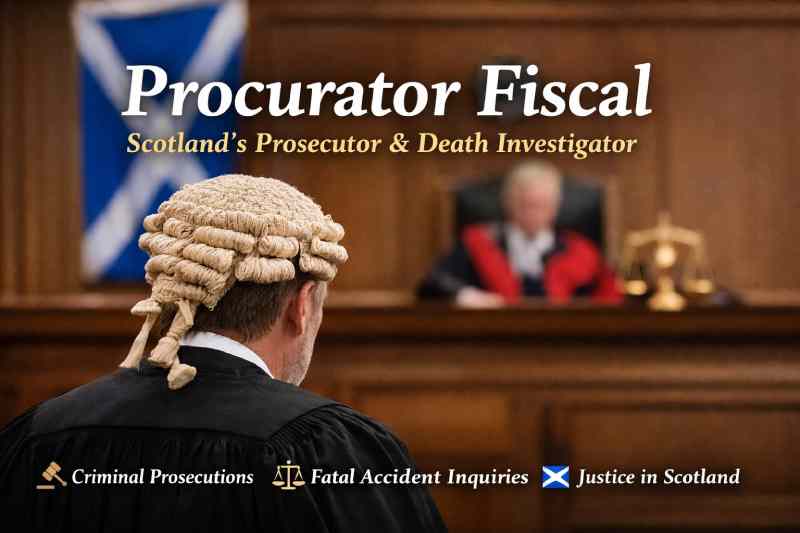
The Procurator Fiscal plays a central role in Scotland’s distinctive legal system, acting as both public prosecutor and investigator of sudden or unexplained deaths. While many across the wider United Kingdom may be familiar with Crown Prosecutors or coroners, Scotland operates under a different model. At the heart of this system stands the Procurator Fiscal, a legal officer whose responsibilities stretch far beyond simply presenting cases in court.
The Origins and Historical Development
The office of the Procurator Fiscal has deep historical roots in Scotland, dating back several centuries. The term itself reflects continental European influences on Scots law, which differs in important respects from the legal traditions of England and Wales.
Originally, local officials were appointed to represent the Crown’s interests in judicial matters. Over time, the role evolved into a professionalised public prosecution service. Today, Procurators Fiscal operate under the Crown Office and Procurator Fiscal Service (COPFS), which is Scotland’s national prosecution authority.
The development of this role reflects Scotland’s unique legal identity. Unlike England and Wales, which separate prosecutorial and coroner functions, Scotland consolidated both responsibilities within a single office. This dual capacity remains one of the defining characteristics of the position.
The Role Within Scotland’s Legal Framework
Public Prosecution Duties
One of the primary responsibilities of the Procurator Fiscal is deciding whether criminal proceedings should be initiated. After police complete their investigations, reports are submitted for review. The Fiscal examines the evidence and determines:
- Whether sufficient evidence exists
- Whether prosecution is in the public interest
- What level of court is appropriate
In Scotland, criminal cases are prosecuted in different courts depending on severity, including Justice of the Peace Courts, Sheriff Courts, and the High Court of Justiciary. The Procurator Fiscal conducts prosecutions in the lower courts, while more serious cases in the High Court are led by Advocates Depute under the direction of the Lord Advocate.
The decision-making process is guided by legal standards rather than political pressure. Independence from both police and government influence is crucial in maintaining public confidence.
Investigation of Sudden or Unexplained Deaths
Unlike other parts of the UK, Scotland does not have coroners. Instead, the Procurator Fiscal investigates sudden, suspicious, accidental, or unexplained deaths. This includes deaths in custody, workplace fatalities, and certain medical incidents.
In these circumstances, the Fiscal may:
- Order a post-mortem examination
- Instruct further inquiries
- Decide whether a Fatal Accident Inquiry (FAI) is required
A Fatal Accident Inquiry is a public hearing aimed at establishing the circumstances of a death and identifying steps that might prevent similar incidents in the future. It is not designed to assign blame but to promote safety and transparency.
Organisational Structure and Oversight
The Procurator Fiscal operates under the authority of the Lord Advocate, who is Scotland’s chief legal officer and head of the prosecution service. COPFS manages local offices across Scotland, ensuring consistency while allowing for regional responsiveness.
Each local area has designated Procurators Fiscal who manage cases within their jurisdiction. Specialist units also exist to handle complex matters such as organised crime, financial offences, and health and safety breaches.
This centralised yet regionally implemented model allows the prosecution system to function efficiently while maintaining national standards.
The Decision-Making Process
The Test for Prosecution
When a case report is received from the police, the Procurator Fiscal applies a two-stage test:
- Sufficiency of Evidence – There must be corroborated evidence indicating that a crime has been committed and that the accused committed it. Corroboration is a distinctive feature of Scots law, requiring at least two independent sources of evidence.
- Public Interest – Even if evidence is sufficient, prosecution must serve the public interest. Factors may include the seriousness of the offence, the age of the accused, and the impact on victims.
This approach ensures that prosecution decisions are measured and proportionate.
Alternatives to Prosecution
Not every offence results in court proceedings. The Procurator Fiscal may issue direct measures such as:
- Fiscal fines
- Compensation orders
- Diversion to social work programmes
These alternatives allow minor offences to be addressed without burdening the courts, while still holding individuals accountable.
Interaction with Victims and Witnesses
Modern practice recognises the importance of supporting victims and witnesses throughout the legal process. The Procurator Fiscal’s office provides information about case progress and court procedures. Victims have rights to be informed of key developments, including decisions not to prosecute.
In cases involving vulnerable individuals, special measures may be requested to reduce stress during court appearances. This might include giving evidence via video link or behind a screen.
The role has therefore expanded beyond purely legal functions to include elements of communication and care.
High-Profile and Complex Cases
The Procurator Fiscal frequently handles complex and high-profile matters. These may involve corporate manslaughter investigations, large-scale fraud, or deaths in custody. Such cases often attract intense media scrutiny and require meticulous evidence gathering.
In these situations, the office must balance transparency with fairness, ensuring that justice is pursued without compromising due process.
Scotland’s distinct corroboration rule can sometimes complicate high-profile cases, making the evidential threshold more demanding than in other UK jurisdictions.
Relationship with Police Scotland
Police Scotland investigates crime and submits reports to the Procurator Fiscal. However, the police do not decide whether charges proceed. That responsibility lies solely with the prosecution service.
This separation ensures checks and balances within the justice system. It prevents investigative authorities from exercising unchecked power and reinforces impartiality.
The working relationship is collaborative yet clearly defined. While the police gather evidence, the Fiscal determines legal strategy and court presentation.
The Fatal Accident Inquiry System
Purpose and Function
Fatal Accident Inquiries are a distinctive feature of Scots law. When required, the Procurator Fiscal initiates proceedings in the Sheriff Court to examine the circumstances surrounding certain deaths.
Mandatory FAIs apply in cases such as deaths in custody. Discretionary inquiries may be held where public concern exists or systemic failures are suspected.
The purpose is preventive rather than punitive. Sheriffs may make recommendations aimed at improving procedures, workplace safety, or institutional practices.
Impact on Public Policy
Over time, FAIs have influenced reforms in areas such as prison safety, healthcare practices, and industrial regulation. By identifying systemic shortcomings, they contribute to long-term improvements.
This preventive approach reflects a broader commitment to accountability and public welfare.
Challenges and Criticisms
No public institution is immune from scrutiny. The Procurator Fiscal service has faced criticism over delays in complex investigations and the length of time taken to hold Fatal Accident Inquiries.
Families affected by sudden deaths sometimes express frustration at prolonged processes. Resource constraints and increasing case complexity have added pressure to the system.
Efforts have been made in recent years to modernise procedures, introduce digital case management, and improve communication with bereaved families.
Training and Professional Standards
To become a Procurator Fiscal, candidates must qualify as solicitors or advocates in Scotland. They undergo additional specialist training in criminal law, courtroom advocacy, and death investigation procedures.
Ongoing professional development ensures that prosecutors remain informed about legislative changes and evolving best practice.
Ethical standards are strict. Independence, impartiality, and fairness are foundational principles guiding every decision.
Differences from Other UK Jurisdictions
In England and Wales, the Crown Prosecution Service handles prosecutions, while coroners investigate deaths. Northern Ireland follows a similar separation.
Scotland’s consolidation of these functions under the Procurator Fiscal is unique. This model streamlines procedures but also concentrates responsibility within a single authority.
Understanding this distinction is essential for anyone comparing UK legal systems.
Public Confidence and Transparency
Maintaining public trust is essential for the justice system. The Procurator Fiscal must demonstrate transparency, fairness, and accountability.
Public reporting, open court proceedings, and clear communication all contribute to confidence in the system. While criticism is inevitable in complex legal matters, the overarching objective remains consistent: to uphold the rule of law.
FAQs
What does a Procurator Fiscal do?
A Procurator Fiscal reviews evidence submitted by police, decides whether to prosecute criminal cases, conducts prosecutions in lower courts, and investigates sudden or unexplained deaths.
Is the Procurator Fiscal the same as a coroner?
No. In Scotland, the Procurator Fiscal performs functions similar to both a public prosecutor and a coroner combined.
Can a Procurator Fiscal decide not to prosecute?
Yes. If evidence is insufficient or prosecution is not in the public interest, proceedings may not go ahead.
What is a Fatal Accident Inquiry?
A Fatal Accident Inquiry is a public hearing in Scotland examining the circumstances of certain deaths to improve safety and prevent recurrence.
How independent is the Procurator Fiscal?
The office operates independently of the police and political direction, acting under the authority of the Lord Advocate.
Conclusion
The Procurator Fiscal stands at the centre of Scotland’s criminal justice framework, embodying a system that blends prosecution with investigative oversight of sudden deaths. With historical roots stretching back centuries and modern responsibilities shaped by evolving public expectations, the role remains both demanding and essential.
Through measured decision-making, commitment to public interest, and dedication to transparency, this office ensures that justice in Scotland operates with integrity and accountability. Whether prosecuting offences or examining tragic circumstances, the Procurator Fiscal continues to serve as a cornerstone of the nation’s legal order.