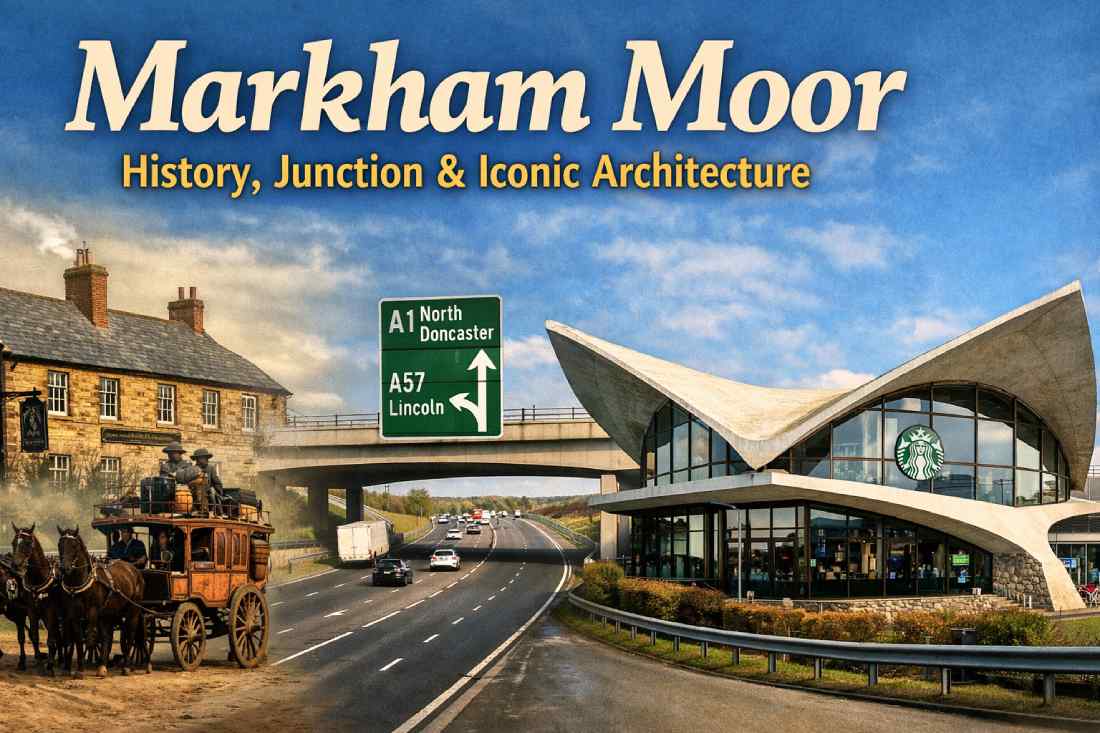
Nestled quietly within the English countryside, Markham Moor is a place that defies expectations. At first glance, it appears to be just another small rural settlement in Nottinghamshire. Yet, beneath its modest exterior lies a location of remarkable historical, architectural, and logistical importance. Over centuries, Markham Moor has evolved from a simple stopping point on an ancient route into a modern transport hub that continues to influence travel across England.
The Geographic Significance of Markham Moor
A Strategic Location in England
Markham Moor is situated in the East Midlands, approximately five miles south of Retford. Its location might seem unremarkable at first, but geography has played a defining role in shaping its identity.
The village lies at the intersection of several key transport routes, including:
- The A1, one of Britain’s most important north-south roads
- The A57, connecting Liverpool to Lincoln
- The A638, linking local towns and communities
This convergence of routes has made Markham Moor a vital junction for centuries. Long before motorways existed, travellers moving between London and northern England would pass through this area, making it a natural stopping point.
The Legacy of the Great North Road
Historically, Markham Moor was part of the Great North Road, the principal route connecting London to Edinburgh. This road was the backbone of long-distance travel in Britain for hundreds of years.
Travellers along this route included:
- Merchants transporting goods
- Royal messengers carrying official correspondence
- Stagecoaches filled with passengers
- Soldiers moving between regions
Markham Moor’s position along this road ensured its steady importance, even as transport methods evolved.
Historical Development of Markham Moor
Early Settlement and Rural Life
The origins of Markham Moor are rooted in agriculture and rural living. Like many English villages, it developed gradually around farmland, with a small population engaged in traditional occupations.
Life in early Markham Moor would have been characterised by:
- Farming and livestock rearing
- Local trade and craftsmanship
- Close-knit community relationships
Despite its modest size, its location meant that it was never entirely isolated from the wider world.
The Rise of Coaching Inns
As travel along the Great North Road increased, Markham Moor became an ideal location for coaching inns. These establishments provided essential services for travellers, including:
- Food and drink
- Overnight accommodation
- Horse changes for long journeys
Coaching inns played a crucial role in sustaining long-distance travel. Markham Moor, positioned at a convenient stopping point, naturally developed several such facilities.
These inns also contributed to the local economy, bringing a steady flow of visitors and commerce to the area.
Markham Moor and the Evolution of Road Travel
From Horse-Drawn Carriages to Motor Vehicles
The transition from horse-drawn transport to motor vehicles marked a turning point in the history of Markham Moor. As cars became more common in the early 20th century, the nature of travel changed dramatically.
Markham Moor adapted to this shift by:
- Replacing stables with petrol stations
- Expanding roadside services
- Catering to motorists instead of carriage travellers
Its strategic location ensured that it remained relevant, even as the technology of travel evolved.
The Development of the A1 Junction
The A1 has long been one of Britain’s most significant roads, and Markham Moor sits directly on this route. Over time, increasing traffic volumes necessitated improvements to the junction.
Originally, the intersection was a simple roundabout. However, congestion and safety concerns led to major upgrades.
In 2008, the junction was transformed into a grade-separated interchange featuring a flyover. This development:
- Improved traffic flow
- Reduced congestion
- Enhanced safety for drivers
Today, the Markham Moor junction is a key point on the A1, handling a substantial volume of traffic daily.
Architectural Landmark: The Scorer Building
A Modernist Icon
One of the most striking features of Markham Moor is its iconic Scorer Building. Designed by architect Sam Scorer in the late 1950s, this structure stands out as a masterpiece of modernist design.
The building was originally constructed as a petrol station, but its design elevates it far beyond a typical roadside structure.
The Unique Roof Design
The most distinctive element of the Scorer Building is its roof, which takes the form of a hyperbolic paraboloid. Often described as a “butterfly roof,” this shape creates a dramatic and visually appealing silhouette.
Key characteristics include:
- A thin concrete shell, only a few centimetres thick
- A sweeping, curved form that appears both light and dynamic
- Structural efficiency combined with aesthetic elegance
This innovative design was ahead of its time and remains a rare example of such architecture in Britain.
Preservation and Modern Use
The Scorer Building has been recognised as a Grade II listed structure, ensuring its protection as a piece of architectural heritage.
Today, it has been repurposed as a café, demonstrating how historic structures can be adapted for modern use without losing their character.
Its presence continues to draw attention, making it one of the most recognisable features of Markham Moor.
Economic and Social Role
A Hub for Travellers
Markham Moor’s primary function in modern times is as a service hub for travellers. Its facilities cater to a wide range of needs, including:
- Fuel stations
- Restaurants and cafés
- Hotels and accommodation
- Convenience stores
For many people, Markham Moor is not a destination but a stop along the way. Yet, these brief توقفات contribute significantly to the local economy.
Supporting Local Communities
Beyond serving travellers, Markham Moor also plays a role in supporting nearby communities. Its services provide:
- Employment opportunities
- Access to amenities
- Connectivity to larger towns and cities
This dual role—as both a travel hub and a local resource—underscores its importance.
Cultural and Historical Identity
A Place Defined by Movement
Unlike many villages defined by static landmarks, Markham Moor is shaped by movement. Its identity is closely tied to the flow of people and goods passing through it.
This dynamic character sets it apart from more traditional rural settlements.
The Intersection of Past and Present
Markham Moor offers a unique blend of historical continuity and modern development. Elements of its past, such as its role in the Great North Road, coexist with contemporary infrastructure like the A1 interchange.
This coexistence creates a layered identity that reflects broader changes in British society.
Environmental and Landscape Context
The Nottinghamshire Countryside
Markham Moor is surrounded by the rolling landscapes of Nottinghamshire, characterised by:
- Open fields
- Hedgerows
- Scattered woodlands
This rural setting provides a contrast to the busy roads that define the village.
Balancing Development and Preservation
As traffic and infrastructure continue to expand, maintaining this balance becomes increasingly important. Efforts to preserve the character of the area while accommodating modern needs are ongoing.
Challenges and Future Prospects
Traffic and Infrastructure Pressures
As a major junction, Markham Moor faces challenges related to:
- Increasing traffic volumes
- Road maintenance
- Environmental impact
Addressing these issues requires careful planning and investment.
Opportunities for Growth
Despite these challenges, there are opportunities for development, including:
- Enhanced roadside services
- Tourism centred around architectural heritage
- Improved connectivity with surrounding areas
Markham Moor’s strategic location ensures that it will remain relevant in the future.
Conclusion
Markham Moor stands as a compelling example of how geography and infrastructure can shape the identity of a place. From its origins as a rural settlement to its role as a key junction on one of Britain’s most important roads, it has continuously adapted to the changing demands of travel and society.
Its significance lies not in size or population, but in function and history. The presence of the iconic Scorer Building adds a layer of architectural importance, while its strategic location ensures its ongoing relevance.
In many ways, Markham Moor represents the intersection of past and present—a place where centuries-old travel routes meet modern engineering, and where quiet rural surroundings coexist with constant movement. It may not command headlines, but its story is one of enduring importance, woven into the fabric of England’s transport and cultural landscape.