Preventing Unplanned Downtime: The Hidden Role of Thermal Management in Industrial Automation

Unplanned downtime represents one of the most severe drains on modern manufacturing profitability. Across automotive assembly plants, automated fulfillment centers, and heavy processing facilities, downtime costs routinely surpass $250,000 per hour in lost throughput and labor overhead.
While mechanical failures and software glitches receive immediate root-cause attention, thermal degradation remains a silent catalyst for catastrophic systemic failures. Industrial automation systems operate on sensitive microelectronics that require strict temperature boundaries to function reliably.
The True Cost of Heat in Manufacturing Environments
Industrial solid-state electronics—such as Programmable Logic Controllers (PLCs), Variable Frequency Drives (VFDs), and switchgear—convert electrical power into kinetic work. In doing so, internal resistance turns a predictable fraction of that energy into thermal waste.
Thermodynamic stress accelerates component wear according to the Arrhenius equation, which dictates that every 10°C rise above a component’s rated operating temperature halves its operational lifespan. Excessive ambient heat inside control panels causes:
- Thermal Throttling: Processors deliberately downclock to prevent thermal destruction, resulting in erratic communication latency across bus networks.
- Capacitive Breakdown: Electrolytic smoothing capacitors inside VFDs dry out prematurely, causing unstable DC bus voltages and premature inverter failure.
- Nuisance Tripping: Circuit breakers and thermal overload relays trip under false current thresholds due to high localized ambient temperatures.
- Solder Joint Fatigue: Repetitive expansion and contraction cycles cause micro-fracturing along surface-mount connections on printed circuit boards.
Why Enclosures Become Heat Traps
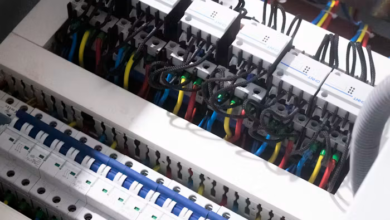
As industrial automation scales, electrical enclosures are forced to house increasingly dense configurations of variable frequency drives and processors, essentially turning them into localized heat traps. Without strategic airflow, internal ambient temperatures can rapidly exceed the safe operating thresholds of silicon-based components.
According to technical documentation from ACDCFAN, mitigating this risk requires precisely engineered active ventilation—such as high-temperature-resistant AC or EC axial fans—to establish constant air exchange and prevent thermal throttling within critical control cabinets.
Control cabinets are typically sealed to isolate sensitive electronics from external manufacturing airborne contaminants. However, this isolation creates internal heat stratification, where hot air naturally collects at the top of the cabinet near critical controller modules.
Without forced mechanical displacement, internal temperatures can exceed exterior ambient plant temperatures by 20°C to 30°C. When a facility experiences summer ambient spikes of 38°C, unventilated cabinet cores can surge past 65°C, surpassing the maximum ratings of standard industrial controllers.
Evaluating Active vs. Passive Cooling Strategies
Facility engineers must balance thermodynamic demands against capital budgets when designing cabinet thermal management. The two primary schools of thermal design are passive dissipation and active forced convection.
Passive cooling relies exclusively on natural convection, conductive heat transfer through enclosure panel walls, and non-powered louver vents. While passive methods eliminate electrical consumption and moving parts, their cooling capacity is strictly limited by Newton’s Law of Cooling.
Passive dissipation requires a significant temperature differential between the enclosure interior and the plant floor. In high-load automated plants, passive cooling fails under three primary operating constraints:
- Insufficient Heat Transfer Rates: Cabinets packed with multi-axis servo drives generate heat loads exceeding 1,500 Watts, which far surpasses the natural convective dissipation capacity of metal enclosure walls.
- Severe Thermal Stratification: In static air, heat pools at the top of the enclosure, exposing top-mounted PLCs to continuous thermal stress while the bottom remains cool.
- Vulnerability to Ambient Shifts: When factory ambient temperatures rise during seasonal heatwaves, the thermal gradient disappears, reducing heat transfer to near zero.
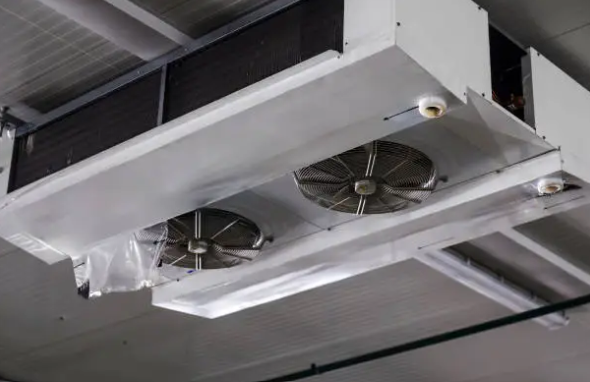
Active cooling utilizing forced air circulation through motorized axial and centrifugal fans solves these thermodynamic bottlenecks. Forced convection introduces high-velocity airflow that actively strips boundary-layer heat away from hot heat sinks.
By generating continuous positive or negative static pressure, industrial fans force turbulent air through dense wiring harnesses and drive racks. This continuous air turnover eliminates dangerous micro-climates, homogenizes cabinet temperatures, and maintains reliable delta-T metrics.
Engineering Standards for Industrial Cooling Components
Specifying cooling hardware requires engineering rigor. Off-the-shelf consumer or IT-grade fans fail quickly when subjected to the mechanical, electrical, and environmental stresses of the factory floor.
Commercial facility components cannot tolerate intermittent operation; cooling subsystems must run continuously for up to 70,000 to 100,000 hours in hostile surroundings.
IP Protection and Environmental Resilience
Industrial manufacturing environments subject hardware to severe operational hazards that compromise mechanical components. Cooling fans mounted on cabinet perimeters represent an intentional breach in the enclosure envelope, making their construction vital to overall system integrity.
Cooling equipment must withstand multiple plant-floor threats:
- Airborne Particulates: Conductive metallic dust, wood fibers, and abrasive silica can infiltrate fan motor bearings and cause physical lockups or stator shorts.
- Moisture and Washdown: High-pressure sanitary washdowns in food, beverage, and pharmaceutical facilities demand impervious electrical sealing.
- Corrosive Atmospheres: Petrochemical facilities, plating shops, and wastewater plants release airborne acid and sulfur vapors that erode copper windings.
To safeguard automation assets, engineers mandate IP68-rated cooling assemblies. An IP68 rating verifies complete protection against microscopic dust ingress and sustained water submersion under continuous pressure.
Achieving this durability requires all-metal construction. Die-cast aluminum alloy frames and precision metal impellers resist structural warping caused by ambient temperature extremes, mechanical impact, and chemical degradation.
Furthermore, high-specification fans employ dual precision ball bearings rather than cheap sleeve alternatives. Sealed ball bearings resist mechanical wear, tolerate structural vibration from adjacent stamping presses, and maintain rotational stability in any mounting orientation.
The Shift Toward EC Technology
The industrial fan sector is undergoing a major transition from traditional alternating current (AC) shaded-pole motors to Electronically Commutated (EC) motor architectures.
EC technology combines the direct-line compatibility of AC power with the electrical efficiency and precise control of brushless DC (BLDC) motors. Integrated electronics convert incoming AC line voltage to DC, driving a permanent-magnet rotor without slip losses.
This motor architecture delivers substantial engineering advantages:
- Superior Energy Efficiency: EC fans consume up to 70% less electrical power than standard AC induction fans, reducing continuous parasitic loads across large facilities housing hundreds of control cabinets.
- Reduced Motor Self-Heating: Traditional AC induction motors generate significant heat in their own copper windings, adding internal thermal load to the cabinet. EC motors run cooler, eliminating secondary heat input.
- Universal Voltage Support: EC drivers automatically accept wide-range inputs (100V to 240V AC, 50/60 Hz), eliminating line-frequency variations and simplifying spare parts inventories across international facilities.
- Precise Speed Control: EC motors support Pulse Width Modulation (PWM) and 0-10V analog speed controls. This allows the fan to dynamically modulate its RPM to match real-time thermal sensor readings rather than running at an inefficient fixed speed.
Implementing Predictive Maintenance in Thermal Systems
Modern automation facilities are moving away from reactive component replacement and static calendar maintenance. Instead, operations teams treat thermal management as a critical telemetry node within the Industrial Internet of Things (IIoT).
Modern fans feature embedded tachometer (FG) signals and locked-rotor alarm (RD) circuits wired directly into PLC digital inputs. When dust accumulation increases aerodynamic drag, the controller detects the resulting RPM drop long before an internal thermal sensor triggers a catastrophic shutdown.
Rather than reacting to thermal shutdowns, modern operational directors are integrating cooling infrastructure into broader predictive maintenance frameworks. By monitoring the performance of ventilation systems alongside core manufacturing equipment, plants can anticipate failures before they halt the assembly line.
In fact, comprehensive studies by McKinsey on industrial maintenance reveal that implementing predictive protocols for critical facility assets can reduce machine downtime by up to 50% while significantly extending the operational lifespan of the hardware.
Predictive thermal management protocols integrate multiple layers of operational telemetry:
- Airflow Differential Pressure Monitoring: Tracking pressure drop across inlet filter media flags particulate clogging before airflow drops below the critical convective threshold.
- Dynamic Winding Temperature Tracking: Monitoring motor current draw identifies winding degradation or bearing seizure risks early.
- Automated Speed Adjustment: Centralized supervisory systems (SCADA) elevate fan speeds in anticipation of planned heavy manufacturing cycles, precooling cabinets before thermal loads spike.
Key Takeaways
| Area | Key Takeaway | Impact/Data |
| Downtime | Mitigate silent thermal microelectronic degradation | Avoids $250,000/hour in lost throughput |
| Lifespan | Control sealed cabinet ambient temperatures | Every 10°C rise halves component lifespan |
| Hardware | Deploy IP68-rated, all-metal EC fans | Cuts cooling power consumption by 70% |
| Telemetry | Integrate fan RPM telemetry into IIoT | Reduces overall machine downtime by 50% |
Conclusion: Safeguarding the Bottom Line
Industrial automation uptime is governed by the reliability of its weakest electrical link. While high-performance PLCs and advanced VDs represent major capital investments, their functional reliability depends on the thermal environment inside the cabinet.
Neglecting thermal management leads to component degradation, unexplained intermittent network faults, and expensive line shutdowns. Passive dissipation techniques are insufficient for the power densities found in modern industrial facilities.
Investing in rugged, high-performance active cooling—backed by IP68 environmental sealing, all-metal structural frames, and energy-efficient EC motor technology—serves as an inexpensive insurance policy. By proactively engineering thermal resilience into automated facilities, manufacturing leaders protect their physical infrastructure, optimize productivity, and protect their operating margins.